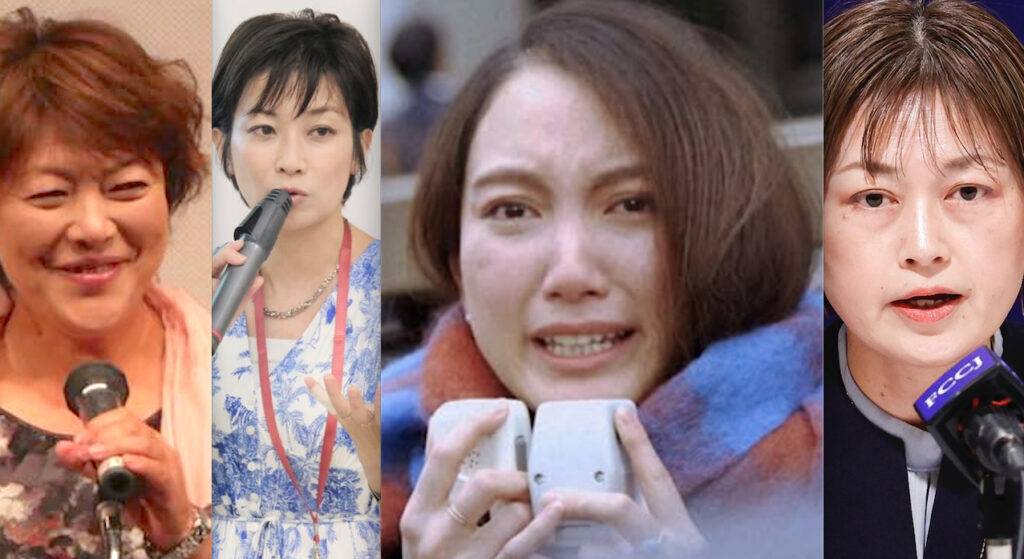
日本では毎日30人がレイプされています。なぜ日本の女性はお互いに助け合わないのでしょうか? 三上智恵、望月 衣塑子、伊藤詩織、西広陽子? 30 people are raped every day in Japan. Why don’t Japanese women help each other? MIKAMI Chie, MOCHIZUKI Isoko, ITO Shiori, NISHIHIRO Yoko?
As a feminist from West Berlin who has lived and worked in Japan for over 40 years, I am quite shocked by the recent developments regarding 伊藤詩織 ITO Shiori’s documentary film “Black Box Diaries”.
My dear ART+CULTURE readers do probably remember:
今日の金平茂紀氏の発言:「ケツ舐め記者」(2022/9/17)
Today’s Statement by KANEHIRA Shigenori: “Ass-licking Journalists”
https://art-culture.world/articles/kanehira-shigenori-ケツ舐め記者/
Quote from 2022/9/17:
今日のおまけ。
ご存知のように。
「総理」幻冬舎文庫-1024x723.jpg)
Sexual assault litigation[edit]
See also: International response to the MeToo movement § Japan
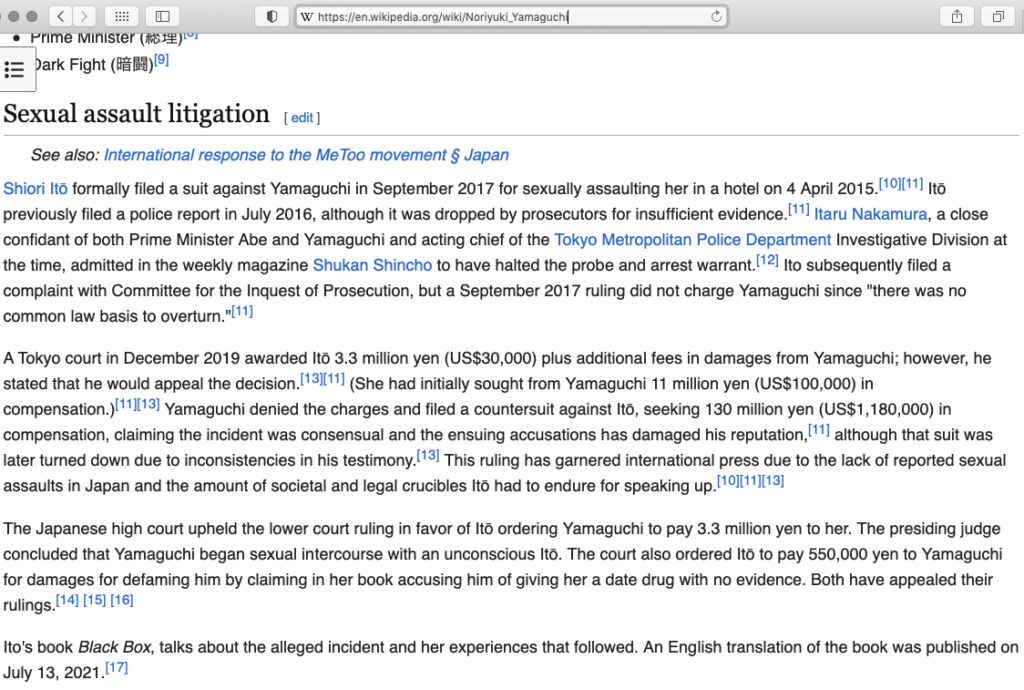
Shiori Itō formally filed a suit against Yamaguchi in September 2017 for sexually assaulting her in a hotel on 4 April 2015.[10][11] Itō previously filed a police report in July 2016, although it was dropped by prosecutors for insufficient evidence.[11] Itaru Nakamura, a close confidant of both Prime Minister Abe and Yamaguchi and acting chief of the Tokyo Metropolitan Police Department Investigative Division at the time, admitted in the weekly magazine Shukan Shincho to have halted the probe and arrest warrant.[12] Ito subsequently filed a complaint with Committee for the Inquest of Prosecution, but a September 2017 ruling did not charge Yamaguchi since “there was no common law basis to overturn.”[11]
A Tokyo court in December 2019 awarded Itō 3.3 million yen (US$30,000) plus additional fees in damages from Yamaguchi; however, he stated that he would appeal the decision.[13][11] (She had initially sought from Yamaguchi 11 million yen (US$100,000) in compensation.)[11][13] Yamaguchi denied the charges and filed a countersuit against Itō, seeking 130 million yen (US$1,180,000) in compensation, claiming the incident was consensual and the ensuing accusations has damaged his reputation,[11] although that suit was later turned down due to inconsistencies in his testimony.[13] This ruling has garnered international press due to the lack of reported sexual assaults in Japan and the amount of societal and legal crucibles Itō had to endure for speaking up.[10][11][13]
The Japanese high court upheld the lower court ruling in favor of Itō ordering Yamaguchi to pay 3.3 million yen to her. The presiding judge concluded that Yamaguchi began sexual intercourse with an unconscious Itō. The court also ordered Itō to pay 550,000 yen to Yamaguchi for damages for defaming him by claiming in her book accusing him of giving her a date drug with no evidence. Both have appealed their rulings.[14] [15] [16]
Ito’s book Black Box, talks about the alleged incident and her experiences that followed. An English translation of the book was published on July 13, 2021.[17]
https://en.wikipedia.org/wiki/Noriyuki_Yamaguchi
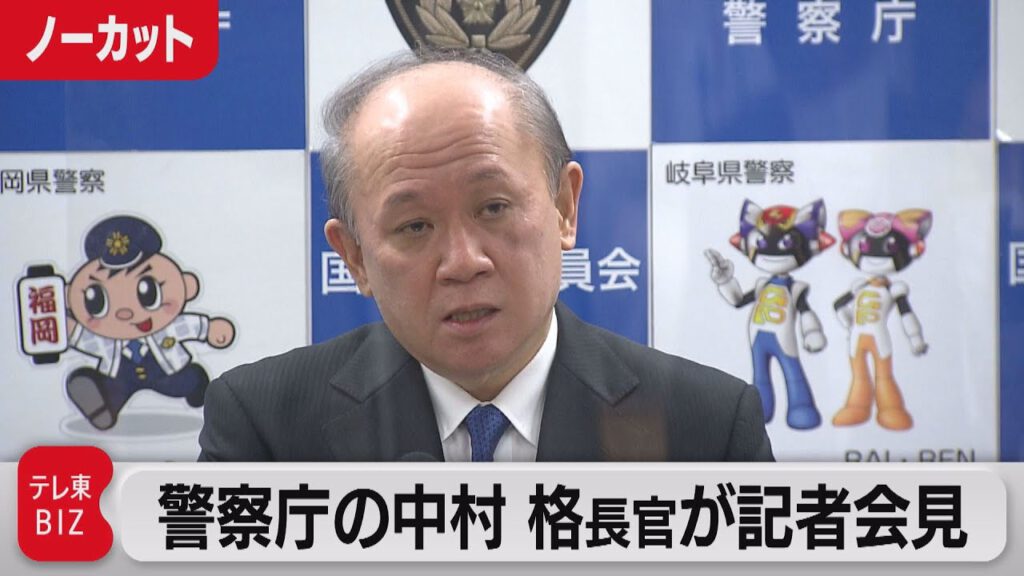
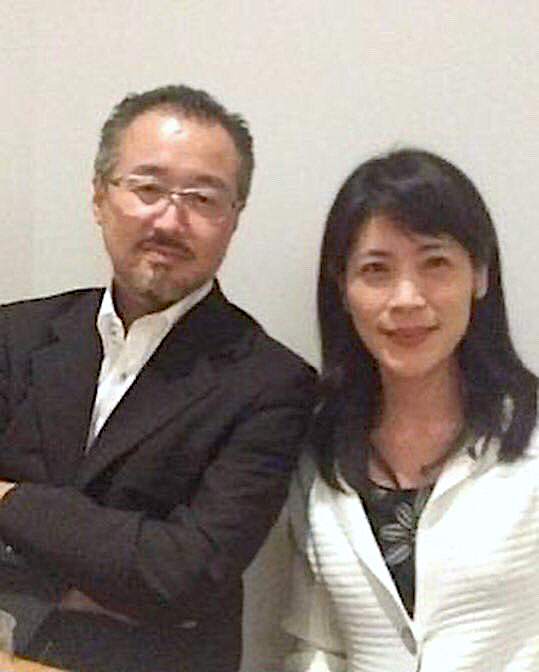
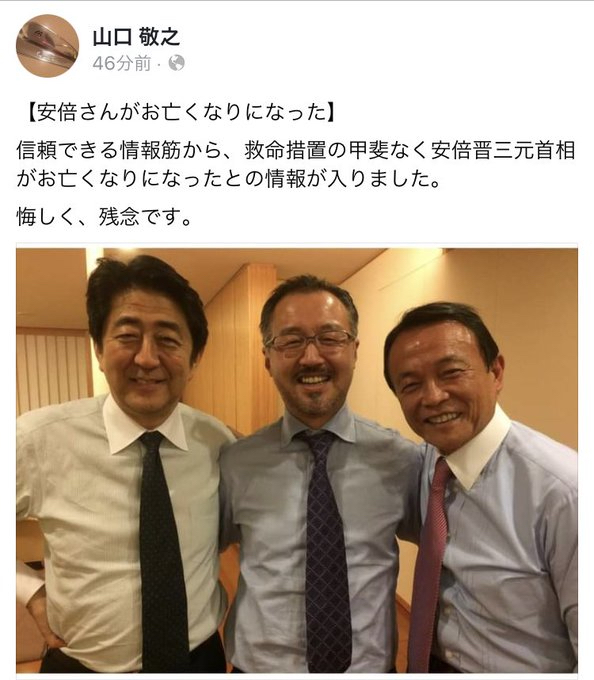
We all know this right-wing extremist, former TBS journalist YAMAGUCHI Noriyuki 山口敬之, who promoted the right-wing extremist, former PM ABE Shinzo 安倍晋三 using illegal methods.
This man is proven to have raped the journalist ITO Shiori 伊藤詩織 on April 4, 2015.
One of 30 rapes per day in Japan.
In Japan you need at “every corner” a KOBAN 交番, a small police station. Why? Because there exist many BAD Japanese. In Germany, Italy, Switzerland where I’m coming from, in Europe there’s no need of KOBANs.
Refer to:
変態社会にっぽん (2) :スカウトグループ「ナイツ」はおよそ4年間で6000人以上の女性を全国の性風俗店 (約350店) に紹介
Perverted Society Japan (2): Scout group “Knights” has introduced more than 6,000 women to prostitution places (about 350) nationwide in about 4 years
https://art-culture.world/articles/hentai-japan-self-lie/
Since Ms. Ito is a journalist, she knew how to use her journalistic expertise to bring her severe suffering closer to Japanese society.
Ito has since survived suicide attempts and was able to successfully shoot/produce the documentary “Black Box Diaries”, which has been already screened in over 50 overseas countries and regions.
But not in Japan.
In my opinion, in the context of balancing of conflicting interests, “the only visual proof” (Ito) has to be included in the film. In Ito’s documentary the use of “unauthorized” footage in the name of fair use and public interest has to be seriously considered.
The unwillingness, in common sense terms, by Japanese hotel owners to cooperate for a better future of Japan’s society with newly written laws regarding rape victims is scandalous!
The hotel charged Ito 450.000 Yen (around 3.000 US$), which is, under these horrific circumstances, disgusting. They should return the money!
The footage of the hotel in conjunction with the taxi driver’s footage are in the public interest because it shows the kind of evidence that rape victims may need to obtain in order to prove their case both in court and to the public. The taxi driver is not portrayed in any negative light, but actually a quite sincere person who was conflicted at the time; if there exists a harm to him, it should be called relatively miniscule.
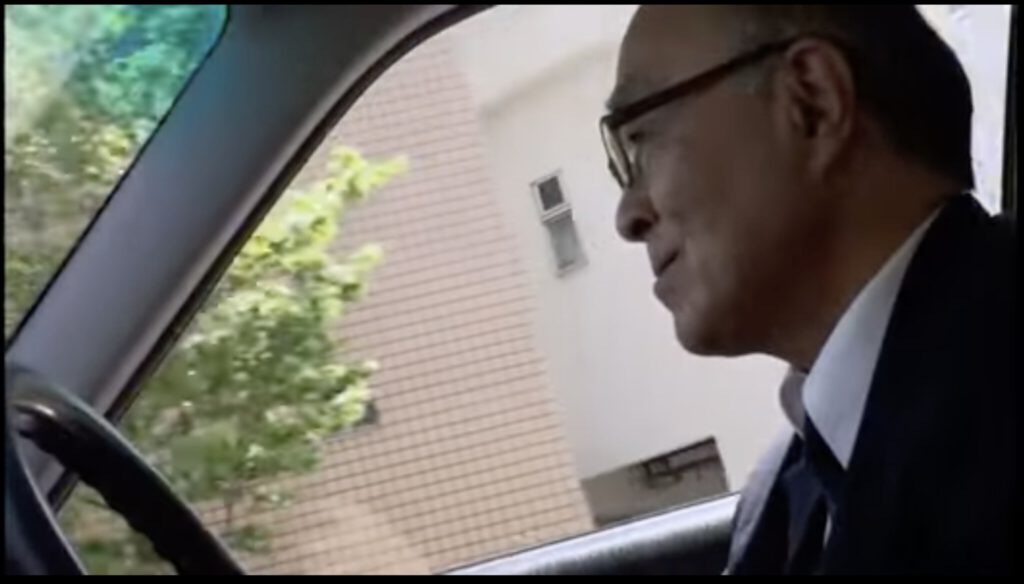
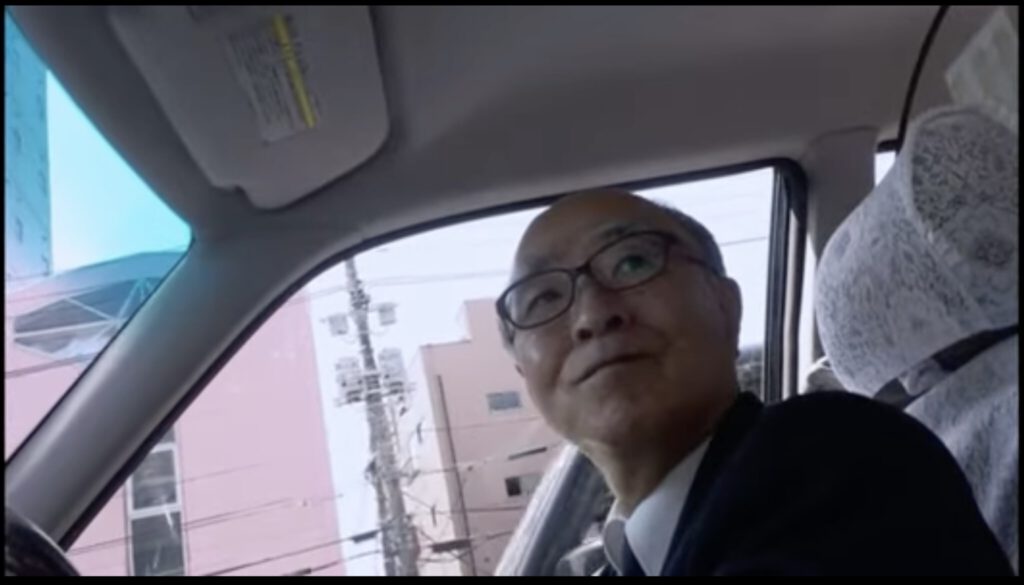
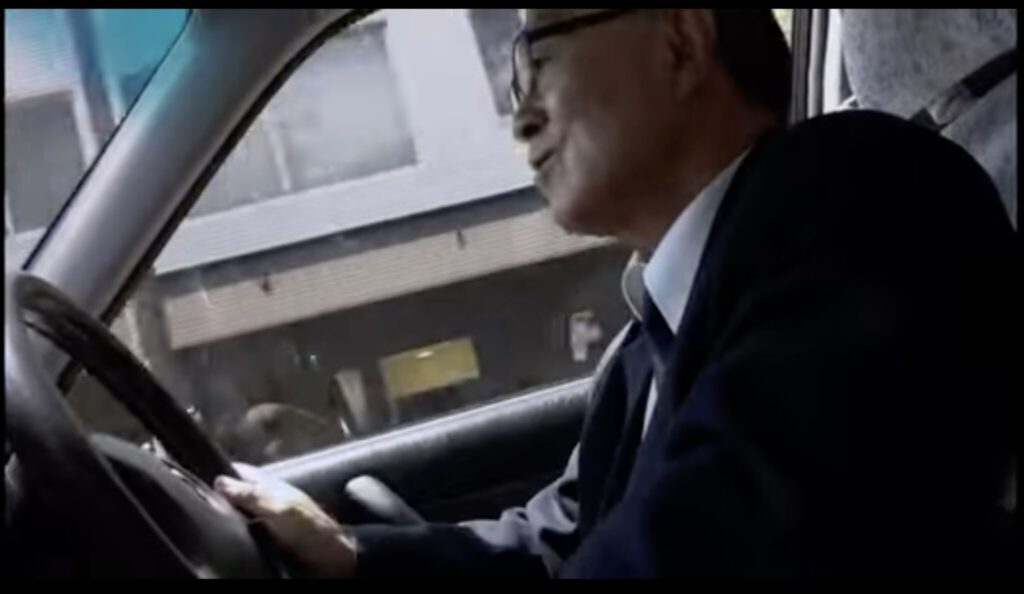
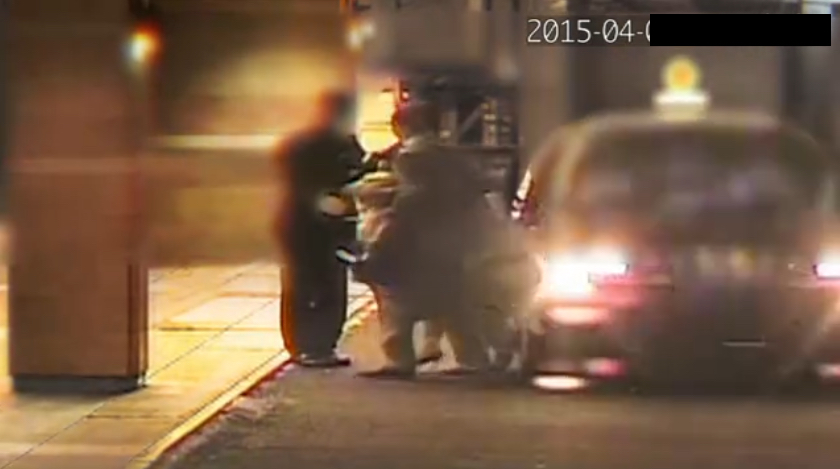
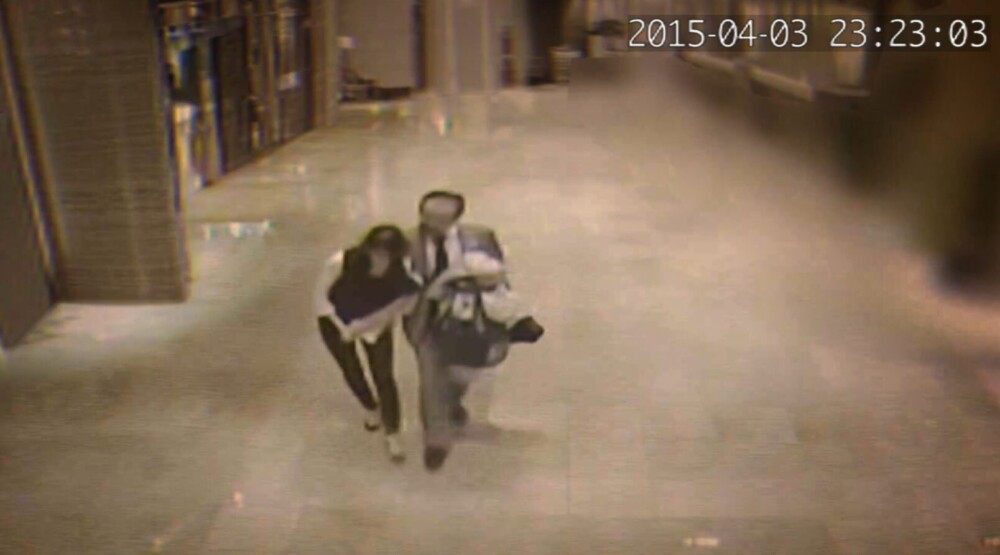
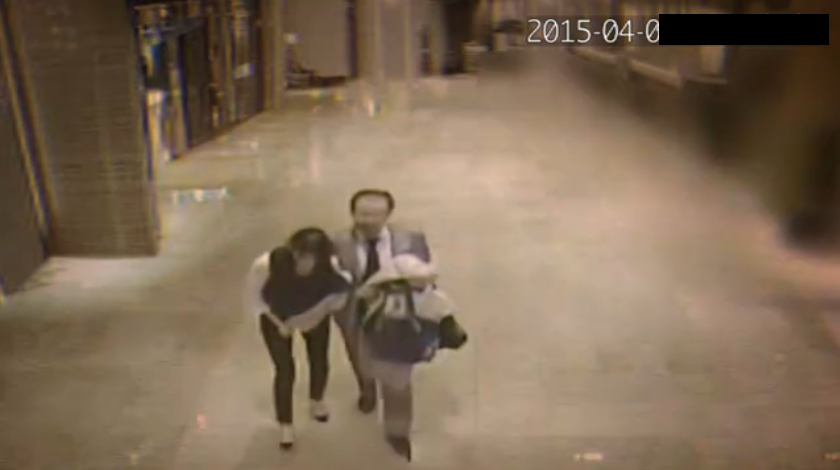
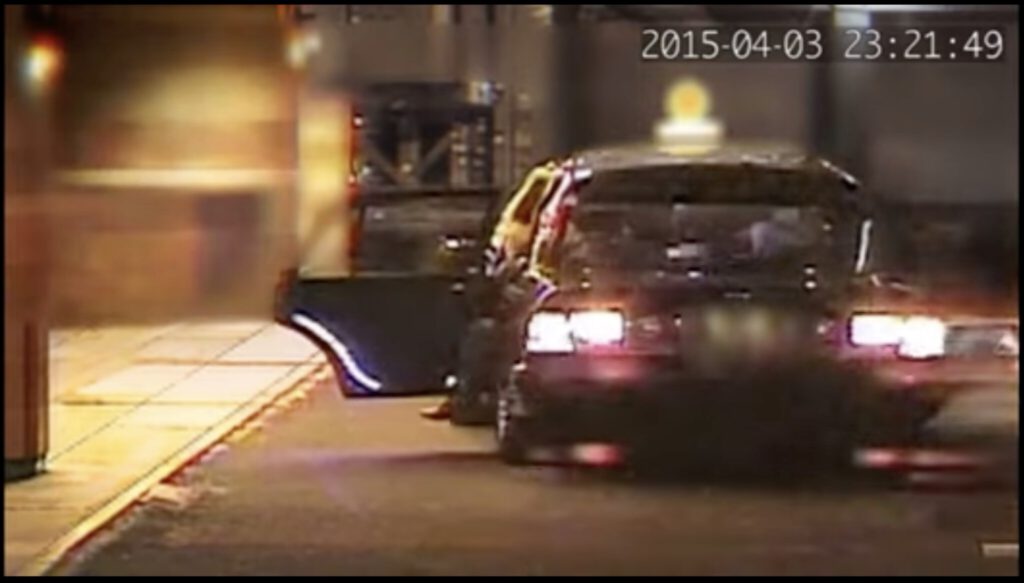
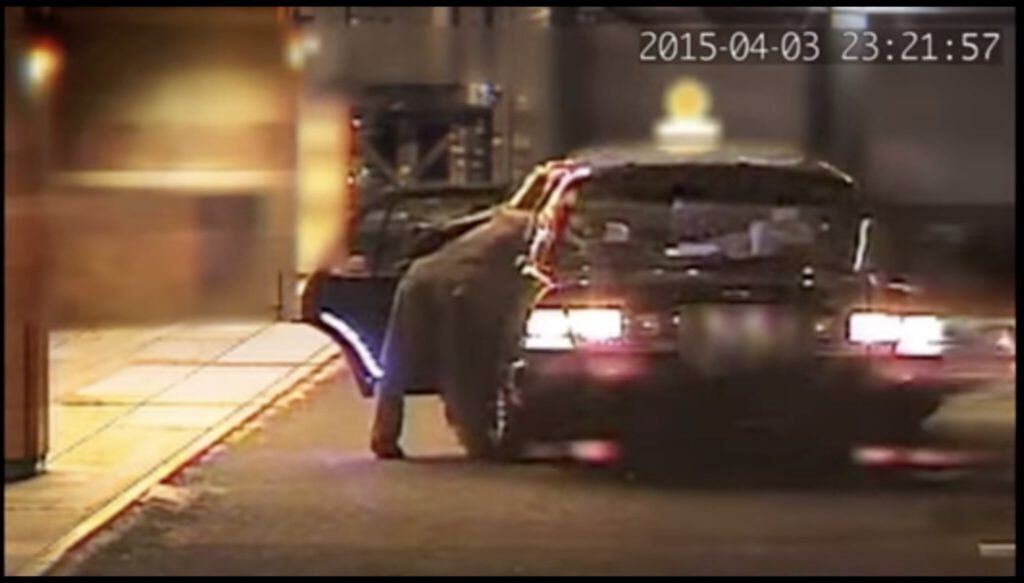
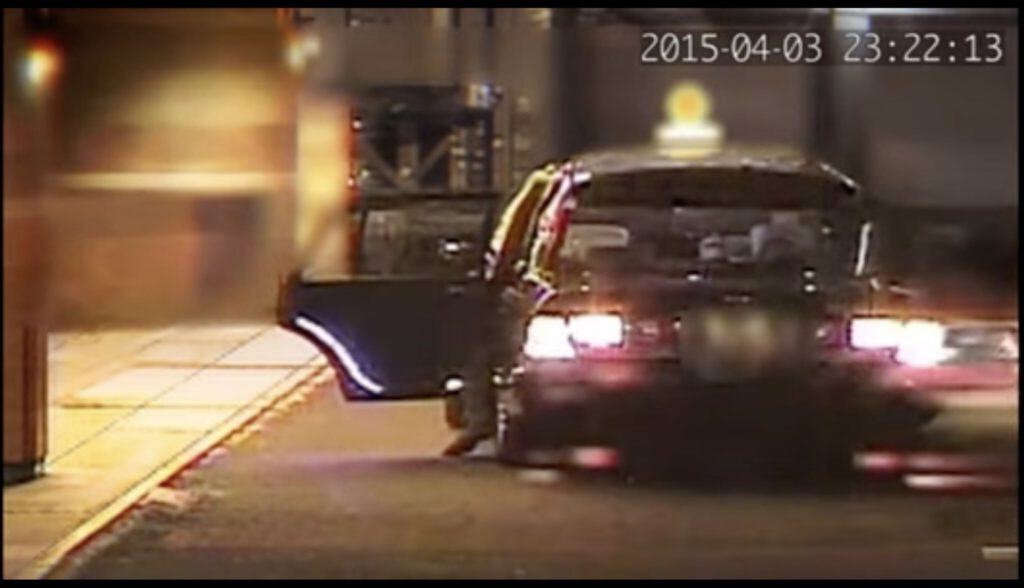
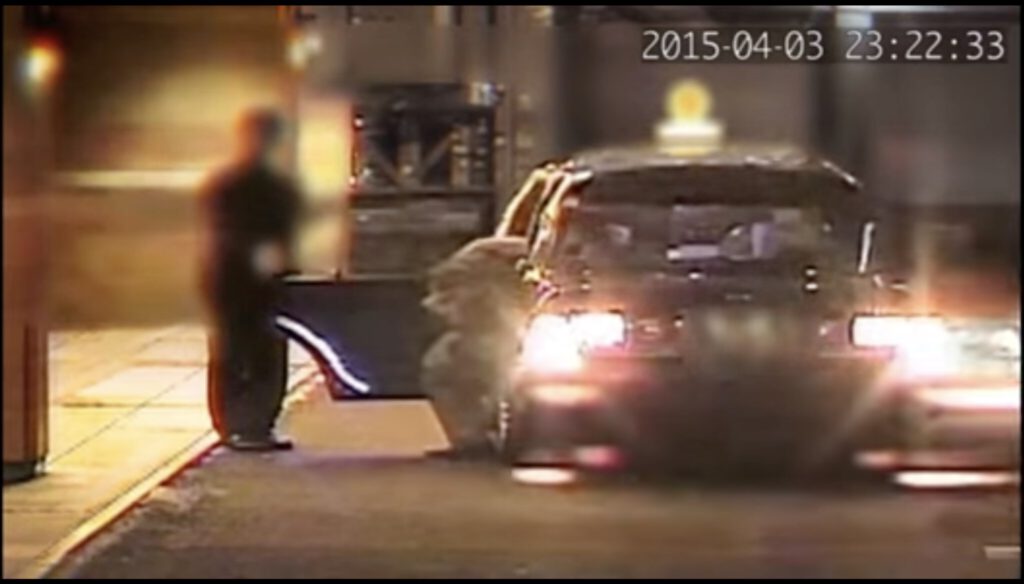
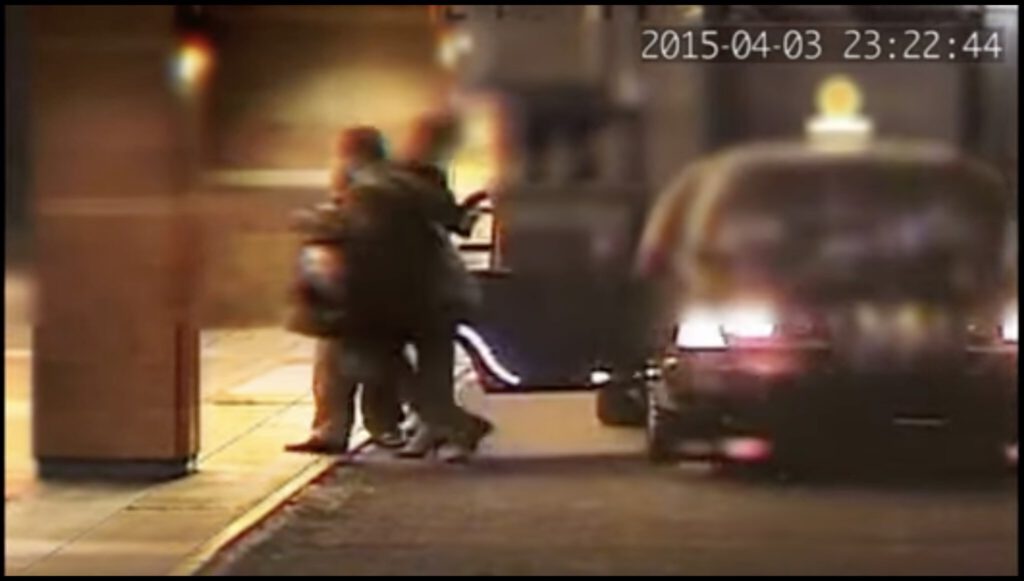
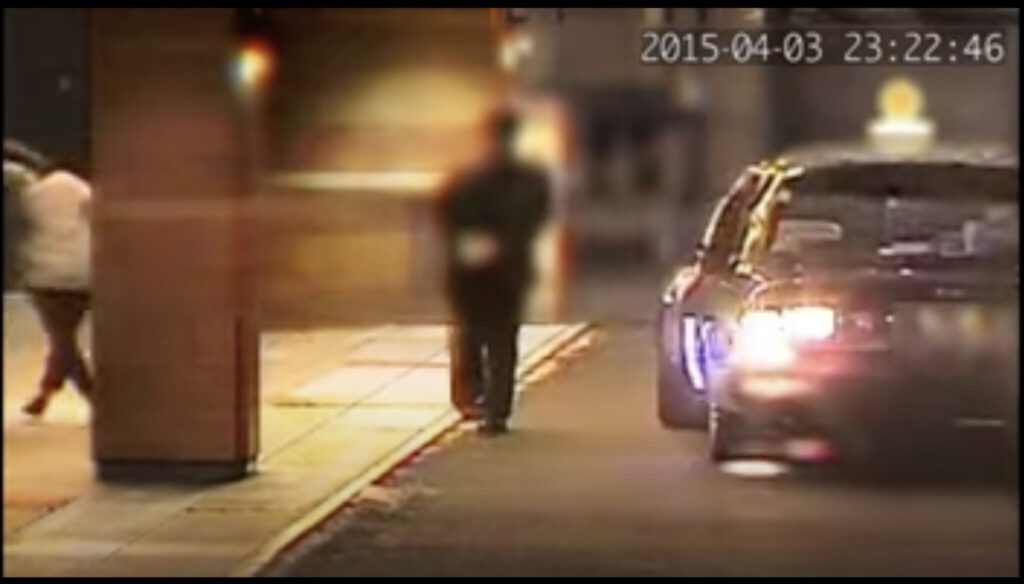
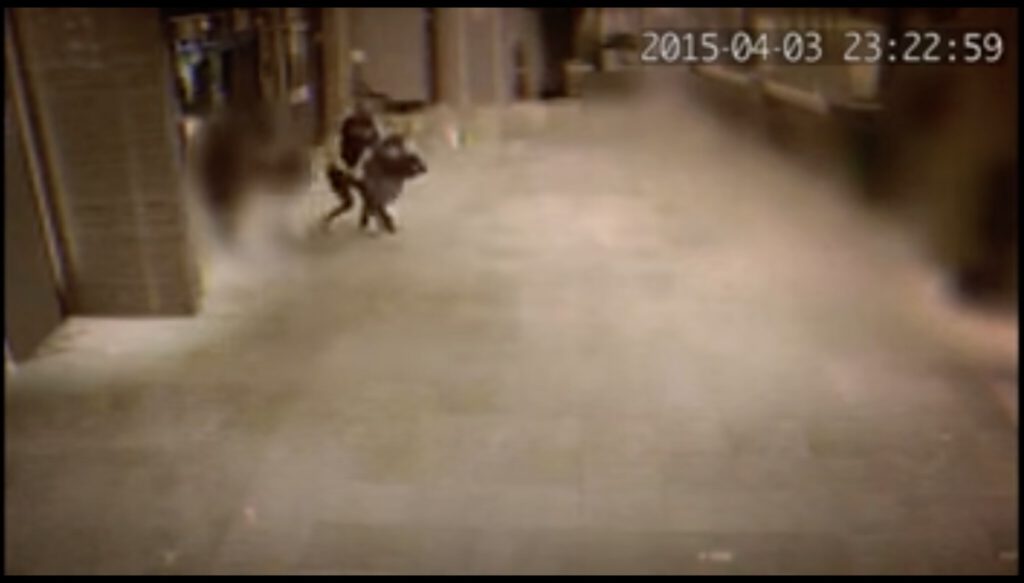
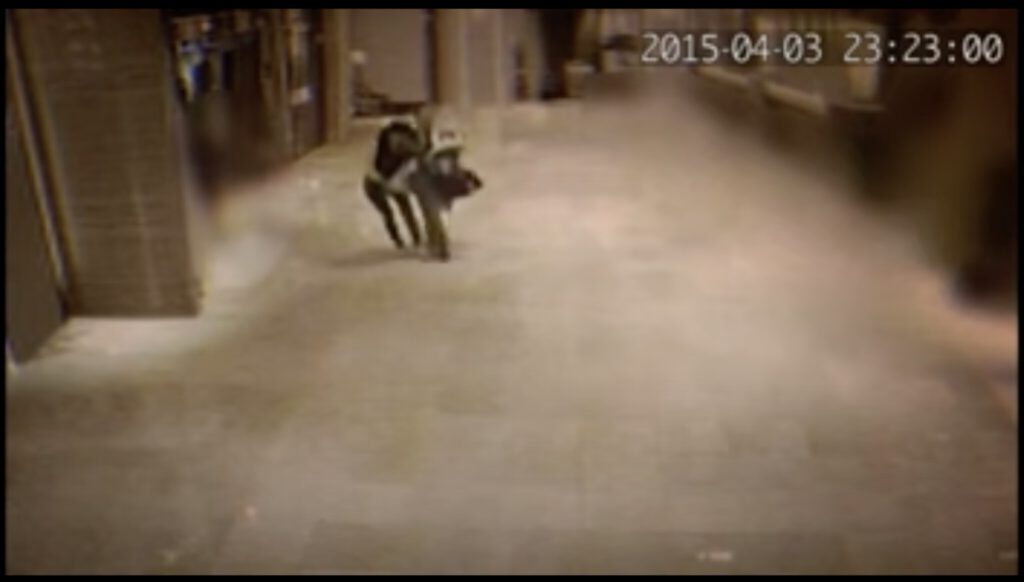
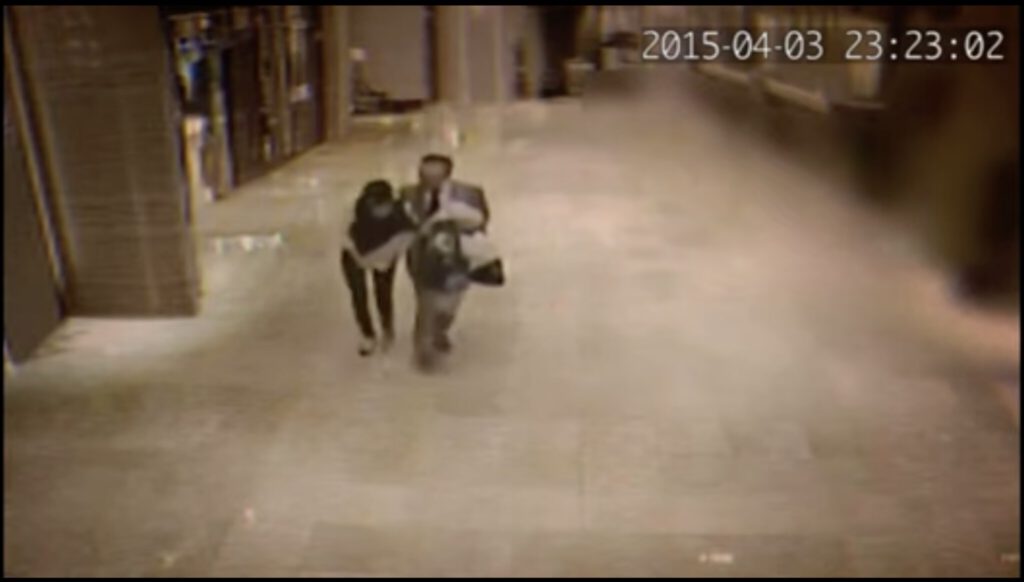
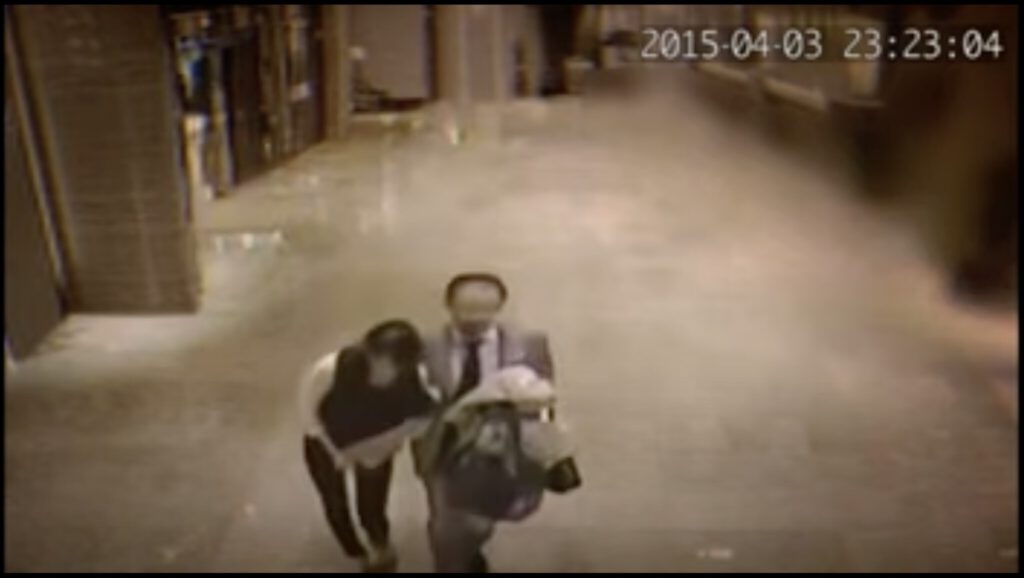
One more important crucial aspect has to be kept in mind, when discussing Ito’s film. The ordinary citizen in Japan does not know that the political, right-wing pressure (obstruction through right-wing, YAKUZA-like, activists movements and the LDP/Japanese Government) on this documentary “Black Box Diaries”, is huge, immense!
Check Wikipedia:
https://en.wikipedia.org/wiki/Black_Box_Diaries
I was shocked to see how these three women MIKAMI Chie 三上智恵 (film director, journalist) (1), MOCHIZUKI Isoko 望月 衣塑子 (journalist) (2) and NISHIHIRO Yoko 西広陽子 (representing Ito’s former lawyer team) (3) have severely hindered Ito from being able to show her Oscar-nominated documentary in Japan.
In other words, there is no sign of solidarity among Japanese women.
A disgrace for male-dominated, socially backward Japan, where the role of women is a discriminatory. Women in Japan are still second-class human beings. In 2023, Japan’s gender gap index was ranked 125th out of 146 countries.
伊藤詩織 ITO Shiori’s documentary film “Black Box Diaries” will rank very highly in the Japanese public’s interest because it actually has the power to prevent rape and other forms of sexual assault in the future through building awareness on the issue.
Please keep in mind: 30 rapes per day in Japan. And the number has been increasing year by year!
(I know, YOU as a Japanese man, won’t agree with my opinion.)
God bless you.
2025/2/25 Tokyo
Mario A
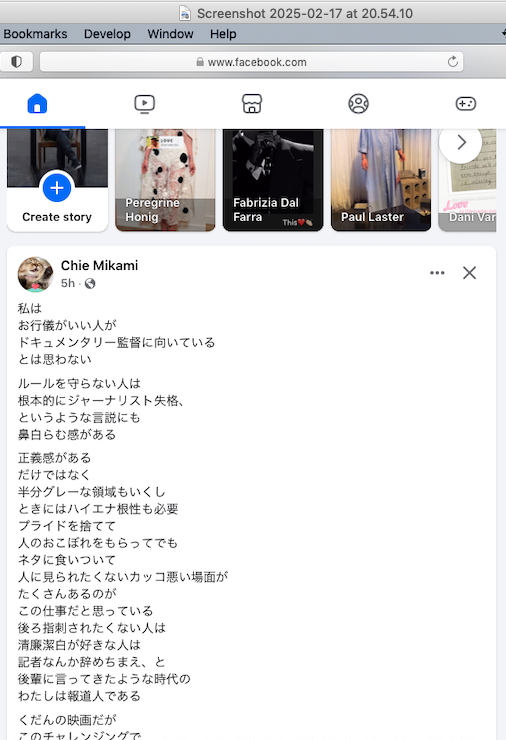
1) MIKAMI Chie 三上智恵 (film director, journalist)
Chie Mikami 2025/2/17
私は
お行儀がいい人が
ドキュメンタリー監督に向いている
とは思わない
ルールを守らない人は
根本的にジャーナリスト失格、
というような言説にも
鼻白らむ感がある
正義感がある
だけではなく
半分グレーな領域もいくし
ときにはハイエナ根性も必要
プライドを捨てて
人のおこぼれをもらってでも
ネタに食いついて
人に見られたくないカッコ悪い場面が
たくさんあるのが
この仕事だと思っている
後ろ指刺されたくない人は
清廉潔白が好きな人は
記者なんか辞めちまえ、と
後輩に言ってきたような時代の
わたしは報道人である
くだんの映画だが
このチャレンジングで
身を挺したことを
最大の売りにしている覚悟の映画で
潔白ではない
問題を孕むシーンが
いくつも指摘されるのも
作り手は織り込み済み
なのだと思う
だから一つ一つのシーンの
評価については
多くの人が指摘している
正しさは正しいし
私も、確かにそうだよね、とはなる
使わないでも作れたよね、とか
無難な意見も言える
でもこの話、私には
なにか違うモヤモヤが
付き纏って離れない
仮にそれぞれに使用した場面が
正しくなくても
その論争が盛り上がればあがるほど
この映画は見たいと思う人は
減るどころか増えて行くという
性質がある
載せられてる気もする
オスカーの栄光か、それともー
という見出しに加えて
あの伊藤詩織が
あの望月衣塑子をー
というリードが踊るこの展開
ここまで来ると
いやらしさが鼻につく
これは、監督サイドの
意図的な戦略ではなのか?
アメリカサイドのプロデューサーとか配給側の
炎上は最大の営業、とする
肝の座り方なのか、とか
でもそれは
伊藤詩織さんの本意なのか?
と考えあぐねていた
けれども
元々、真っ先に詩織さんの取材に
駆けつけてくれてから
長く友人関係にあった
望月記者個人を訴えるという
この段階にきて
これはモンスターだな、と思った
それこそ報道人であれは
間違った記事に腹を立て
必要なら法的手段にというのは
あるかもしれない
であれば訴える相手は
東京新聞だろう
なぜ望月記者個人にしたのか?
それは
伊藤詩織VS望月衣塑子
という構図はショッキングで
リベラル派は仰天して
ため息をついて
なんでこんなことにー?と
話題で持ちきりになり
元々2人に興味がない向きにも
無責任に楽しめる
キャットファイトに映り
その話題の映画を
見てみてえもんだ、となる
元々セルフプロデュース力が
群を抜いているし
使えるものは総動員して
自身の苦難の道のりを
どんなことをしてでも
昇華させてみせるという
ハングリー精神は
凄いと思う
だとしても、だ。
私は個人的に
女友達を利用する女
女友達を裏切る女、が
毛虫の次に嫌いだ
長年苦楽を共にした
女性弁護士たちの
あの怒りに震える会見をみて
背中に冷たいものが走った
望月さんは二日前のアークタイムスで
涙ぐんでいたが
彼女は大事にするべき人を
大事にしていない、と
私は判断する
これが無名の男性記者であれば
個人を訴えたか?
名誉毀損されたことよりも
名誉毀損をも映画への注目を集める
手段にするために
注目を集められる望月さんだからこそ
踏み込んだのではないか?
またこのことで
20日に外国人記者クラブで
海外に向けて会見を開くという
得意の英語で
海外からの賞賛をバックに
彼女のペースを守り抜くのだろう
他の人が海外での伊藤さんの発言を
まとめた記事を読んだが
日本で映画が公開できない理由
についても
まだまだ保守的で、、のような
人権後進国的なニュアンスで
語られていたようだ
片っ端から
海外の映画祭に応募して
たくさんの賞を取って
話題を集めて
幾多の困難を蹴散らして
日本に逆上陸を果たすという
劇場型の公開計画の
最後の段階にきている今
オスカーの発表が迫る
このタイミングでの英語の記者会見
きっと日本人記者も
いつもの倍は来るだろう
ワールドワイドで賛否が渦巻く
さらに上映国が増える
TBS記者の悪事は万里を走る
加害者への復讐は
過去に例がない破壊力を持つ
ドキュメンタリー映画を使って
ここまで成し遂げるとは
私の想像を完全に超えている
モンスターだ
いや、
モンスターになったのだろう
映画論とかドキュメンタリー論が
飛び交う時空とは別のところに
この話は根を生やしている
2) MOCHIZUKI Isoko 望月 衣塑子 (journalist)
From Wikipedia:
Tokyo Shimbun article and defamation suit[edit]
On January 14, 2025, the Tokyo Shimbun reported that footage of female journalists discussing their experiences of sexual harm at a private meeting that took place in December 2017 was used in the film, including the version streaming on Paramount+, without permission from several of the participants filmed, even though one of them had been told by Itō in late 2024 that her request that the scene be removed had been accepted. The organizer of the event told the newspaper that they authorized Itō to use the footage under the condition that she obtain permission from everyone filmed, but they did not confirm that she indeed did, and they would deliberate whether they too would request the scene be removed. Representatives of Itō wrote to the newspaper, “We believe that there exists no obligation to respond to those who keep making malicious personal attacks, and we suggest you operate under that assumption going forward.”[49]
On February 7, 2025, the newspaper issued a clarification and apology saying that the woman shown in the film speaking about her experience of sexual harm had in fact given Itō permission to use her footage, while maintaining that some other participants had not, acknowledging the original headline was misleading.[49]
On February 10, 2025, Itō sued Isoko Mochizuki, the Tokyo Shimbun reporter who wrote the article, for defamation seeking ¥3.3 million in damages. The complaint stated that the meeting was not one for discussing sexual harm but a study session to which Itō was invited as a lecturer, and that Mochizuki falsely painted Itō as a selfish person who uses unauthorized footage of other sexual victims and this drove Itō’s social reputation “into the ground”. Mochizuki said, “The article didn’t get anything wrong, but we accommodated Ms. Itō’s wishes as much as possible. I cannot help but sense an intent to stifle speech by putting the cost of the lawsuit on me personally, which is deeply regrettable.”[50][51]
https://en.wikipedia.org/wiki/Black_Box_Diaries
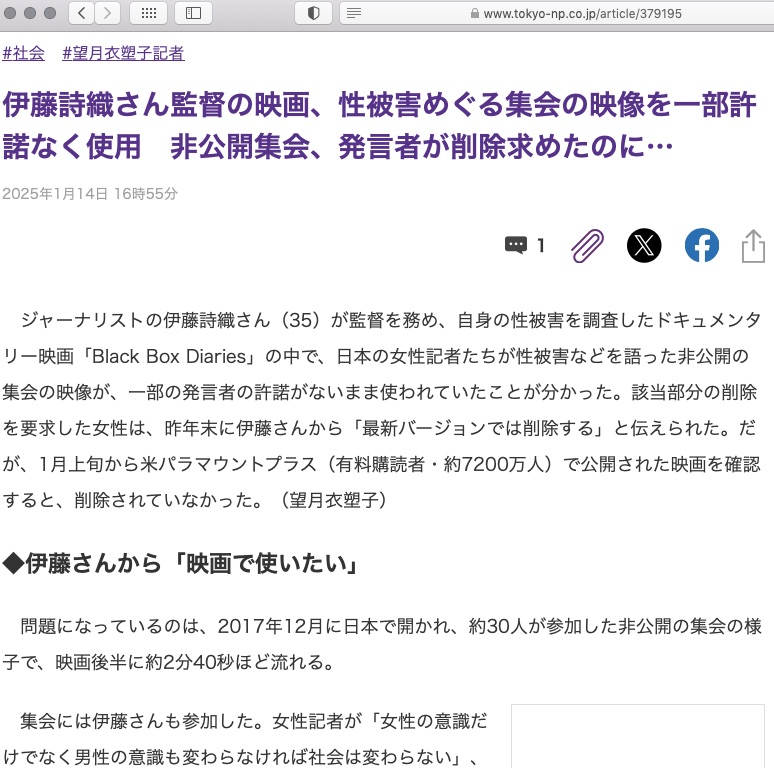
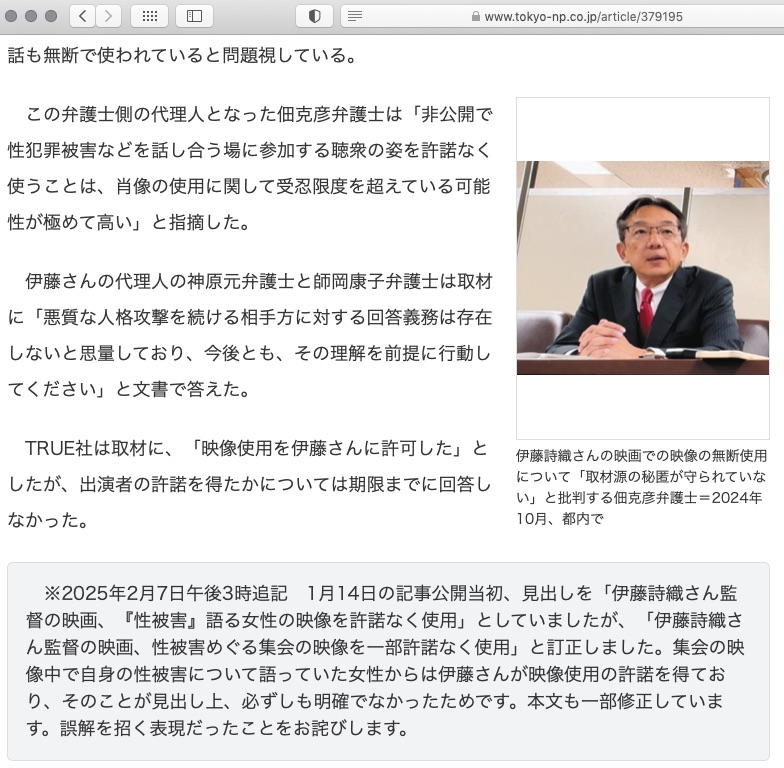
伊藤詩織さん監督の映画、性被害めぐる集会の映像を一部許諾なく使用 非公開集会、発言者が削除求めたのに…
2025年1月14日 16時55分
ジャーナリストの伊藤詩織さん(35)が監督を務め、自身の性被害を調査したドキュメンタリー映画「Black Box Diaries」の中で、日本の女性記者たちが性被害などを語った非公開の集会の映像が、一部の発言者の許諾がないまま使われていたことが分かった。該当部分の削除を要求した女性は、昨年末に伊藤さんから「最新バージョンでは削除する」と伝えられた。だが、1月上旬から米パラマウントプラス(有料購読者・約7200万人)で公開された映画を確認すると、削除されていなかった。(望月衣塑子)
◆伊藤さんから「映画で使いたい」
問題になっているのは、2017年12月に日本で開かれ、約30人が参加した非公開の集会の様子で、映画後半に約2分40秒ほど流れる。
集会には伊藤さんも参加した。女性記者が「女性の意識だけでなく男性の意識も変わらなければ社会は変わらない」、別の女性記者も「20代のころ、詩織さんと似た経験した。公開すると記者の仕事も続けられなくなると思って黙っていた」と体験を振り返り、伊藤さんが感謝を述べている。
集会の主催者によると、当初は英BBC放送(BBC)で放映するドキュメンタリーとして英の製作会社「TRUEVISION」が「伊藤さんを撮影したい。参加者は後ろから映すだけ」と参加者の許諾を得て撮影した。その後、伊藤さんから映像を映画で使いたいと申し入れがあり、主催者は「映っている参加者の許諾を得れば良い」と認めたが、全員の許諾を得たかは確認していなかった。
◆個人を特定されてしまう懸念
他の参加者については、一部の人の正面の顔や横顔、後ろ姿でも個人を特定できる可能性が高いものもある。自身の性被害を語った女性からは許諾を得ていたが、映像に映ったり、発言したりしている女性らが「許諾していない」と話している。主催者は「会として今後、映像の削除を要望するかは、皆で検討する」としている。
映画を巡っては、伊藤さんが元テレビ局記者から性加害を受けた場所とするホテルの監視カメラ映像が無断使用されていることが問題に。映像は加害者に損害賠償を求めた訴訟の証拠で、伊藤さん側とホテル側が「裁判以外では使わない」と誓約書を交わしていた。
◆「受忍限度を超える可能性が高い」
この問題は、伊藤さんの民事訴訟で代理人を務めた弁護士が2024年10月に明らかにした。伊藤さんと元記者が乗ったタクシー運転手の姿や証言、刑事や伊藤さんの代理人弁護士との会話も無断で使われていると問題視している。
この弁護士側の代理人となった佃克彦弁護士は「非公開で性犯罪被害などを話し合う場に参加する聴衆の姿を許諾なく使うことは、肖像の使用に関して受忍限度を超えている可能性が極めて高い」と指摘した。
伊藤さんの代理人の神原元弁護士と師岡康子弁護士は取材に「悪質な人格攻撃を続ける相手方に対する回答義務は存在しないと思量しており、今後とも、その理解を前提に行動してください」と文書で答えた。
TRUE社は取材に、「映像使用を伊藤さんに許可した」としたが、出演者の許諾を得たかについては期限までに回答しなかった。
※2025年2月7日午後3時追記 1月14日の記事公開当初、見出しを「伊藤詩織さん監督の映画、『性被害』語る女性の映像を許諾なく使用」としていましたが、「伊藤詩織さん監督の映画、性被害めぐる集会の映像を一部許諾なく使用」と訂正しました。集会の映像中で自身の性被害について語っていた女性からは伊藤さんが映像使用の許諾を得ており、そのことが見出し上、必ずしも明確でなかったためです。本文も一部修正しています。誤解を招く表現だったことをお詫びします。
https://www.tokyo-np.co.jp/article/379195
English translation from the added text February 7, 2025:
*Added at 3:00 PM, February 7, 2025: When this article was first published on January 14, the headline read, “Shiori Ito’s film uses footage of a woman speaking out about sexual assault without permission,” but has been corrected to, “Shiori Ito’s film uses some footage from a rally about sexual assault without permission.” This was because Ito had obtained permission from the woman who spoke about her own sexual assault in the footage from the rally to use the footage, and this fact was not entirely clear in the headline. Part of the text has also been revised. We apologize for the misleading wording.
3) NISHIHIRO Yoko 西広陽子 (representing Ito’s former lawyer team)
PRESS CONFERENCE: Ethical concerns over Shiori Ito documentary
2025/12/16 up-date:
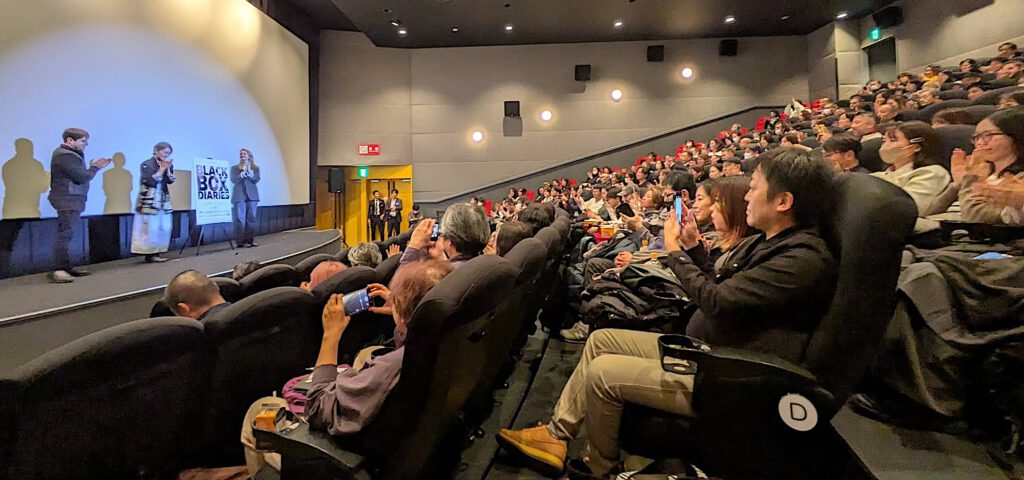
“Black Box Diaries”, which I already saw twice, can be finally seen in Japan.
Japanese right-wing people obstruct. A solidarity attitude amongst Japanese left-wing women journalists still missing.

(1.)
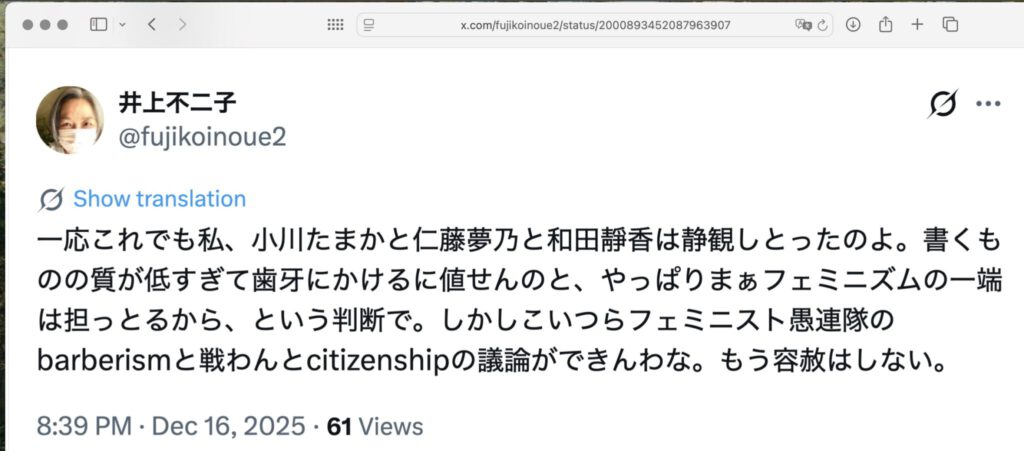
井上不二子 @fujikoinoue2
一応これでも私、小川たまかと仁藤夢乃と和田靜香は静観しとったのよ。書くものの質が低すぎて歯牙にかけるに値せんのと、やっぱりまぁフェミニズムの一端は担っとるから、という判断で。しかしこいつらフェミニスト愚連隊のbarberismと戦わんとcitizenshipの議論ができんわな。もう容赦はしない。
Even with all this, I have been quietly watching OGAWA Tamaka, NITO Yumeno and WADA Shizuka. We decided that the quality of their writings was too low to be worth paying any attention to, and that they do, after all, represent a part of feminism. But you can’t have a discussion about citizenship without fighting the barberism of these feminist thugs. We’re no longer showing any mercy.
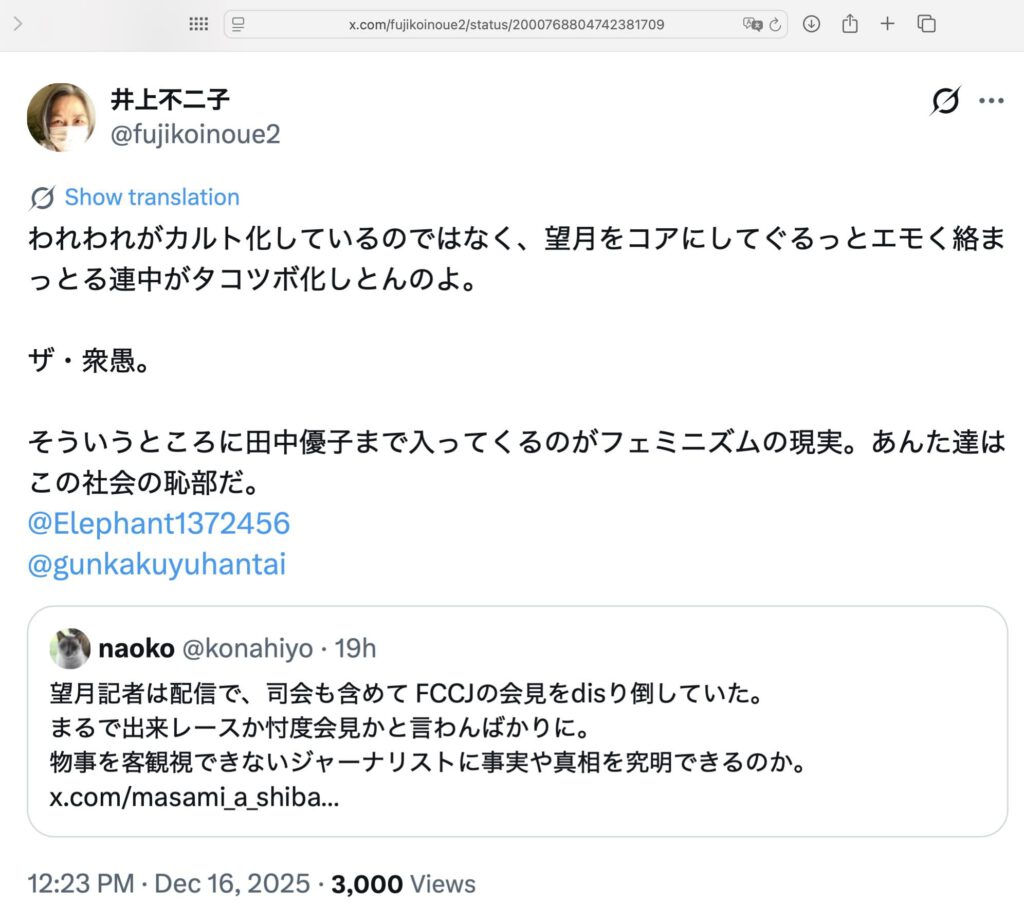
PLUS: (2.)
われわれがカルト化しているのではなく、望月をコアにしてぐるっとエモく絡まっとる連中がタコツボ化しとんのよ。
ザ・衆愚。
そういうところに田中優子まで入ってくるのがフェミニズムの現実。あんた達はこの社会の恥部だ。
It’s not that we’re turning into a cult; it’s that the bunch of folks emotionally entangled around MOCHIZUKI as the core are turning into an octopus pot.
The mob.
It’s the reality of feminism that even TANAKA Yūko gets drawn into that kind of place. You all are the shameful underbelly of this society.
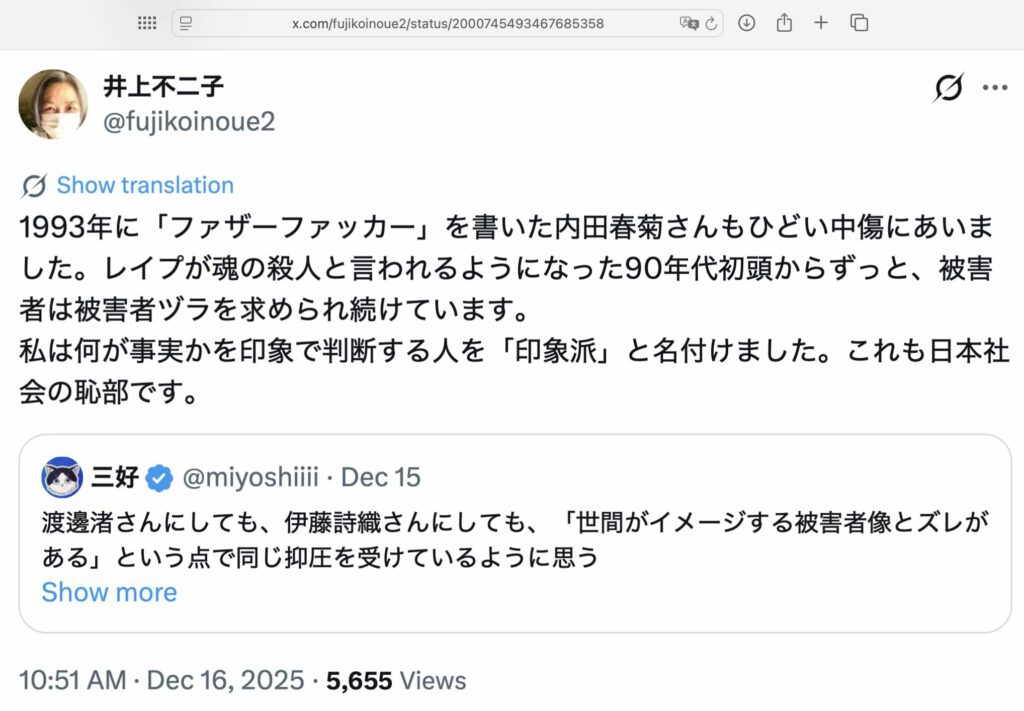
(3.)
1993年に「ファザーファッカー」を書いた内田春菊さんもひどい中傷にあいました。レイプが魂の殺人と言われるようになった90年代初頭からずっと、被害者は被害者ヅラを求められ続けています。
私は何が事実かを印象で判断する人を「印象派」と名付けました。これも日本社会の恥部です。
In 1993, UCHIDA Shungiku, who wrote “Father Fucker,” also faced severe defamation. Ever since the early 1990s, when rape began to be called the murder of the soul, victims have continuously been demanded to put on a “victim face.”
I named people who judge what is fact based on impressions as “Impressionists.” This too is a shameful aspect of Japanese society.
https://x.com/fujikoinoue2/status/2000893452087963907
https://x.com/fujikoinoue2/status/2000768804742381709
https://x.com/fujikoinoue2/status/2000745493467685358
報道関係者各位
司法記者クラブ 御中
『Black Box Diaries(日本公開版)』に関するご報告と修正・配慮事項のご説明
日本公開版に関する事実関係および修正・配慮事項を、下記のとおり取りまとめました。
本資料は、これまでの経緯と現在の対応内容を整理したものです。一部報道に見受けられる誤った情報の是正と正確な情報共有への一助としてご参照ください。
(1)ホテルの防犯カメラ映像
『Black Box Diaries』は、防犯カメラ映像を性暴力の「可視化」に資する重要な記録として位置づけています。性暴力は密室で第三者不在の状況で起こりやすく、被害の有無や経緯が後から疑われやすいという構造的問題があります。防犯カメラの記録は客観性を担保し得る数少ない重要な映像アーカイブです。本作制作過程では、オリジナル版のものから当初よりプライバシーと権利保護の観点、外観・内装・車両等をCGで差し替えるなどの編集・加工を施しています。本来、防犯カメラは犯罪抑止と再発防止のための仕組みですが、実際には被害発生時にこそ役立つ現実があります。二度と繰り返さないため、ホテル等の関係者が即応・協力できる社会を切望します。
ホテルとは裁判以外に防犯カメラ映像を使わないと約束したのは事実であり、防犯カメラ映像の取得にご協力いただいた西廣弁護士には申し訳なく思いますが、性暴力被害の実像を問題提起する本件映画において不可欠と判断し、決断しました。責任は私にあります。
(2)西廣弁護士に関して
本件映画に代理人弁護士の映像が使われることについて、西廣弁護士を含む代理人弁護士から出演承諾書に署名をもらい、弁護士らが映っている実際に使う映像については編集が完成に近くなった2023年12月に実際にお見せして事前確認をとっています。他方、伊藤がドアマンと連絡を取る場面において、「ホテルが止めに入るのでは」と懸念する電話での西廣弁護士の一部音声が入っていました。声のみで西廣弁護士であることは映像では特定されていません。この部分は私が西廣弁護士に事前確認をするのが抜け落ちてしまった場面であり、世界配信される前の2024年7月の協議の際から何度も謝罪をし、製作側から削除が可能である旨をお伝えしていましたが、削除のご要望はありませんでした。しかしその後、西廣弁護士が公にこの点について非難されていることから、当方の判断でこの西廣弁護士との電話のシーン自体を日本版よりカットしています。なお、これまで何度も、新しいバージョンを見ていただきたい、会って説明したいとご説明する機会を求めていましたが申し出はいずれも断られています。
また、日本バージョンでは西廣弁護士が映らないように配慮した編集を行う判断をし、変更しています。
(3)捜査官A
オリジナル版のものから一貫して、顔など特定できる映像は使っておらず、音声は声質加工を施したうえで使用しています。日本版では音声をさらに加工して編集しています。一方、西廣弁護士は、本件映画の中では、警察官の証言が音声を変更することなく無断で使用されていると2024年10月の会見で述べました。しかし、本件映画は、当初より全ての警察官の声を加工・変更して使用しており、この点は、西廣弁護士に、2024年7月31日の協議において明確に伝えていますが、明らかに事実と相違する発言がその後会見などでなされたため、誤った情報が報道されてきました。
(4)タクシー運転手
新バージョンでの使用許可をいただいております。
(5)メディアで働く女性たちに向けた伊藤詩織講演シーン
映画映像をともに撮影したBBCクルーによる映像撮影時にイベントを後方から撮影する許可をえており、また映りたくない方は申し出てもらえるようにお伝えしていました。今回、映像を使うにあたり、参加していた一人一人の方に個別に承認していただくことが不十分であり、応援してくださった会の皆さんにご迷惑をおかけしたことをお詫びします。日本公開版では、明確に本件映画での映像もしくは声を使う同意を得た方以外はすべて個人が特定できないよう、修正しました。なお、このシーンはメディアで働く女性たちが継続して行っている様々な課題についての学習会の場に、「Black box 」を出版した伊藤が呼ばれて講演を行ったものです。一部の誤った報道で、性暴力被害者の会合とか性被害を語る会合との情報が広がりましたが、事実と違います。
2025年12月12日
伊藤詩織
Source:
https://x.com/tondeiruHASU/status/2000939031807627736
2025/12/18 up-date
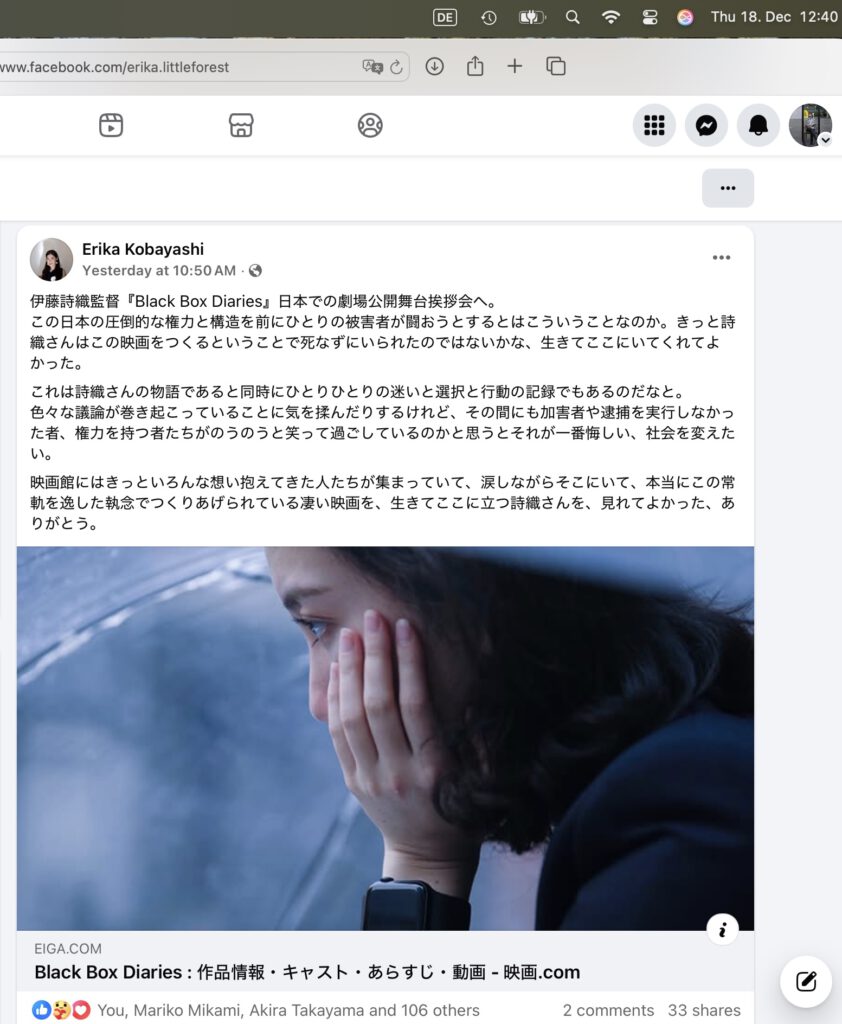
Erika Kobayashi
Yesterday at 10:50 AM
·
伊藤詩織監督『Black Box Diaries』日本での劇場公開舞台挨拶会へ。
この日本の圧倒的な権力と構造を前にひとりの被害者が闘おうとするとはこういうことなのか。きっと詩織さんはこの映画をつくるということで死なずにいられたのではないかな、生きてここにいてくれてよかった。
これは詩織さんの物語であると同時にひとりひとりの迷いと選択と行動の記録でもあるのだなと。
色々な議論が巻き起こっていることに気を揉んだりするけれど、その間にも加害者や逮捕を実行しなかった者、権力を持つ者たちがのうのうと笑って過ごしているのかと思うとそれが一番悔しい、社会を変えたい。
映画館にはきっといろんな想い抱えてきた人たちが集まっていて、涙しながらそこにいて、本当にこの常軌を逸した執念でつくりあげられている凄い映画を、生きてここに立つ詩織さんを、見れてよかった、ありがとう。
I attended the stage greeting event for the Japanese theatrical release of director Shiori Ito’s “Black Box Diaries.”
Is this what it means for a single victim to try to fight back against Japan’s overwhelming power and structure? I’m sure making this film saved Shiori’s life; I’m glad she’s alive and here with us.
This is Shiori’s story, but at the same time, it is also a record of each individual’s doubts, choices, and actions.
I am worried about the various discussions that are taking place, but when I think that the perpetrators, those who did not carry out the arrests, and those in power are all laughing along in the meantime, that is what frustrates me the most; I want to change society.
I’m sure there were many people gathered in the cinema with all sorts of thoughts in their hearts, and I was there in tears, and I’m so glad I got to see this amazing film, which was made with such extraordinary determination, and to see Shiori standing here alive. Thank you.
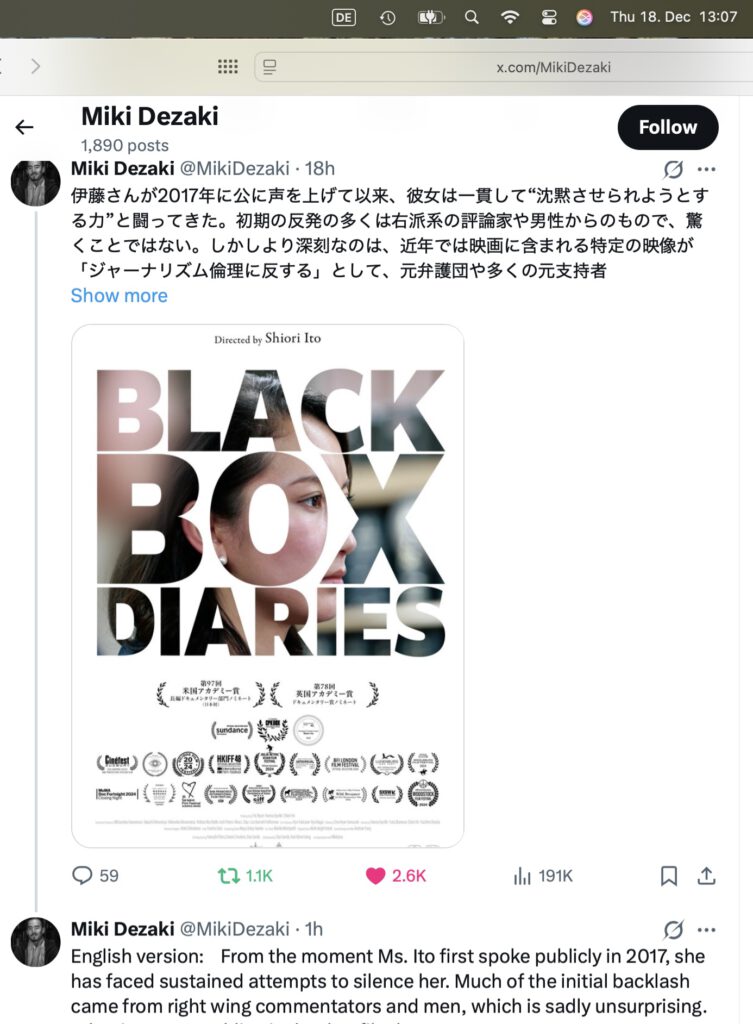
Miki Dezaki
@MikiDezaki·18h
伊藤さんが2017年に公に声を上げて以来、彼女は一貫して“沈黙させられようとする力”と闘ってきた。初期の反発の多くは右派系の評論家や男性からのもので、驚くことではない。しかしより深刻なのは、近年では映画に含まれる特定の映像が「ジャーナリズム倫理に反する」として、元弁護団や多くの元支持者から批判を受け、作品への妨害が生じている点だ。ドキュメンタリー映画はジャーナリズムの厳格な倫理規範に縛られるものではない。ここで強調したいのは、ドキュメンタリー映画はジャーナリズムではないという点である。両論を提示する必要はなく、主観的な芸術作品でありながらしばしば重要な何かを明らかにし、観客に対象者の経験を“見る”だけでなく“感じる”ことを可能にするということである。
上映を観た私には、そして観た人には誰でも、伊藤さんがあえてその映像を入れた理由が明確に理解できる。詳細は明かさないが、元弁護団が問題視した三つのシーンには、山口氏、タクシー運転手、警察官という男性たちが、女性の上に権力を行使し搾取を可能にする家父長制の構造の“能動的な担い手”として映し出されている。
一方、左派系の一部批評家たちは、映画によって伊藤さんがタクシー運転手や警察官、さらにはホテルにまで権力を行使していると主張する。しかし彼らや企業は決して無力ではない。もし彼らの誰かが映画に異議を唱えていれば多くの弁護士やジャーナリストがその声を広めただろう。何より、彼らは伊藤さんを含む多くの女性を裏切った構造そのものの一部である。もっとも、タクシー運転手や警察官は後に、伊藤さんの調査において非常に貴重な協力を提供したことは特筆すべきである。
そもそも「伊藤さんが大きな権力を手にした」という主張自体、現実と矛盾している。むしろ最近の強烈な反発こそ、彼女がいかに脆弱な立場に置かれているかを示している。国際的な評価を受けているにもかかわらず、日本における彼女の立場は、自由派メディア、ドキュメンタリー制作者、一部フェミニストによる批判や嘲笑、攻撃によって深く傷つけられてきた。この広範な攻撃の事実こそ、彼女が日本社会で権力を持っているわけではないことを示している。
とりわけ深刻なのは、“過剰な権力を持つ”という虚像が、彼女への残酷な扱いを正当化する口実として使われていることだ。人々は彼女がレイプ被害者であり、脅迫や過剰な監視、精神的重圧にさらされてきたことを忘れてしまう。
最近、小川たまか氏が衝撃的な記事を書き、読者を伊藤さんが性的暴行を受けたという事実を疑う方向へ誘導している。伊藤さんが2019年に民事訴訟で勝訴してから6年が経つにもかかわらず、フェミニストを自称する小川氏が公に伊藤さんの主張を疑うのは驚くべきことだ。小川氏は、争点となる複雑で文脈に依存する証拠をあたかも自動的に伊藤さんの性的暴行の主張を否定するかのように提示し、映画から意図的に除外したと非難している。さらに、小川氏自身は、トラウマによって記憶が断片化したり証言に不一致が生じることがあるというよく知られた研究を無視している。さらに指摘せざるを得ないのは、小川氏のレトリックの多く、信頼性を疑う、見かけ上の不一致を強調する、被害者を感情的に操作的であるかのように描く、といった手法は、日本の元慰安婦に対するナショナリストの攻撃方法と非常に似通っているという点である。
日本のナショナリスト的手法に関連して、2025年12月15日の外国特派員協会での記者会見後、望月衣塑子氏はライブ配信を行い、視聴者に映画を観る必要はないと述べました(さらに、劇場上映は観客が来ないため12月17日で終了すると誤って述べましたが、実際には1日2回の上映から3回に増えています)。これは、まさに日本のナショナリストが私の映画の上映を阻止しようとした際に用いたレトリックと同じです。また、望月氏は執筆において、伊藤さんが他の性的暴行被害者を傷つけることを気にしない人物であるかのように描いています。これは事実に反するだけでなく、残酷な描写です。
過剰な詳細には触れませんが、望月氏は当初、伊藤さんが性的暴行被害者の集まりを無断で撮影したと主張しました。しかし実際には、その集まりはメディア関係者の女性たちの集まりであり、伊藤さんは事前に主催者から撮影の許可を得ていました。その後、一部の参加者が映画に映らないよう希望したため、伊藤さんは可能な限りその希望を尊重しています。重要な点として、一度許可が得られた後は、参加者を後から削除する必要は必ずしもないことです。そうでなければ、人を含む映像を制作することはほぼ不可能であり、非常にリスクが高くなります。望月氏による事実の誤解釈は、映画や伊藤さんの評価を貶めるより広範な動きに寄与しています。
さらに衝撃的なのは、伊藤さんの元弁護士の一人が記者会見で、彼女による無断映像使用は「本人の意思を無視する性的暴力の構造と何ら変わらない」と発言したことです。その前に、弁護士は伊藤さんに直接「詩織さんがやっていることは山口がやったレイプと同じ」と述べ、伊藤さんが元弁護士に行ったことが加害者が伊藤さんに行ったことと同等であるかのように主張しました。レイプ被害者を代理する弁護士が、このように元依頼人に向かって加害者の名前を挙げることは、非常に不適切であり、深刻な再トラウマの危険に対する驚くべき無関心を示しています。このような比較を考えるだけでも問題ですが、公に口にすることで、レイプの重大性に対する深い理解不足と専門家としての判断力の欠如を露呈しています。さらに問題なのは、弁護士仲間や記者の誰一人として、この発言をメディアで非難しなかったことです。それにもかかわらず、日本の多くの人々にとって、この発言は「権力を持つ」伊藤さんが与えたとされる損害に対する正当な反応と見なされています。
外国特派員協会での記者会見を精神的な崩壊のため(医師のストップによって)欠席せざるを得なかった際、一部のリベラル系論者は、アカデミー賞での様子を根拠に、彼女が本当に具合が悪かったのか疑問を呈した。その比較は不合理である。世界最高峰の映画賞で称えられる瞬間と、敵意ある記者の質問に直面する場はまったく別物だからだ。さらに、病気であったとしても、会見には這ってでも出席すべきだとまで言う者もいた。
会見中止後、アカデミー賞の前に、私は集英社新書プラスの記事の取材確認のため伊藤さんに電話をした。通話の声を聞いた瞬間、彼女がどれほど衰弱し、か細くなっていたかが痛いほどわかった。そのときの弱り切った声は、これまで聞いたことがないほどだった。
映画の中で、私たちは伊藤さんが“理想的な被害者像”から常に外れて扱われてきたことを目の当たりにする。そして今、レッドカーペットで笑顔を見せたことさえ、彼女が人間であり、サバイバーであり、『Black Box Diaries』が彼女自身の正義の追求であり、多くの女性にとって希望の源であることを忘れさせてしまっている。
何より重要なのは、多くの批評家がより大きな全体像を見失っていることである。本来であれば、この映画の日本公開を、日本社会における性暴力への理解を深め、被害者が直面する構造的な困難について議論を広げる機会とすべきところ、彼らは伊藤さんを「巧妙な操作者」として描き出し、作品を人々の目に触れさせまいとし、さらには彼女が性的暴行を受けたという事実そのものにまで疑念を投げかけている。
(上記は、私が『Black Box Diaries』のパンフレットのために執筆したエッセイを一部加筆・修正したものです。)
English version: From the moment Ms. Ito first spoke publicly in 2017, she has faced sustained attempts to silence her. Much of the initial backlash came from right wing commentators and men, which is sadly unsurprising. What is more troubling is that her film has more recently been undermined by criticism from her former lawyers and a significant number of former supporters who argue that certain footage in the film violates journalistic ethics, even though documentary films are not bound by those standards. I must stress this point that documentary films are not journalism. They do not need to show both sides. They are mostly subjective art work that often reveals something meaningful, and allows us to not only to see but to feel the experiences of its subjects.
After viewing the film, it was clear to me, and likely clear to anyone who sees it, why Ms. Ito took the risk of including the contested footage. Without revealing its details, the three scenes her former lawyers object to, show how the men in those clips, Mr. Yamaguchi, the taxi driver, and the police officer, are embedded as active agents in a patriarchal system that holds power over women and enables their exploitation.
Some critics on the left argue that Ms. Ito, through her filmmaking, now wields power over the taxi driver and police officer (and the hotel). But these men (and corporate entity) are not powerless. Had any of them spoken out against the film numerous lawyers and journalists would have eagerly amplified their voices. More importantly, these men were part of the very structures that failed Ms. Ito and countless other women. Although, it should be acknowledged that the taxi driver and police officer later gave Ms. Ito invaluable help with her investigation.
The idea that Ms. Ito now possesses overwhelming power is also contradicted by reality. If anything, the backlash against her demonstrates how vulnerable she remains. Despite her international recognition, her standing in Japan has been severely damaged by waves of criticism, dismissal, and personal attacks across the media landscape, including from liberal journalists, documentary filmmakers, and even feminists. The breadth of this opposition makes clear that she does not occupy a position of institutional or cultural power in Japan.
Perhaps saddest of all is how the exaggerated perception of her power has been used to justify cruelty against her. People forget that she is a rape survivor who has endured threats, relentless scrutiny, and enormous psychological pressure.
Recently, Ogawa Tamaka wrote a shocking article that guides the reader towards disbelieving that Ms. Ito was sexually assaulted. It is astonishing that, six years after Ms. Ito won her civil lawsuit, a self-identified feminist would publicly cast doubt on her story. Ms. Ogawa does this by presenting contested and contextually complex evidence as if they automatically disprove Ms. Ito’s sexual assault claims, and accusing Ms. Ito of deliberately omitting it from her film to manipulate the narrative. Moreover, Ms. Ogawa ignores well-established research showing that trauma can cause memory fragmentation and inconsistencies in testimony. It is difficult for me not to point out that many of Ms. Ogawa’s rhetorical attacks, including questioning credibility, emphasizing perceived inconsistencies, and portraying victims as emotionally manipulative, mirror the methods Japanese nationalists have used to attack former “comfort women”.
Speaking of Japanese nationalist tactics, following the December 15th press conference at the Foreign Correspondents Club of Japan, Mochizuki Isoko conducted a live stream in which she advised viewers that they didn’t need to see the film (and falsely stating that the theater screening would end on December 17 because of the lack of people coming to see it. The film has actually been bumped up from 2 screenings a day to 3 screenings). This is exactly the same rhetoric Japanese nationalists used in attempts to prevent my film from being seen. I should also note that Ms. Mochizuki, in her writing, has portrayed Ms. Ito, a survivor of sexual assault, as someone who supposedly doesn’t care about hurting other sexual assault survivors. This characterization is not only inaccurate but also cruel.
Without going into excessive detail, Ms. Mochizuki initially claimed that Ms. Ito filmed a gathering of sexual assault victims without obtaining consent. In reality, the event was a gathering of women in media, and Ms. Ito had obtained prior consent from the organizer to film it. Later, some attendees requested not to be shown in the film, and Ms. Ito has done her best to honor those wishes. It is important to note, however, that once consent has been given, it is not generally necessary to remove participants retroactively; otherwise, producing any media featuring people would be almost impossible and fraught with risk. The misrepresentation of these facts by Ms. Mochizuki contributes to a broader effort to discredit the film and Ms. Ito.
Most disturbing is that one of Ms. Ito’s former lawyers declared at a press conference that her use of unauthorized footage was “no different from the structure of sexual violence that ignores a person’s will.” Prior to that, the lawyer told Ms. Ito directly, “Shiori, what you are doing is the same as Yamaguchi committing rape”, effectively claiming that what Ms. Ito had done to her former legal team was equivalent to what her perpetrator did to her. It is difficult to imagine anything more inappropriate for an attorney representing a rape survivor. Invoking the name of her perpetrator directly to Ms. Ito’s face in that way was deeply cruel and shows a shocking disregard for the risk of re-traumatizing a victim. Merely entertaining such a comparison, let alone voicing it publicly, demonstrates not only a profound misunderstanding of the seriousness of rape but also an alarming lack of professional judgment. Equally troubling is that none of the lawyer’s peers nor any journalists saw fit to condemn the remark in the media. And yet, among many in Japan, this statement is viewed as a reasonable response to the supposed harm inflicted by a “powerful” Ms. Ito.
When Ms. Ito was forced (doctor stop) to cancel a scheduled appearance at a Foreign Correspondents Club press conference in February because of a mental breakdown, some liberal commentators questioned whether she was truly unwell, citing her appearance at the Academy Awards as evidence. The comparison is absurd. Being honored on a global stage at the most prestigious film award ceremony is not the same as facing hostile questioning from the media. Others went as far as to say that even if she was sick, she should have crawled to the press conference.
After the cancellation of the press conference and before the Academy Awards, I called Ms. Ito to verify some details for an article I was writing for Shueisha Shinsho Plus about why I believed the contested footage was in the public interest and met the standard of fair use. The moment I heard her voice on the call, I could feel how weakened and frail she was. Her voice at that time was the most exhausted I had ever heard.
In the film, we see how Ms. Ito was never perfect enough of a victim for Japanese society’s expectations. And now her smiling on a red carpet has led some to forget that she remains human, a survivor, and that “Black Box Diaries” is part of her own pursuit of justice as well as a catalyst of hope for many women.
Most importantly, critics have lost sight of the larger picture. Instead of embracing the film’s release in Japan as a chance to deepen public understanding of sexual assault and the systemic obstacles faced by victims, they choose to depict Ms. Ito as a master manipulator, attempt to prevent audiences from seeing the film, and even question whether she was sexually assaulted at all.
https://x.com/MikiDezaki/status/2001488756050940100
2025年12月30日、18:36 のアップデート up-date
https://x.com/photograshiori/status/2005905706940317749
4:36 PM · Dec 30, 2025 ·25.1K Views
Shiori Ito @photograshiori
「伊藤側の弁護士が辞任」と報じられていますが、事実関係が正確でないので相手方代理人に送付した「委任関係終了の通知」を公開し、説明に代えさせていただきます。
師岡、神原元弁護士ご尽力のおかげで、日本での公開を迎えられました。お二人に心より感謝申し上げます。
It has been reported that “the lawyer on Ito’s side has resigned,” but since the facts are not accurate, I will make public the “Notice of Termination of the Agency Relationship” sent to the opposing counsel and use it in place of an explanation.
Thanks to the dedicated efforts of attorney Morooka and attorney KANBARA Hajime, we have been able to hold a public release in Japan. I extend my heartfelt gratitude to both of you.
FAX通信書
2025年12月25日
西廣陽子氏・加城千波氏代理人
弁護士 佃克彦 先生
伊藤詩織氏代理人
弁護士 師岡 康子
弁護士 神原 元
【貴職との交渉の終了について】
1 当職らは、本年2月以来、貴職に対し、本件に関し、第三者を巻き込まず、当事
者間での対面による率直な意見交換により問題を解決することを申し入れ、その際
は、経過説明とともに、修正バージョンをお見せすると繰り返しお伝えしてきまし
たが、貴職において拒絶された状態が続いてきました。
2 すなわち、2月27日午後6時頃、貴職の事務所において、神原から「腹案だが、
防犯カメラの部分については『双方の意見を尊重する』とし、その他の部分について
修正バージョンを確認して意見を頂戴しつつ調整するという線で和解できないか」と
提案すると、貴職は、 「防犯カメラについて『双方の意見を尊重する』ということはあ
りえない」「修正バージョンを見てお墨付きを与える結果になるので、当方にメリット
がない」等と発言し、3月3日には、協議を行う前提として、伊藤さん本人が貴職ら
の2回の会見と同質・同量の記者会見をしてほしいとの旨のFAX文書を送付されま
した。また、西廣弁護士は、3月19日には「映画の修正に関する具体的な相談や提
案もなく、修正された映像の提示もない」として再び元依頼者である伊藤氏を公に非
難するコメントを公表しましたが、これは、神原が2月27日に、修正バージョンを
見せる等具体的な相談をした事実を無視したものであり、貴職から西廣弁護士にその
旨が伝わっているのか疑わざるを得ないものでした。
さらに、今般送付されてきた質問についても、当職らは、7月11日付けで「修正
版の調整は他の権利者の意向もあり、極めてデリケートかつ複雑な問題が絡む」ため、
「(伊藤氏)ご自身から先生方にご説明できるよう諸々調整」している旨連絡し、9月
8日には「お問い合わせの件も含めて伊藤氏自身の口から直接ご説明申し上げるのが
最も誠意ある態度であると思料して」いる旨連絡し、10月6日には、 「伊藤氏が直接
お会いし、映画の修正に関する具体的なご提案、ご説明を行いたいと面談」を申し入
れ、 10月17日には 「話合いの席で映画の修正部分をお見せし、ご意見を頂きたい」
旨提案し、神原が11月6日付けFAXと7日付け内容証明でも同様の申し入れをし
ているにも拘わらず、貴職は、これらをいずれも拒絶しました。そして、12月11
日、西廣弁護士は、再度、 「 『映画を修正した』とか『修正バージョンを見て』という
話は一切ありませんでした」等と元依頼者である伊藤氏を非難し、当職らの提案につ
いても「日本で映画を上映するための既成事実をつくり、それに利用されるのだと感
じました」等とするコメントを、メディアを通じて公に発表しました。
3 12月11日付けで公表された西廣弁護士のコメントを見れば、貴職らが、未だ
「防犯カメラ」の許諾問題に固執し、「防犯カメラ」の映像を映画から削除しない限
り、元依頼者である伊藤氏を非難する姿勢を変えないとの立場に立っていることが明
らかです。
京都朝鮮学校襲撃事件で画期的な勝訴判決を勝ち取った弁護団の 1 人である富
増四季弁護士は、12月21日に「伊藤詩織氏さんの映画をめぐる会見について、
弁護士として考えたこと」と題する論考を公表し、その中で、 「弁護士が抱いた不満
や抗議の思いは、非公開で、弁護士・依頼者間での折衝を通じて解決を模索すべき
ものだったように見受けられます。紛議調停といった手続も弁護士会には準備され
ています。法律論をふりかざした公開の場での糾弾という手段を用いるべきではな
かったと、私は考えています」と貴職の手法を批判していますiが、当職らも同様に
感じております。
結局、貴職は、 「防犯カメラ」の映像に関する貴職の見解に固執し、一歩も譲歩し
ない姿勢を崩さず、当方が12月11日付FAXの質問に12月14日までに回答
するよう要請してもこれを拒絶し、当職らに一方的な要求を押し付ける一方、当職
らの質問には一切答えないとの態度を繰り返しているのですから、残念ながら、も
はや、貴職とのFAXの交換で協議が進展する可能性はないというほかありません。
4 このように、貴職との間で協議が成立する見通しがないことから、当職らは、本
状(本 FAX)により、貴職に対し、伊藤氏と当職らとの本件に関する委任関係が終
了した旨を通知します。以後、当方にFAX等送られても伊藤氏に対し一切法的効
果が生じることはないこと、したがって、本件に関し、今後、貴職から当職ら宛の
書面送付には対応いたしかねることをご承知置きください。
5 なお、伊藤氏は、西廣弁護士に対し、12月12日付で公表した文書「西廣陽子
弁護士のステートメントについての伊藤詩織の見解」において表明したとおり、西
廣弁護士の声の録音について2024年7月の会合で直接謝罪し、削除できること
を伝え、 「西廣弁護士を深く傷つけたことを反省し、あらためてお詫び」しており、
さらに「元弁護団の方々への感謝の気持ちを、今も変わらず持ち続け」、現在も、西
廣弁護士との直接の対面での対話を望んでいることを申し添えます。
以上
i https://note.com/shiki_4seasons/n/n2c4c1e40d39b
添付資料
「伊藤詩織さんの映画をめぐる会見について、弁護士として考えたこと」
弁護士 冨増四季 note
なお、当該ブログには、420件以上の賛同「いいね」が貼付されております。