The Slow Death of the New York Art Scene (3) ニューヨーク・アートシーンの緩慢な死 (3)
The continuation of “The Slow Death of the New York Art Scene” ニューヨーク・アートシーンの緩慢な死 (1)
https://art-culture.world/articles/slow-death-of-the-new-york-art-scene-1/
The Slow Death of the New York Art Scene (2)
ニューヨーク・アートシーンの緩慢な死 (2)
https://art-culture.world/art-world/slow-death-of-the-new-york-art-scene-2/
For about 7 years there has been a growing feeling that it is not important for artists to exhibit in New York.
To put it bluntly: New York is out.
The music plays somewhere else.
With the establishment of international art fairs in Basel, London, Hong Kong, Paris, Seoul and Tokyo, the gravitational pull of contemporary art has shifted away from New York, away from American artists, towards Europe and Asia.
The USA also cannot offer a Venice Biennale, documenta Kassel or Gwangju Biennale. Berlin plays a more important role for artists than New York.
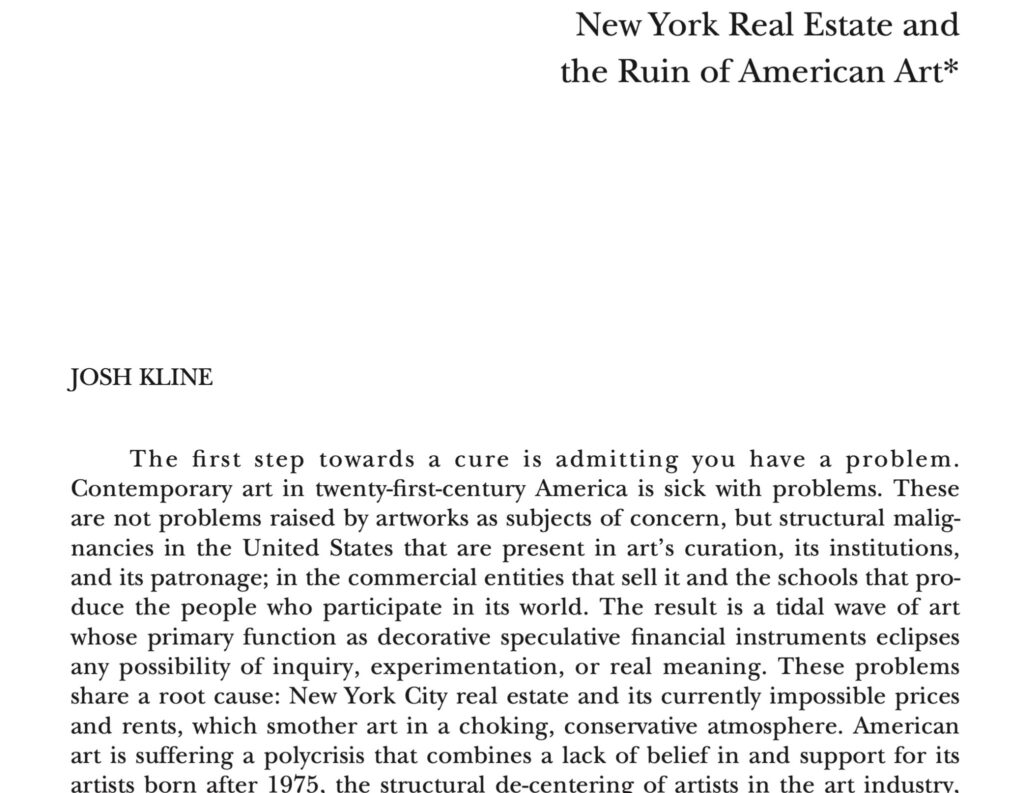
The article by Josh Kline about “New York Real Estate and the Ruin of American Art” is symptomatic of the plight of the New York art scene.
God bless America.
Tokyo, 2026/4/11
Mario A
New York Real Estate and the Ruin of American Art
Josh Kline
October (2026) (195): 91–109.
https://doi.org/10.1162/OCTO.a.539
Abstract
Part of October’s “Art Communities at Risk” series, Josh Kline’s essay examines key structural problems in the American art industry through the lens of class, tracing their origins back to the staggering prices and rents for commercial and residential real estate in New York City today. Kline’s text draws on personal observations and experience accumulated over the last twenty-five years while working as an institutional curator and as an emerging and mid-career artist, as well as on extensive background conversations with peers and colleagues.
Article
The first step towards a cure is admitting you have a problem. Contemporary art in twenty-first-century America is sick with problems. These are not problems raised by artworks as subjects of concern, but structural malignancies in the United States that are present in art’s curation, its institutions, and its patronage; in the commercial entities that sell it and the schools that produce the people who participate in its world. The result is a tidal wave of art whose primary function as decorative speculative financial instruments eclipses any possibility of inquiry, experimentation, or real meaning. These problems share a root cause: New York City real estate and its currently impossible prices and rents, which smother art in a choking, conservative atmosphere. American art is suffering a polycrisis that combines a lack of belief in and support for its artists born after 1975, the structural de-centering of artists in the art industry, and the subsequent stagnation and possible breakdown of formal innovation in art. In other words, meaningful art, relevant for society and our time, may not be sustainable under the current conditions here.
another quote:
Galleries
Rirkrit Tirivanija’s recent survey at MoMA PS1, curated by Ruba Katrib and Yasmil Raymond, presented documentation of one of his early solo shows in 1991 at Randy Alexander Gallery in SoHo. When it opened, the only object in the gallery was a pair of binoculars on the windowsill. The binoculars allowed visitors to occasionally catch a glimpse of a young Tirivanija at work as an art handler at the gallery across the street. Occasionally he’d send voice recordings to the gallery. Can you imagine a single art dealer in Manhattan allowing a young artist to mount a solo exhibition like that today?
Let’s talk about the costs of doing business for NYC galleries: the astronomical cost of rent in Manhattan’s major gallery neighborhoods—Chelsea, the Upper East Side, Tribeca, and the Lower East Side—and the cost of paying the wages and, in some cases, health insurance of employees who must pay residential rents in downtown Manhattan and Brooklyn’s gentrifying neighborhoods. According to Zillow, the median rent for a one-bedroom apartment in New York is currently around $3,500, although in many of the aforementioned neighborhoods the rent is significantly higher. Gallery employees must be able to afford the expensive bars, restaurants, nightlife, recreational drugs, clothes, and personal maintenance required to network and advance careers in the field. All of these costs/co-pays also involve New York real estate. The expensive commercial rent that the restaurants, bars, clothing stores, and salons are paying ultimately factor into the salary requirements of gallery employees as well. These ancillary businesses must also pay their own employees enough for them to afford living in New York. The next time you’re in a gallery in the city, count the employees and do the math.
The 1990s and early 2000s were a golden age of large-scale sculpture, installation, and video projection. Chelsea’s blue-chip and mega galleries—carved out of former garages and warehouses—are relics from this slightly less unaffordable era. Founded by baby boomers when real estate was more accessible, the most powerful American galleries won a generational lottery. America’s art world, like its government, is a gerontocracy captured by boomers. And as in all other areas of American life, the art world’s boomers have worked hard to pull the ladders up behind them, leaving the generations that follow with less. Many of these galleries own their buildings in Manhattan, allowing them to operate from a comparatively safe position. They can also usually count on sales of works by their established, blue-chip artists and secondary-market deals. This gives them the potential ability to take risks that younger galleries cannot. Unfortunately for artists born after 1980, their rosters are already full, their exhibition slots filled by older artists. The largest galleries bide their time and skim off the cream of the crop, harvesting a successful younger artist or two from emerging galleries each year. Those fortunate few are artists whose careers are usually developed at great financial risk by young galleries that are unable to fully capitalize on their success. As their most financially successful artists leave for boomer galleries, Gen X or millennial galleries are left without any possibility of growing or competing with their elders.
Other gallery expenses that contribute to today’s conservative and risk-averse programming include shipping and crating costs, art storage (real estate again), the cost of build-outs and material for building walls, etc., all of which have exploded since March 2020. The cost of shipping artwork is often three or four times the price in 2019. The cost of off-site art storage in and near New York City has also ballooned, making it less attractive for galleries, collectors, and even major museums to support sculpture. The art-storage company UOVO, founded by real-estate developers who are also art collectors, charges $11 per square foot for climate-controlled storage in New York with generator backups that can last two weeks in the event of catastrophe. In 2024, the director of a major New York art museum told me that the museum was no longer collecting sculpture because they’d run out of room in their storage facilities. While the costs of exhibition-specific temporary architecture in galleries are often lower than in museums,7 they are still substantial. Exhibitions of paintings, which are easier to sell and require minimal or no reconfiguration of the gallery’s architecture, are the inevitable result. The number of gallery exhibitions in New York focused on sculpture and video has plummeted since 2020.
For Japanese readers, the following text may be help to get an overview of the problematic situation in New York’s art scene.
ニューヨークの不動産環境と現代アートの衰退という現実
Tomoki Sakuta|Arts & Considerations
2026年4月11日 09:45
ジョシュ・クラインの論考と、その反響から考える
キュレーターの天野太郎さんから面白い論考を紹介していただきました。ジョシュ・クラインの “New York Real Estate and the Ruin of American Art” です。掲載は学術誌 October 195号(Winter 2026)で、https://direct.mit.edu/octo/article/doi/10.1162/OCTO.a.539/135707/New-York-Real-Estate-and-the-Ruin-of-American-Art から読むことができます。この論考は、同誌の連載シリーズ “Art Communities at Risk” の一篇でもあります。
私と同じ1979年生まれのジョシュ・クラインは、テクノロジー、労働、気候危機、政治といった現代社会の条件を、映像、彫刻、写真、デザインを横断しながら扱ってきた作家です。ホイットニー美術館でも3年前、大規模な個展が開かれています。つまりこの論考は、美術界を外から観察する書き手が書いたものではなく、ニューヨークのアートシーンの真ん中にいる中堅作家が、自分の足場そのものについて書いた文章でもあります。
読んでいて印象的だったのは、クラインが問題を単なる「家賃高騰」や「若手の生活苦」として書いていないことでした。彼が論じているのは、不動産価格、生活費、教育費、市場、制度、発表機会、ネットワークが連動しながら、どのようなアーティストが残り、どのような作品形式が生き延び、誰が可視化されるのかを選別してしまっている、という構造です。
full text:
https://note.com/arts_consider/n/nd35bb7dfc6f2
Check also:
Curatorial Fiasco by Francesco Bonami. Prince, Murakami, Stingel, Cattelan, Fischer @ Dead Gago Art Basel ’25
キュレーター フランチェスコ・ボナミの大失敗。 プリンス、村上、スティンゲル、カテラン、フィッシャー @ 死んだ ガゴ・アート・バーゼル ’25
https://art-culture.world/articles/bonami-fiasco-gagosian/
Trump: “Kiss my Ass” means: Boycott American Art! Blum and Pace Galleries: leave Japan!
トランプ:「俺のケツにキスしな!」= アメリカン・アートをボイコット! BlumやPace ギャラリーは日本から出て行け!
https://art-culture.world/articles/boycott-american-art/
Me and Mr. Robinson, God bless you please, coo coo ca-choo, hey, hey, hey
https://art-culture.world/articles/walter-robinson/
とても悪い人、アートアドバイザー リーザ・シッフ氏:「私はフェイク、毎日 詐欺師でした。」
A very bad person, art advisor Lisa Schiff: “I was a fake, a fraud every day.”
https://art-culture.world/articles/art-advisor-lisa-schiff/
「テイラー・スウィフトなんて大嫌い!」米国が未開の国であることは明らかです。
“I HATE TAYLOR SWIFT!” shows clearly, the USA is an uncivilised country.
https://art-culture.world/articles/taylor-swift-テイラー・スウィフト/
Damien Hirst sells Jeff Koons “Balloon Monkey”
ダミアン・ハーストがジェフ・クーンズの 「バルーン・モンキー 」を販売
https://art-culture.world/articles/hirst-koons/
Tokyo Perspective: Chronicle of a Death Foretold regarding a respected American Art Dealer
奈良美智や村上隆を巡って:「FUCK YOU」や「お前、授乳中なんだから、俺のビジネスパートナーにはなれない」
https://art-culture.world/articles/blum/
Will ‘ARTnews’ and ‘Art in America’ disappear as print journals?
https://art-culture.world/articles/artnews-and-art-in-america-disappear-as-print-journals/
スイスの「ハウザー&ワース」が香港に新スペースオープン:「マーク・ブラッドフォード個展」、東京にギャラリー進出も間近?
Hauser & Wirth opens with Mark Bradford in Hong Kong, could be Tokyo next?
https://art-culture.world/articles/hauser-wirth-ハウザー-ワース-香港/
アメリカはいかにして信用を失ったか How the US lost its credibility
https://art-culture.world/articles/how-the-us-lost-its-credibility/
ダメ、ソシオパス男たち、自分のナラティブ、イメージを高める、ボイス vs トランプ
Bad men, sociopaths Beuys and Trump, cultivating their narratives
https://art-culture.world/articles/beuys-trump/
Art world darling, cool Kenny Schachter @ Art Basel
アート界の寵児、クール ケニー・シャクター @ アート・バーゼル
https://art-culture.world/articles/kenny-schachter/
Extremely boring, pretentious, outdated works by “American Artist” Cady Noland @ GAGOSIAN GALLERY Park & 75, New York City, “AMERICA”
キャディ・ノーランド
https://art-culture.world/articles/cady-noland/
#USABS U.S. ARTY BULL SHIT. NFTデジタル・アーティスト ビープル:「美術史の流れを変えたい」や「悪役である」というメリット
#USABS。NFT Digital Artist Beeple: “I want to change the course of art history” and the merit of “being the bad guy”
https://art-culture.world/articles/nft-beeple-digital-artist-ビープル/
New York’s Arty American Bullshit Spreads Around The World: KAWS.
KAWS。ニューヨークのアメリカン美術ウンコを世界へ。
https://art-culture.world/articles/new-york-arty-bullshit-kaws/
五木田智央のニューヨークのアートディーラー、メアリー・ブーンは刑務所に30ヶ月間
GOKITA Tomoo’s New York Art Dealer Mary Boone sentenced to 30 Months in Prison
https://art-culture.world/articles/gokita-tomoos-new-york-art-dealer-mary-boone-sentenced-to-30-months-in-prison/
“Bribed” journalism at Wall Street Journal: Gagosian pushing up Grotjahn for U.S. Art Flippers, 6 days before the exhibition
https://art-culture.world/articles/gagosian-grotjahn-for-u-s-art-flippers/
ジョアン・ミッチェルのアート・ディーラーが突然変更に:「このアート界はとても野蛮になった」/ (+ ポンピドゥー・センター・メッス画像)
In the context of recent changes by Joan Mitchell’s art dealers: : “This art world has become so uncivilized” // (+ pics from the Centre Pompidou-Metz)
https://art-culture.world/articles/joan-mitchells-art-dealers-problem-this-art-world-has-become-so-uncivilized/
Hedge fund titan Israel Englander pays 1 billion US$ to ex-wife and photographer Caryl, who left him for art dealer Dominique Lévy
New York’s High Society + its Art Scene: Prestige, Sex, Collectors and Money…
https://art-culture.world/articles/dominique-levy/
Prominent Collector and Dealer Adam Lindemann Arrested // New York Art World
https://art-culture.world/articles/adam-lindemann-arrested/
美術評論家:次の絶滅危惧種? Art critics: Next endangered species?
https://art-culture.world/articles/art-critic/
The Year 2021. Still Symptomatic For New York’s Art Scene: Taking Drugs.
2021年。麻薬とニューヨークのアートシーン
https://art-culture.world/articles/new-yorks-art-scene/