The Slow Death of the New York Art Scene (3) ニューヨーク・アートシーンの緩慢な死 (3)
The continuation of “The Slow Death of the New York Art Scene” ニューヨーク・アートシーンの緩慢な死 (1)
https://art-culture.world/articles/slow-death-of-the-new-york-art-scene-1/
The Slow Death of the New York Art Scene (2)
ニューヨーク・アートシーンの緩慢な死 (2)
https://art-culture.world/art-world/slow-death-of-the-new-york-art-scene-2/
For about 7 years there has been a growing feeling that it is not important for artists to exhibit in New York.
To put it bluntly: New York is out.
The music plays somewhere else.
With the establishment of international art fairs in Basel, London, Hong Kong, Paris, Seoul and Tokyo, the gravitational pull of contemporary art has shifted away from New York, away from American artists, towards Europe and Asia.
The USA also cannot offer a Venice Biennale, documenta Kassel or Gwangju Biennale. Berlin plays a more important role for artists than New York.
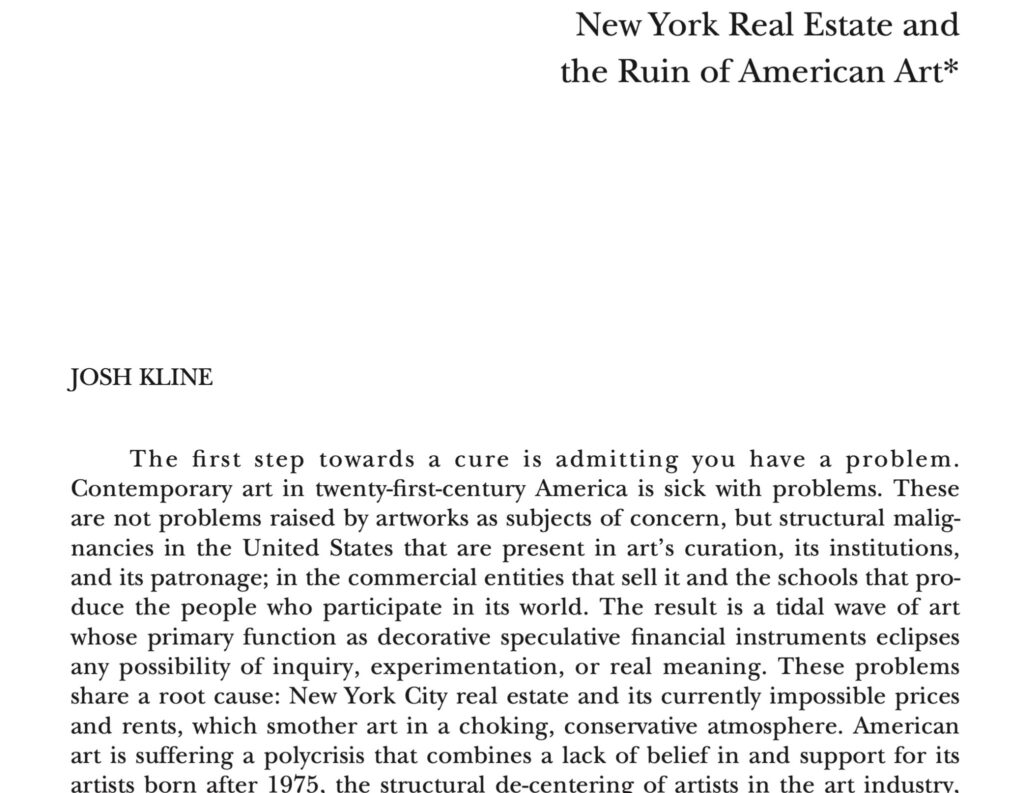
The article by Josh Kline about “New York Real Estate and the Ruin of American Art” is symptomatic of the plight of the New York art scene.
God bless America.
Tokyo, 2026/4/11
Mario A
New York Real Estate and the Ruin of American Art
Josh Kline
October (2026) (195): 91–109.
https://doi.org/10.1162/OCTO.a.539
Abstract
Part of October’s “Art Communities at Risk” series, Josh Kline’s essay examines key structural problems in the American art industry through the lens of class, tracing their origins back to the staggering prices and rents for commercial and residential real estate in New York City today. Kline’s text draws on personal observations and experience accumulated over the last twenty-five years while working as an institutional curator and as an emerging and mid-career artist, as well as on extensive background conversations with peers and colleagues.
Article
The first step towards a cure is admitting you have a problem. Contemporary art in twenty-first-century America is sick with problems. These are not problems raised by artworks as subjects of concern, but structural malignancies in the United States that are present in art’s curation, its institutions, and its patronage; in the commercial entities that sell it and the schools that produce the people who participate in its world. The result is a tidal wave of art whose primary function as decorative speculative financial instruments eclipses any possibility of inquiry, experimentation, or real meaning. These problems share a root cause: New York City real estate and its currently impossible prices and rents, which smother art in a choking, conservative atmosphere. American art is suffering a polycrisis that combines a lack of belief in and support for its artists born after 1975, the structural de-centering of artists in the art industry, and the subsequent stagnation and possible breakdown of formal innovation in art. In other words, meaningful art, relevant for society and our time, may not be sustainable under the current conditions here.
another quote:
Galleries
Rirkrit Tirivanija’s recent survey at MoMA PS1, curated by Ruba Katrib and Yasmil Raymond, presented documentation of one of his early solo shows in 1991 at Randy Alexander Gallery in SoHo. When it opened, the only object in the gallery was a pair of binoculars on the windowsill. The binoculars allowed visitors to occasionally catch a glimpse of a young Tirivanija at work as an art handler at the gallery across the street. Occasionally he’d send voice recordings to the gallery. Can you imagine a single art dealer in Manhattan allowing a young artist to mount a solo exhibition like that today?
Let’s talk about the costs of doing business for NYC galleries: the astronomical cost of rent in Manhattan’s major gallery neighborhoods—Chelsea, the Upper East Side, Tribeca, and the Lower East Side—and the cost of paying the wages and, in some cases, health insurance of employees who must pay residential rents in downtown Manhattan and Brooklyn’s gentrifying neighborhoods. According to Zillow, the median rent for a one-bedroom apartment in New York is currently around $3,500, although in many of the aforementioned neighborhoods the rent is significantly higher. Gallery employees must be able to afford the expensive bars, restaurants, nightlife, recreational drugs, clothes, and personal maintenance required to network and advance careers in the field. All of these costs/co-pays also involve New York real estate. The expensive commercial rent that the restaurants, bars, clothing stores, and salons are paying ultimately factor into the salary requirements of gallery employees as well. These ancillary businesses must also pay their own employees enough for them to afford living in New York. The next time you’re in a gallery in the city, count the employees and do the math.
The 1990s and early 2000s were a golden age of large-scale sculpture, installation, and video projection. Chelsea’s blue-chip and mega galleries—carved out of former garages and warehouses—are relics from this slightly less unaffordable era. Founded by baby boomers when real estate was more accessible, the most powerful American galleries won a generational lottery. America’s art world, like its government, is a gerontocracy captured by boomers. And as in all other areas of American life, the art world’s boomers have worked hard to pull the ladders up behind them, leaving the generations that follow with less. Many of these galleries own their buildings in Manhattan, allowing them to operate from a comparatively safe position. They can also usually count on sales of works by their established, blue-chip artists and secondary-market deals. This gives them the potential ability to take risks that younger galleries cannot. Unfortunately for artists born after 1980, their rosters are already full, their exhibition slots filled by older artists. The largest galleries bide their time and skim off the cream of the crop, harvesting a successful younger artist or two from emerging galleries each year. Those fortunate few are artists whose careers are usually developed at great financial risk by young galleries that are unable to fully capitalize on their success. As their most financially successful artists leave for boomer galleries, Gen X or millennial galleries are left without any possibility of growing or competing with their elders.
Other gallery expenses that contribute to today’s conservative and risk-averse programming include shipping and crating costs, art storage (real estate again), the cost of build-outs and material for building walls, etc., all of which have exploded since March 2020. The cost of shipping artwork is often three or four times the price in 2019. The cost of off-site art storage in and near New York City has also ballooned, making it less attractive for galleries, collectors, and even major museums to support sculpture. The art-storage company UOVO, founded by real-estate developers who are also art collectors, charges $11 per square foot for climate-controlled storage in New York with generator backups that can last two weeks in the event of catastrophe. In 2024, the director of a major New York art museum told me that the museum was no longer collecting sculpture because they’d run out of room in their storage facilities. While the costs of exhibition-specific temporary architecture in galleries are often lower than in museums,7 they are still substantial. Exhibitions of paintings, which are easier to sell and require minimal or no reconfiguration of the gallery’s architecture, are the inevitable result. The number of gallery exhibitions in New York focused on sculpture and video has plummeted since 2020.
For Japanese readers, the following text may be help to get an overview of the problematic situation in New York’s art scene.
ニューヨークの不動産環境と現代アートの衰退という現実
Tomoki Sakuta|Arts & Considerations
2026年4月11日 09:45
ジョシュ・クラインの論考と、その反響から考える
キュレーターの天野太郎さんから面白い論考を紹介していただきました。ジョシュ・クラインの “New York Real Estate and the Ruin of American Art” です。掲載は学術誌 October 195号(Winter 2026)で、https://direct.mit.edu/octo/article/doi/10.1162/OCTO.a.539/135707/New-York-Real-Estate-and-the-Ruin-of-American-Art から読むことができます。この論考は、同誌の連載シリーズ “Art Communities at Risk” の一篇でもあります。
私と同じ1979年生まれのジョシュ・クラインは、テクノロジー、労働、気候危機、政治といった現代社会の条件を、映像、彫刻、写真、デザインを横断しながら扱ってきた作家です。ホイットニー美術館でも3年前、大規模な個展が開かれています。つまりこの論考は、美術界を外から観察する書き手が書いたものではなく、ニューヨークのアートシーンの真ん中にいる中堅作家が、自分の足場そのものについて書いた文章でもあります。
読んでいて印象的だったのは、クラインが問題を単なる「家賃高騰」や「若手の生活苦」として書いていないことでした。彼が論じているのは、不動産価格、生活費、教育費、市場、制度、発表機会、ネットワークが連動しながら、どのようなアーティストが残り、どのような作品形式が生き延び、誰が可視化されるのかを選別してしまっている、という構造です。
full text:
https://note.com/arts_consider/n/nd35bb7dfc6f2
New York Is No Longer a City for Artists
Three years after sculptor Josh Kline finished a mid-career retrospective at the Whitney Museum, he closed the door to his studio. If even a successful artist recognized by the art world cannot survive in New York, what does this city mean for those just starting out?
There is an essay by Kline in the Winter 2026 issue of the art magazine *October* that turned New York upside down. The title of the essay is unequivocal: “New York Real Estate and the Fall of American Art.” He diagnoses that New York’s real estate is structurally destroying American art.
The numbers speak first. Studio rents in Brooklyn have risen 300 percent compared to the early 2000s. But the wages for the jobs artists take to make ends meet (studio assistants, art handlers) remain the same. Sculptors who lost their spaces have started painting. Video artists have picked up canvases too. Because if you don’t make things that sell, you can’t survive. The questions galleries ask themselves have changed too. From “What does this work say?” to “Will this work sell?”
This is not a matter of taste but of structure. All those revolutions—conceptual art, minimalism, performance art—that were born in New York in the 1960s and 70s had one condition: cheap rent. In an era when artists could maintain an apartment and studio by serving two or three days a week, there was no reason to work with the market in mind. Experimentation was free, and failure was not fatal. New York now is the opposite. Real estate prices determine the form of art. Sculpture requires space, space requires money, and money requires sales. Within that cycle, experimentation is steadily losing its place.
Class quietly filters people out too. Those whose families subsidize their rent can endure low-wage gallery internships to become curators. Artists who have apartments provided by their families don’t end up on the street even if their shows don’t sell, so they can continue risky work. Artists without that support end up making the paintings the market wants, caught between student loan notices and next month’s rent. Kline asks: In American art history, artists from poor backgrounds like Jackson Pollock, Andy Warhol, Nan Goldin, and Felix Gonzalez-Torres were able to leave major legacies because the New York of that era allowed them to. Today’s New York does not.
Galleries and museums are not free from this pressure either. Art fair booth rental fees reach hundreds of thousands of dollars, and shipping costs have more than tripled since the pandemic. The result is predictable. Sculpture and video installation exhibitions are shrinking, and programs are being reoriented toward paintings that are easy to transport and sell. One gallerist told Kline that when she asked what sells well at art fairs these days, the response was a single word: “whimsy” (cute and whimsical things).
But Kline does not end his essay in despair. Escape routes have always opened outside the center. The American indie rock, hardcore, and riot grrrl scenes of the 1980s and 90s grew not in New York but in Olympia, Providence, and Chapel Hill. Right now, Philadelphia is full of vacant factories where studio rents are a quarter of New York’s. Artist collectives in Yogyakarta, Indonesia, are building new art ecosystems based on their own communities, without market support or government funding. The experiments of ruangrupa, witnessed by the world at Documenta 15 in 2022, proved that possibility.
If New York has abandoned art, artists can abandon New York too. Kline’s words come close to a declaration. New York no longer deserves to receive the ambitions of young artists. Leave the city that sends bills while selling dreams, and build a new art world yourself in a place that is cheaper, more spacious, and freer. That possibility will be not between the high-rises of Manhattan, but somewhere the rent hasn’t risen yet.
뉴욕은 더 이상 예술가의 도시가 아니다
조각가 조쉬 클라인이 휘트니 미술관에서 중간 경력 회고전을 마치고 3년 뒤, 스튜디오 문을 닫았습니다. 미술계가 인정한 성공한 예술가조차 뉴욕에서 버틸 수 없다면, 이제 막 시작한 예술가에게 이 도시는 무엇을 의미할까요.
클라인이 미술지 『옥토버』 2026년 겨울호에 기고해 온 뉴욕을 ‘발칵’ 뒤집어놓은 글이 있습니다. 에세이의 제목은 단호합니다. “뉴욕 부동산과 미국 예술의 몰락.” 그는 뉴욕의 부동산이 미국 예술을 구조적으로 파괴하고 있다고 진단합니다.
숫자가 먼저 말합니다. 브루클린의 스튜디오 임대료는 2000년대 초 대비 300퍼센트 올랐습니다. 그러나 예술가들이 생계를 위해 맡는 일들(스튜디오 어시스턴트, 아트 핸들러)의 임금은 그대로입니다. 공간을 잃은 조각가들은 그림을 그리기 시작했습니다. 비디오 작가들도 캔버스를 집어 들었습니다. 팔릴 수 있는 것을 만들지 않으면 살아남을 수 없기 때문입니다. 갤러리가 스스로에게 던지는 질문도 달라졌습니다. “이 작품이 무엇을 말하는가”에서 “이 작품이 팔리는가”로.
이것은 취향의 문제가 아니라 구조의 문제입니다. 1960~70년대 뉴욕에서 탄생한 개념미술, 미니멀리즘, 퍼포먼스 아트 등 그 모든 혁명의 조건은 단 하나였습니다. 싼 임대료. 예술가가 주 2~3일 서빙으로 아파트와 스튜디오를 유지할 수 있었던 시대, 시장을 의식하며 작업할 이유가 없었습니다. 실험은 공짜였고, 실패는 치명적이지 않았습니다. 지금 뉴욕은 그 반대입니다. 부동산 가격이 예술의 형식을 결정합니다. 조각은 공간이 필요하고, 공간은 돈이 필요하고, 돈은 판매가 필요합니다. 그 순환 안에서 실험은 점점 설 자리를 잃어갑니다.
계급도 조용히 걸러집니다. 가족이 월세를 보조해주는 사람이 저임금 갤러리 인턴직을 버티며 큐레이터가 됩니다. 집안에서 아파트를 마련해준 예술가는 전시가 팔리지 않아도 거리로 나앉지 않으니, 위험한 작업을 이어갈 수 있습니다. 그렇지 않은 예술가는 학자금 대출 고지서와 다음 달 임대료 사이에서 시장이 원하는 그림을 만들게 됩니다. 클라인은 묻습니다. 미국 미술사에서 잭슨 폴록, 앤디 워홀, 낸 골딘, 펠릭스 곤잘레스-토레스처럼 가난한 배경을 가진 예술가들이 굵직한 족적을 남길 수 있었던 것은, 그 시대의 뉴욕이 그들을 허용했기 때문이라고. 지금의 뉴욕은 허용하지 않습니다.
갤러리도, 미술관도 이 압력에서 자유롭지 않습니다. 아트 페어 부스 대여비는 수십만 달러에 달하고, 팬데믹 이후 운송비는 세 배 이상 뛰었습니다. 결과는 예측 가능합니다. 조각과 영상 설치 전시는 줄어들고, 운반하기 쉽고 팔기 쉬운 회화 중심으로 프로그램이 재편됩니다. 한 갤러리스트는 클라인에게 말했습니다. 요즘 아트 페어에서 잘 팔리는 것이 무엇이냐고 물었더니 돌아온 답은 한 단어였다고. “whimsy”(아기자기하고 유쾌한 것들)
그러나 클라인은 절망으로 글을 끝내지 않습니다. 탈출구는 언제나 중심 바깥에서 열렸습니다. 1980~90년대 미국 인디 록, 하드코어, 라이엇 걸 씬은 뉴욕이 아니라 올림피아, 프로비던스, 채플 힐에서 자랐습니다. 지금 필라델피아에는 작업실 임대료가 뉴욕의 4분의 1 수준인 빈 공장들이 즐비합니다. 인도네시아 요그야카르타의 예술가 콜렉티브들은 시장도, 정부 지원도 없이 서로의 공동체를 기반으로 새로운 예술 생태계를 만들어가고 있습니다. 2022년 도큐멘타 15에서 세계가 목격한 루앙루파의 실험이 그 가능성을 증명했습니다.
뉴욕이 예술을 버렸다면, 예술가도 뉴욕을 버릴 수 있습니다. 클라인의 말은 선언에 가깝습니다. 뉴욕은 더 이상 젊은 예술가의 야망을 받을 자격이 없다고. 꿈을 팔면서 청구서를 보내는 도시를 떠나, 더 싸고 더 넓고 더 자유로운 곳에서 새로운 예술 세계를 직접 만들어야 한다고. 그 가능성은 맨해튼의 고층 빌딩 사이가 아니라, 아직 임대료가 오르지 않은 어딘가에 있을 것입니다.
https://x.com/Poison_Tree/status/2043590037472993321
Check also:
Curatorial Fiasco by Francesco Bonami. Prince, Murakami, Stingel, Cattelan, Fischer @ Dead Gago Art Basel ’25
キュレーター フランチェスコ・ボナミの大失敗。 プリンス、村上、スティンゲル、カテラン、フィッシャー @ 死んだ ガゴ・アート・バーゼル ’25
https://art-culture.world/articles/bonami-fiasco-gagosian/
Trump: “Kiss my Ass” means: Boycott American Art! Blum and Pace Galleries: leave Japan!
トランプ:「俺のケツにキスしな!」= アメリカン・アートをボイコット! BlumやPace ギャラリーは日本から出て行け!
https://art-culture.world/articles/boycott-american-art/
Me and Mr. Robinson, God bless you please, coo coo ca-choo, hey, hey, hey
https://art-culture.world/articles/walter-robinson/
とても悪い人、アートアドバイザー リーザ・シッフ氏:「私はフェイク、毎日 詐欺師でした。」
A very bad person, art advisor Lisa Schiff: “I was a fake, a fraud every day.”
https://art-culture.world/articles/art-advisor-lisa-schiff/
「テイラー・スウィフトなんて大嫌い!」米国が未開の国であることは明らかです。
“I HATE TAYLOR SWIFT!” shows clearly, the USA is an uncivilised country.
https://art-culture.world/articles/taylor-swift-テイラー・スウィフト/
Damien Hirst sells Jeff Koons “Balloon Monkey”
ダミアン・ハーストがジェフ・クーンズの 「バルーン・モンキー 」を販売
https://art-culture.world/articles/hirst-koons/
Tokyo Perspective: Chronicle of a Death Foretold regarding a respected American Art Dealer
奈良美智や村上隆を巡って:「FUCK YOU」や「お前、授乳中なんだから、俺のビジネスパートナーにはなれない」
https://art-culture.world/articles/blum/
Will ‘ARTnews’ and ‘Art in America’ disappear as print journals?
https://art-culture.world/articles/artnews-and-art-in-america-disappear-as-print-journals/
スイスの「ハウザー&ワース」が香港に新スペースオープン:「マーク・ブラッドフォード個展」、東京にギャラリー進出も間近?
Hauser & Wirth opens with Mark Bradford in Hong Kong, could be Tokyo next?
https://art-culture.world/articles/hauser-wirth-ハウザー-ワース-香港/
アメリカはいかにして信用を失ったか How the US lost its credibility
https://art-culture.world/articles/how-the-us-lost-its-credibility/
ダメ、ソシオパス男たち、自分のナラティブ、イメージを高める、ボイス vs トランプ
Bad men, sociopaths Beuys and Trump, cultivating their narratives
https://art-culture.world/articles/beuys-trump/
Art world darling, cool Kenny Schachter @ Art Basel
アート界の寵児、クール ケニー・シャクター @ アート・バーゼル
https://art-culture.world/articles/kenny-schachter/
Extremely boring, pretentious, outdated works by “American Artist” Cady Noland @ GAGOSIAN GALLERY Park & 75, New York City, “AMERICA”
キャディ・ノーランド
https://art-culture.world/articles/cady-noland/
#USABS U.S. ARTY BULL SHIT. NFTデジタル・アーティスト ビープル:「美術史の流れを変えたい」や「悪役である」というメリット
#USABS。NFT Digital Artist Beeple: “I want to change the course of art history” and the merit of “being the bad guy”
https://art-culture.world/articles/nft-beeple-digital-artist-ビープル/
New York’s Arty American Bullshit Spreads Around The World: KAWS.
KAWS。ニューヨークのアメリカン美術ウンコを世界へ。
https://art-culture.world/articles/new-york-arty-bullshit-kaws/
五木田智央のニューヨークのアートディーラー、メアリー・ブーンは刑務所に30ヶ月間
GOKITA Tomoo’s New York Art Dealer Mary Boone sentenced to 30 Months in Prison
https://art-culture.world/articles/gokita-tomoos-new-york-art-dealer-mary-boone-sentenced-to-30-months-in-prison/
“Bribed” journalism at Wall Street Journal: Gagosian pushing up Grotjahn for U.S. Art Flippers, 6 days before the exhibition
https://art-culture.world/articles/gagosian-grotjahn-for-u-s-art-flippers/
ジョアン・ミッチェルのアート・ディーラーが突然変更に:「このアート界はとても野蛮になった」/ (+ ポンピドゥー・センター・メッス画像)
In the context of recent changes by Joan Mitchell’s art dealers: : “This art world has become so uncivilized” // (+ pics from the Centre Pompidou-Metz)
https://art-culture.world/articles/joan-mitchells-art-dealers-problem-this-art-world-has-become-so-uncivilized/
Hedge fund titan Israel Englander pays 1 billion US$ to ex-wife and photographer Caryl, who left him for art dealer Dominique Lévy
New York’s High Society + its Art Scene: Prestige, Sex, Collectors and Money…
https://art-culture.world/articles/dominique-levy/
Prominent Collector and Dealer Adam Lindemann Arrested // New York Art World
https://art-culture.world/articles/adam-lindemann-arrested/
美術評論家:次の絶滅危惧種? Art critics: Next endangered species?
https://art-culture.world/articles/art-critic/
The Year 2021. Still Symptomatic For New York’s Art Scene: Taking Drugs.
2021年。麻薬とニューヨークのアートシーン
https://art-culture.world/articles/new-yorks-art-scene/