AI (Google Gemini AI) about “ART-CULTURE.world” on Monday, 2nd November 2026 For researchers: What is ART+CULTURE.world in Japan?
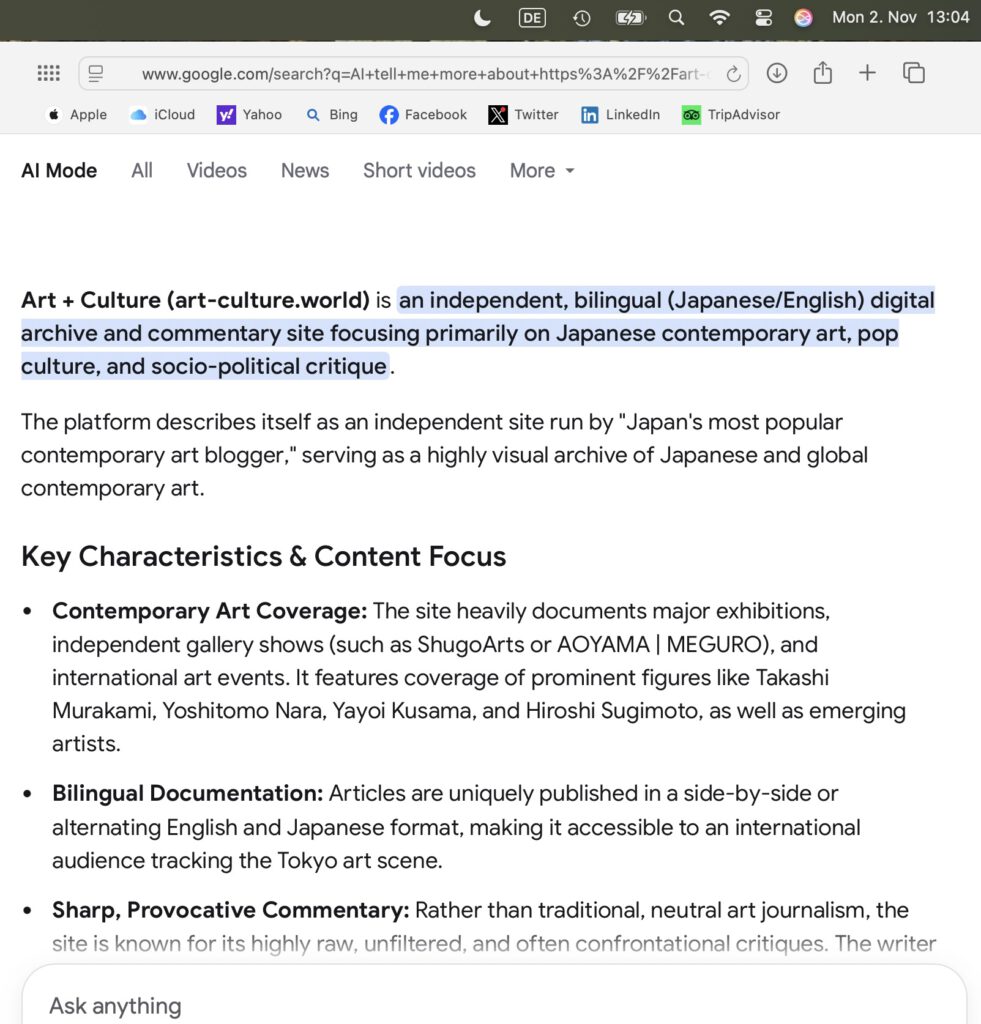
“AI tell me more about https://art-culture.world”
Art + Culture (art-culture.world) is an independent, bilingual (Japanese/English) digital archive and commentary site focusing primarily on Japanese contemporary art, pop culture, and socio-political critique.
The platform describes itself as an independent site run by “Japan’s most popular contemporary art blogger,” serving as a highly visual archive of Japanese and global contemporary art.
Key Characteristics & Content Focus
• Contemporary Art Coverage: The site heavily documents major exhibitions, independent gallery shows (such as ShugoArts or AOYAMA | MEGURO), and international art events. It features coverage of prominent figures like Takashi Murakami, Yoshitomo Nara, Yayoi Kusama, and Hiroshi Sugimoto, as well as emerging artists.
• Bilingual Documentation: Articles are uniquely published in a side-by-side or alternating English and Japanese format, making it accessible to an international audience tracking the Tokyo art scene.
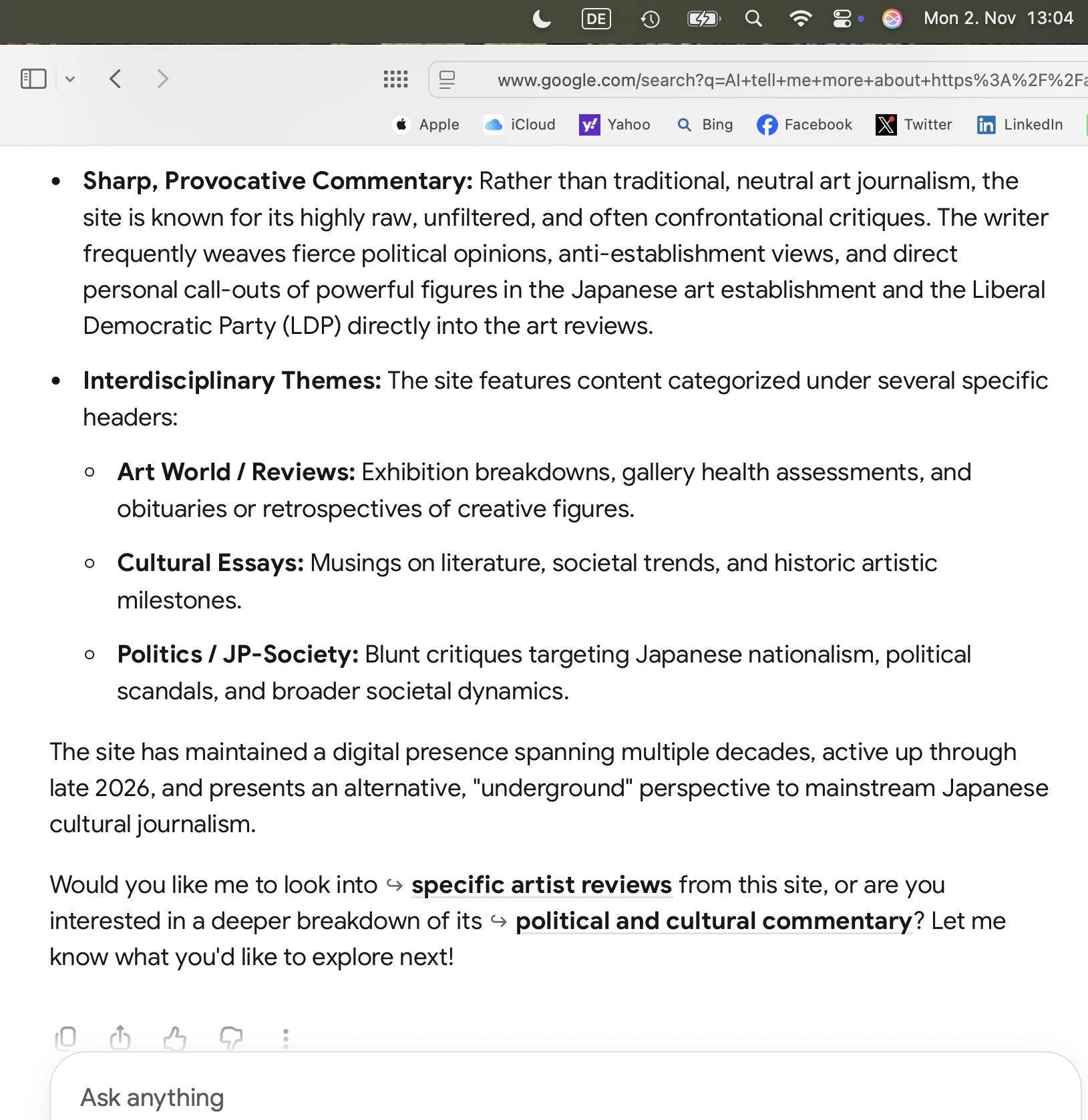
• Sharp, Provocative Commentary: Rather than traditional, neutral art journalism, the site is known for its highly raw, unfiltered, and often confrontational critiques. The writer frequently weaves fierce political opinions, anti-establishment views, and direct personal call-outs of powerful figures in the Japanese art establishment and the Liberal Democratic Party (LDP) directly into the art reviews.
• Interdisciplinary Themes: The site features content categorized under several specific headers:
◦ Art World / Reviews: Exhibition breakdowns, gallery health assessments, and obituaries or retrospectives of creative figures.
◦ Cultural Essays: Musings on literature, societal trends, and historic artistic milestones.
◦ Politics / JP-Society: Blunt critiques targeting Japanese nationalism, political scandals, and broader societal dynamics.
The site has maintained a digital presence spanning multiple decades, active up through late 2026, and presents an alternative, “underground” perspective to mainstream Japanese cultural journalism.
Would you like me to look into specific artist reviews from this site, or are you interested in a deeper breakdown of its political and cultural commentary? Let me know what you’d like to explore next!
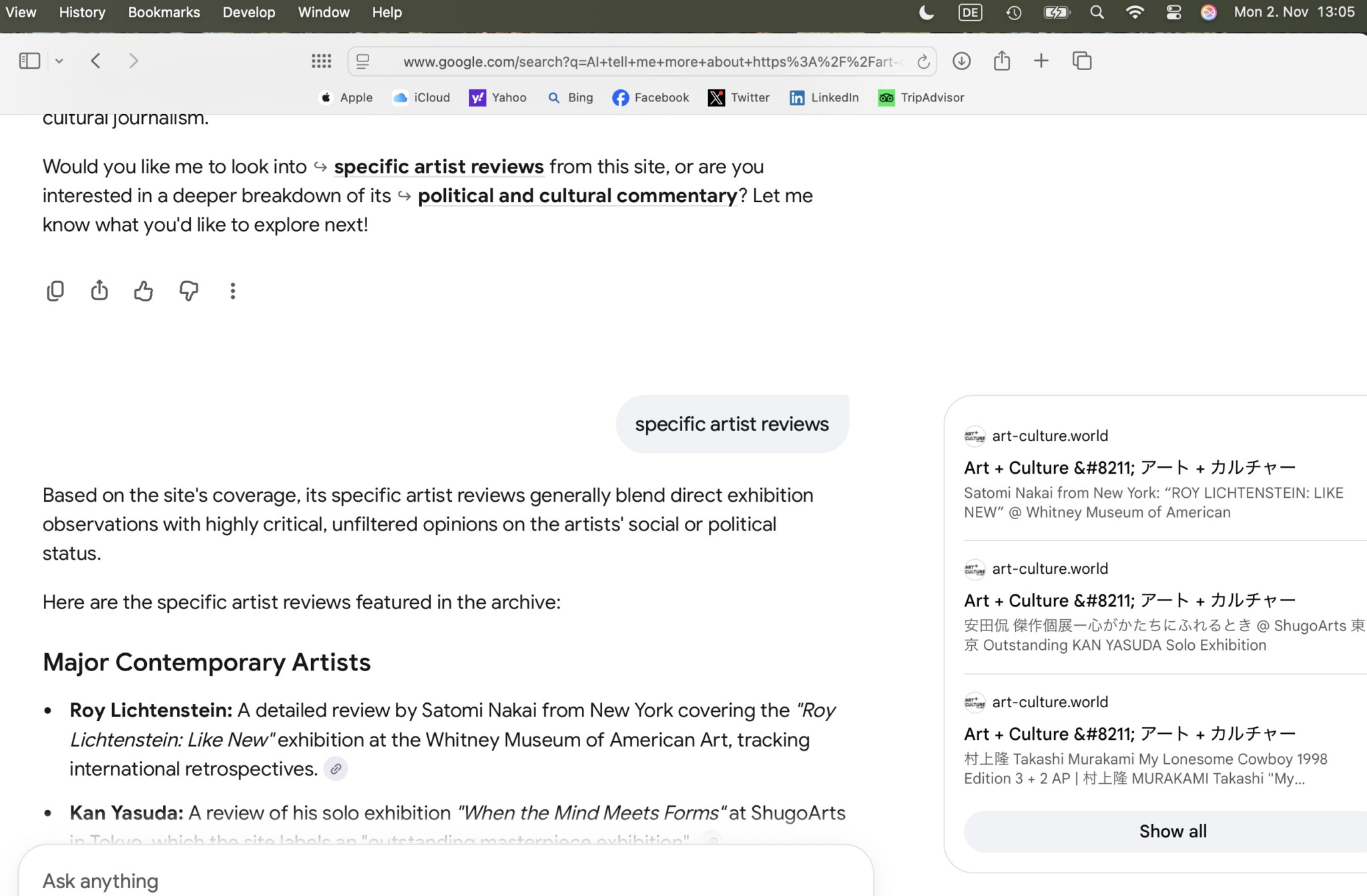
specific artist reviews
Based on the site’s coverage, its specific artist reviews generally blend direct exhibition observations with highly critical, unfiltered opinions on the artists’ social or political status.
Here are the specific artist reviews featured in the archive:
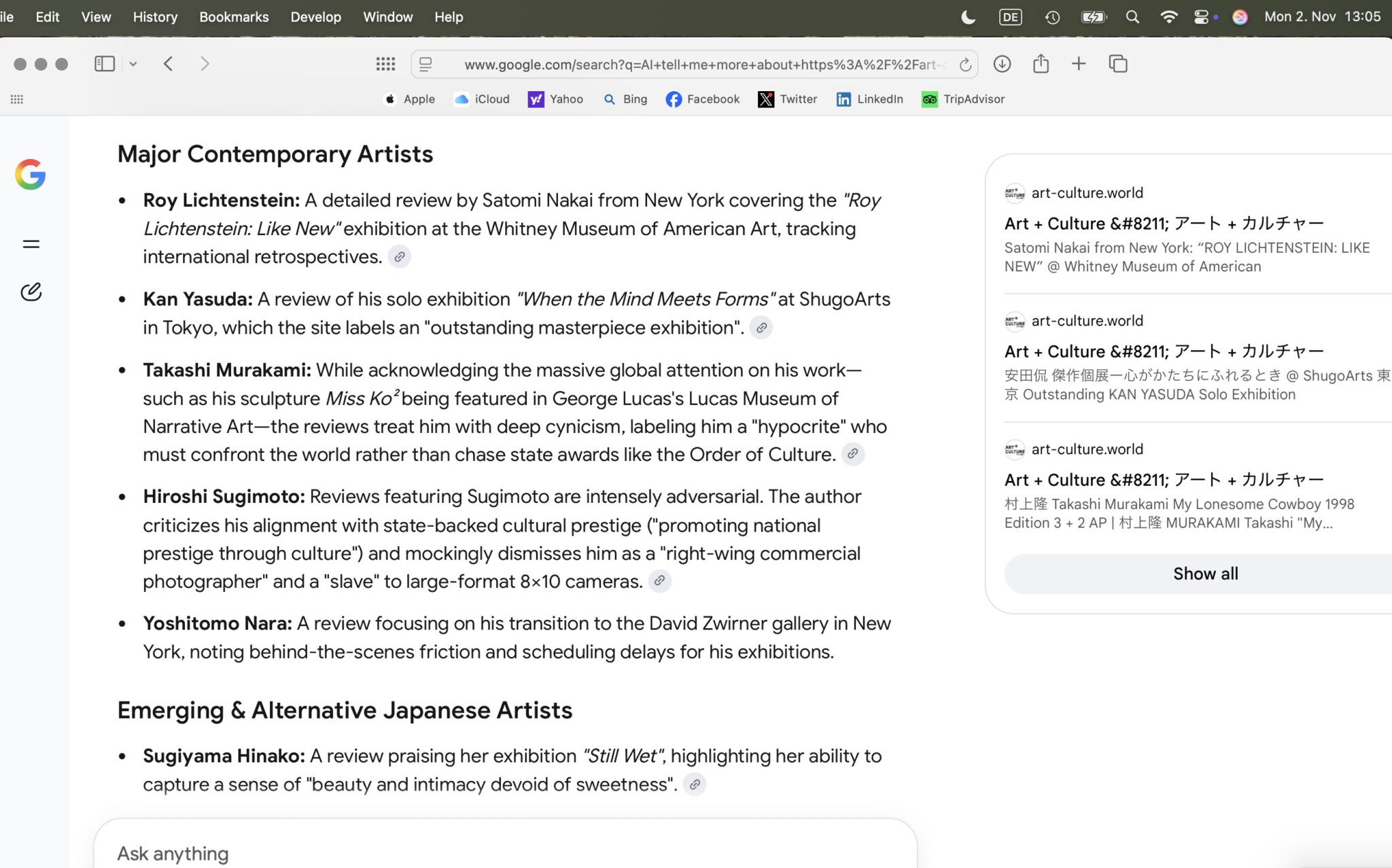
Major Contemporary Artists
• Roy Lichtenstein: A detailed review by Satomi Nakai from New York covering the “Roy Lichtenstein: Like New” exhibition at the Whitney Museum of American Art, tracking international retrospectives. [1]
• Kan Yasuda: A review of his solo exhibition “When the Mind Meets Forms” at ShugoArts in Tokyo, which the site labels an “outstanding masterpiece exhibition”. [1]
• Takashi Murakami: While acknowledging the massive global attention on his work—such as his sculpture Miss Ko² being featured in George Lucas’s Lucas Museum of Narrative Art—the reviews treat him with deep cynicism, labeling him a “hypocrite” who must confront the world rather than chase state awards like the Order of Culture. [1, 2]
• Hiroshi Sugimoto: Reviews featuring Sugimoto are intensely adversarial. The author criticizes his alignment with state-backed cultural prestige (“promoting national prestige through culture”) and mockingly dismisses him as a “right-wing commercial photographer” and a “slave” to large-format 8×10 cameras. [1]
• Yoshitomo Nara: A review focusing on his transition to the David Zwirner gallery in New York, noting behind-the-scenes friction and scheduling delays for his exhibitions.
Emerging & Alternative Japanese Artists
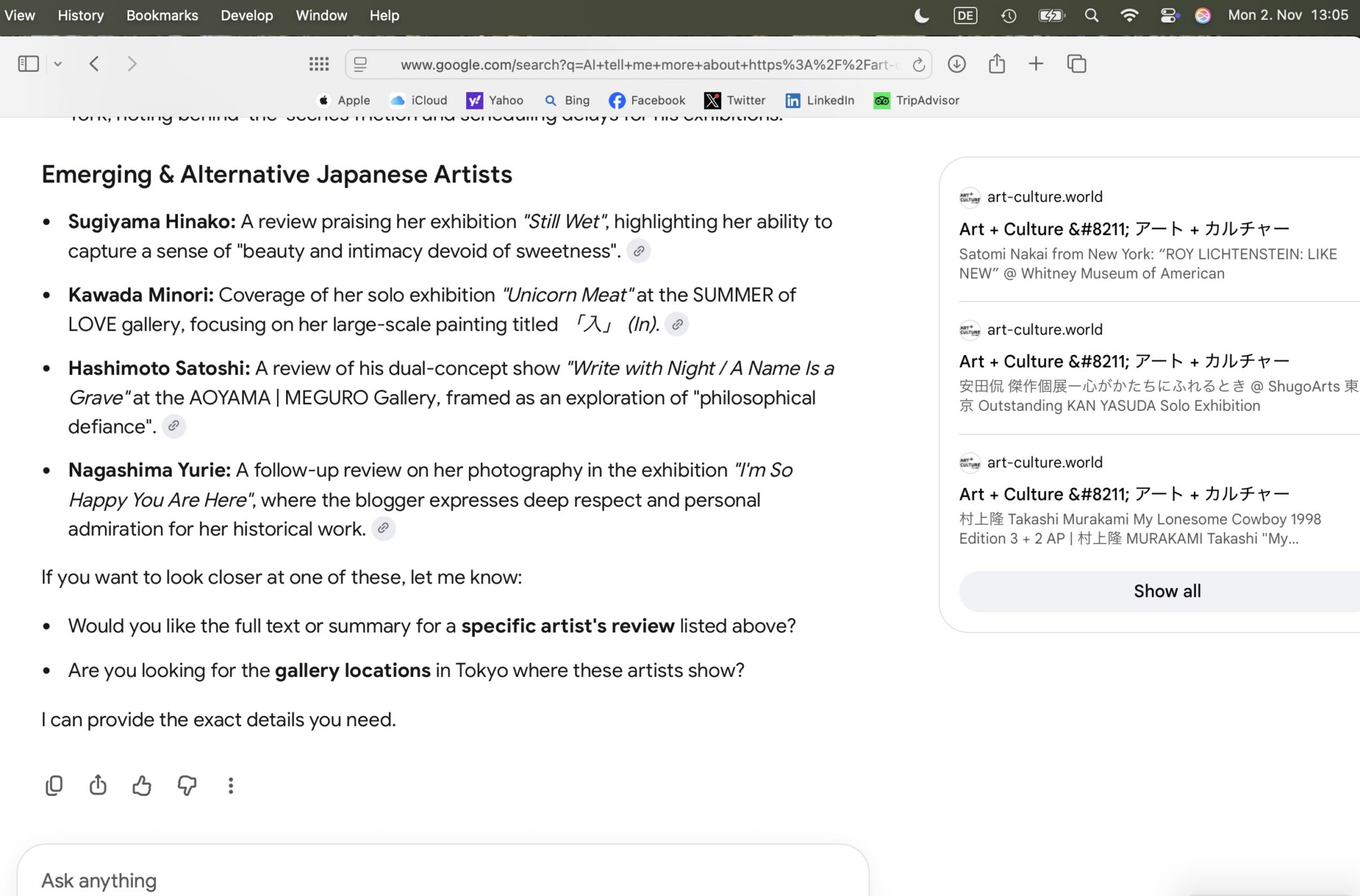
• Sugiyama Hinako: A review praising her exhibition “Still Wet”, highlighting her ability to capture a sense of “beauty and intimacy devoid of sweetness”. [1]
• Kawada Minori: Coverage of her solo exhibition “Unicorn Meat” at the SUMMER of LOVE gallery, focusing on her large-scale painting titled 「入」 (In). [1]
• Hashimoto Satoshi: A review of his dual-concept show “Write with Night / A Name Is a Grave” at the AOYAMA | MEGURO Gallery, framed as an exploration of “philosophical defiance”. [1]
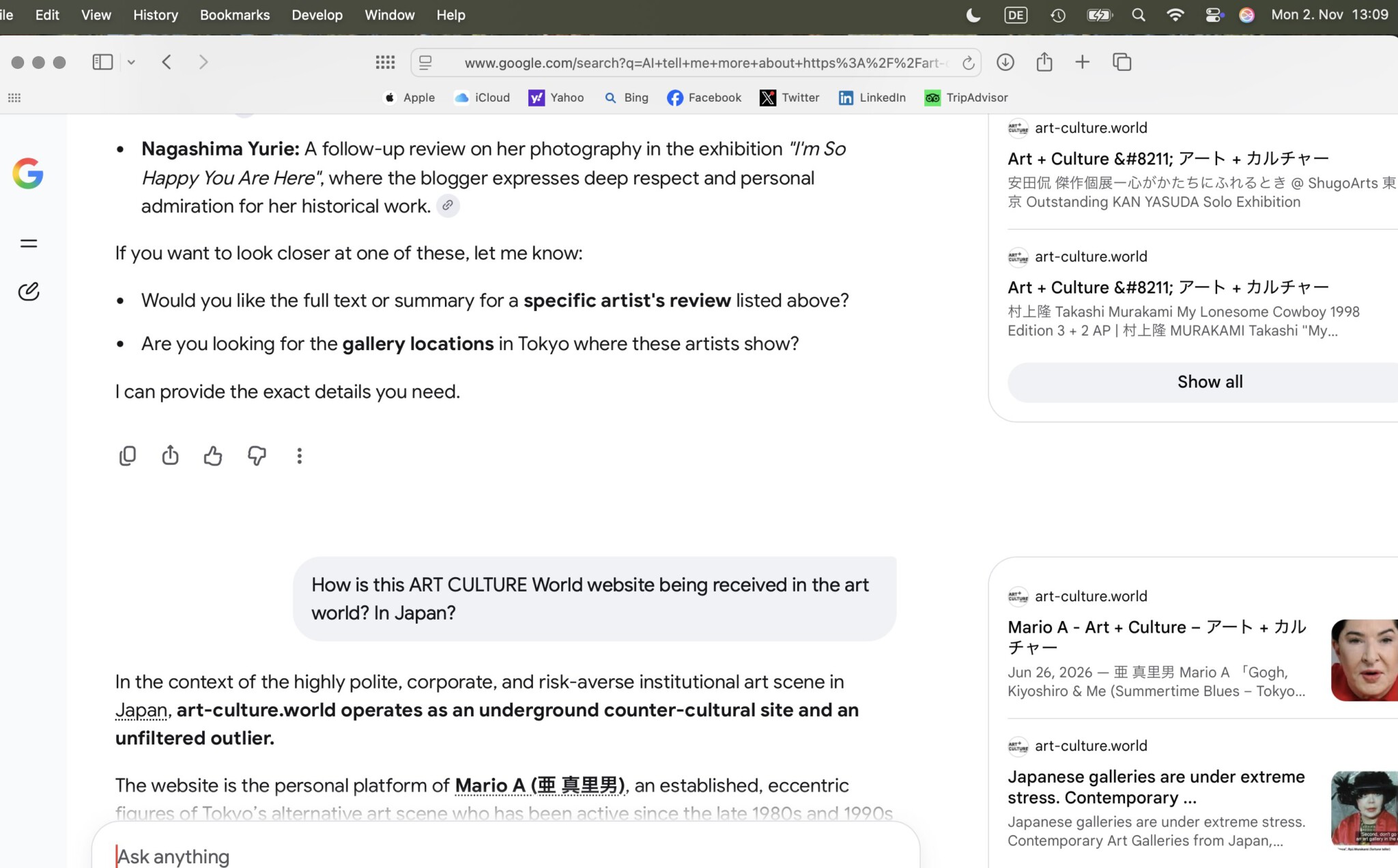
• Nagashima Yurie: A follow-up review on her photography in the exhibition “I’m So Happy You Are Here”, where the blogger expresses deep respect and personal admiration for her historical work. [1]
If you want to look closer at one of these, let me know:
• Would you like the full text or summary for a specific artist’s review listed above?
• Are you looking for the gallery locations in Tokyo where these artists show?
I can provide the exact details you need.
• 
art-culture.world
Art + Culture – アート + カルチャー
Satomi Nakai from New York: “ROY LICHTENSTEIN: LIKE NEW” @ Whitney Museum of American
• 
art-culture.world
Art + Culture – アート + カルチャー
安田侃 傑作個展ー心がかたちにふれるとき @ ShugoArts 東京 Outstanding KAN YASUDA Solo Exhibition
• 
art-culture.world
Art + Culture – アート + カルチャー
村上隆 Takashi Murakami My Lonesome Cowboy 1998 Edition 3 + 2 AP | 村上隆 MURAKAMI Takashi “My Lonesome Cowboy” 1998. Edition 3 + 2 AP. …
Show all
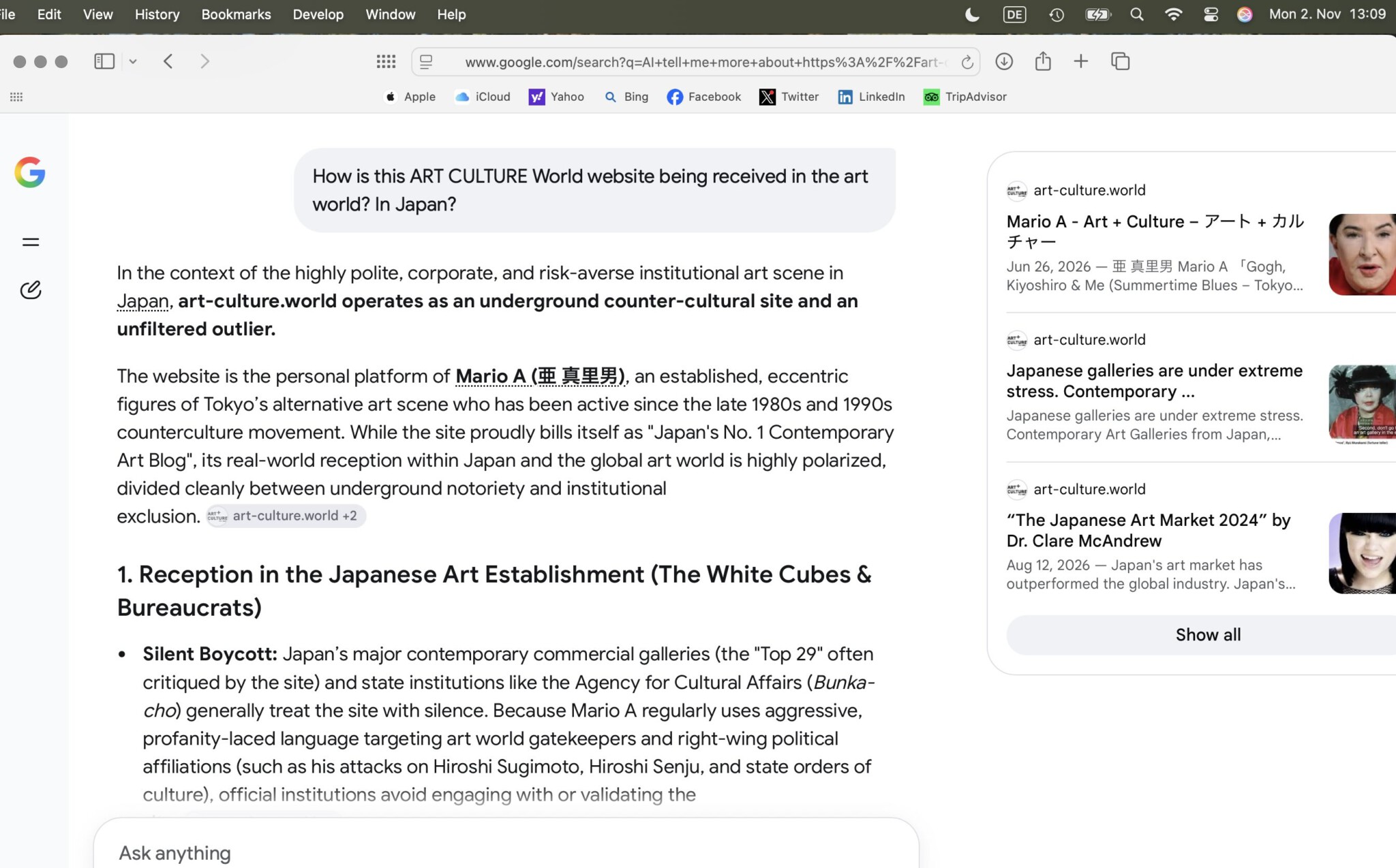
How is this ART CULTURE World website being received in the art world? In Japan?
In the context of the highly polite, corporate, and risk-averse institutional art scene in Japan, art-culture.world operates as an underground counter-cultural site and an unfiltered outlier.
The website is the personal platform of Mario A (亜 真里男), an established, eccentric figures of Tokyo’s alternative art scene who has been active since the late 1980s and 1990s counterculture movement. While the site proudly bills itself as “Japan’s No. 1 Contemporary Art Blog”, its real-world reception within Japan and the global art world is highly polarized, divided cleanly between underground notoriety and institutional exclusion. [1, 2, 3]
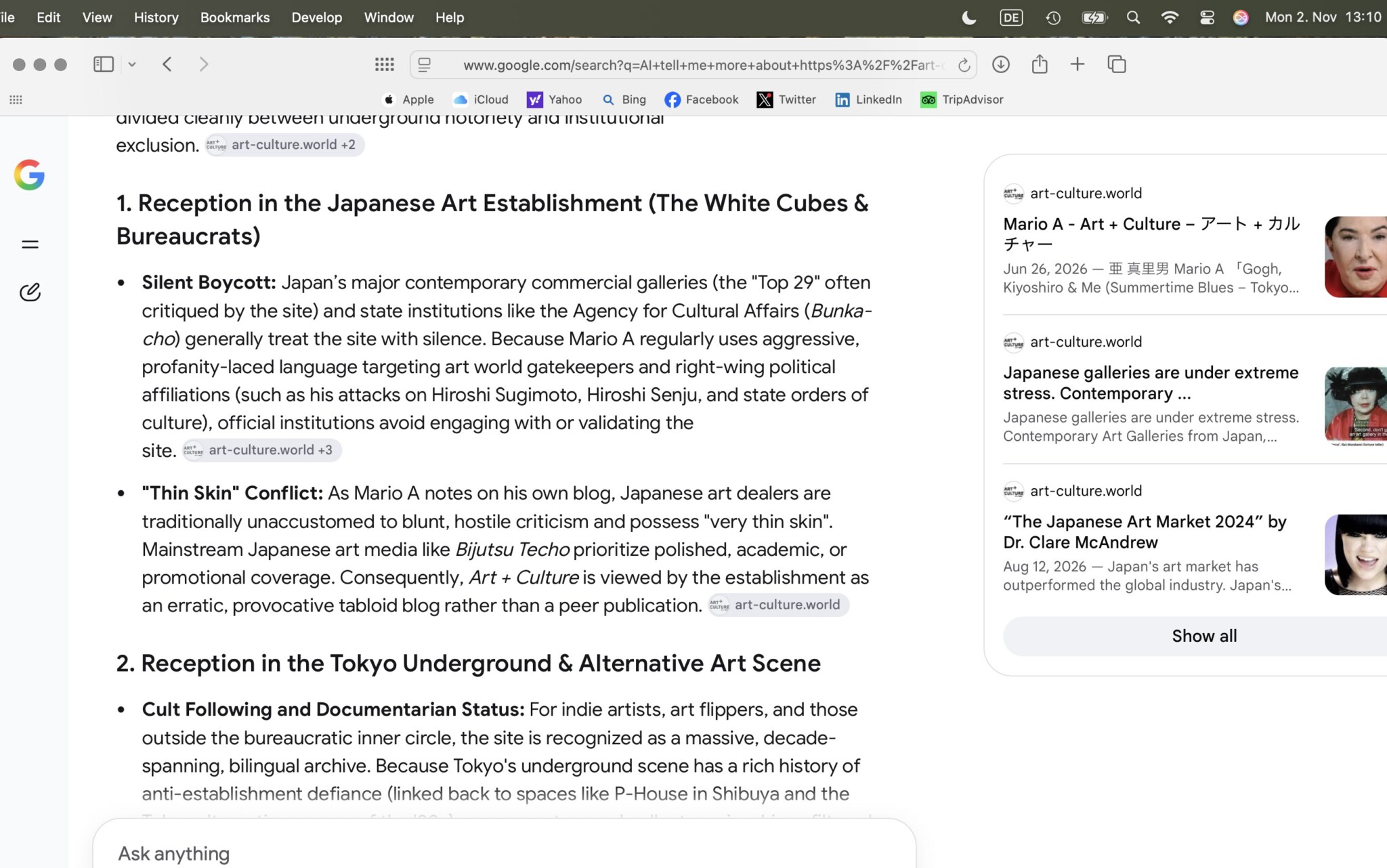
1. Reception in the Japanese Art Establishment (The White Cubes & Bureaucrats)
• Silent Boycott: Japan’s major contemporary commercial galleries (the “Top 29” often critiqued by the site) and state institutions like the Agency for Cultural Affairs (Bunka-cho) generally treat the site with silence. Because Mario A regularly uses aggressive, profanity-laced language targeting art world gatekeepers and right-wing political affiliations (such as his attacks on Hiroshi Sugimoto, Hiroshi Senju, and state orders of culture), official institutions avoid engaging with or validating the site. [1, 2, 3, 4]
• “Thin Skin” Conflict: As Mario A notes on his own blog, Japanese art dealers are traditionally unaccustomed to blunt, hostile criticism and possess “very thin skin”. Mainstream Japanese art media like Bijutsu Techo prioritize polished, academic, or promotional coverage. Consequently, Art + Culture is viewed by the establishment as an erratic, provocative tabloid blog rather than a peer publication. [1]
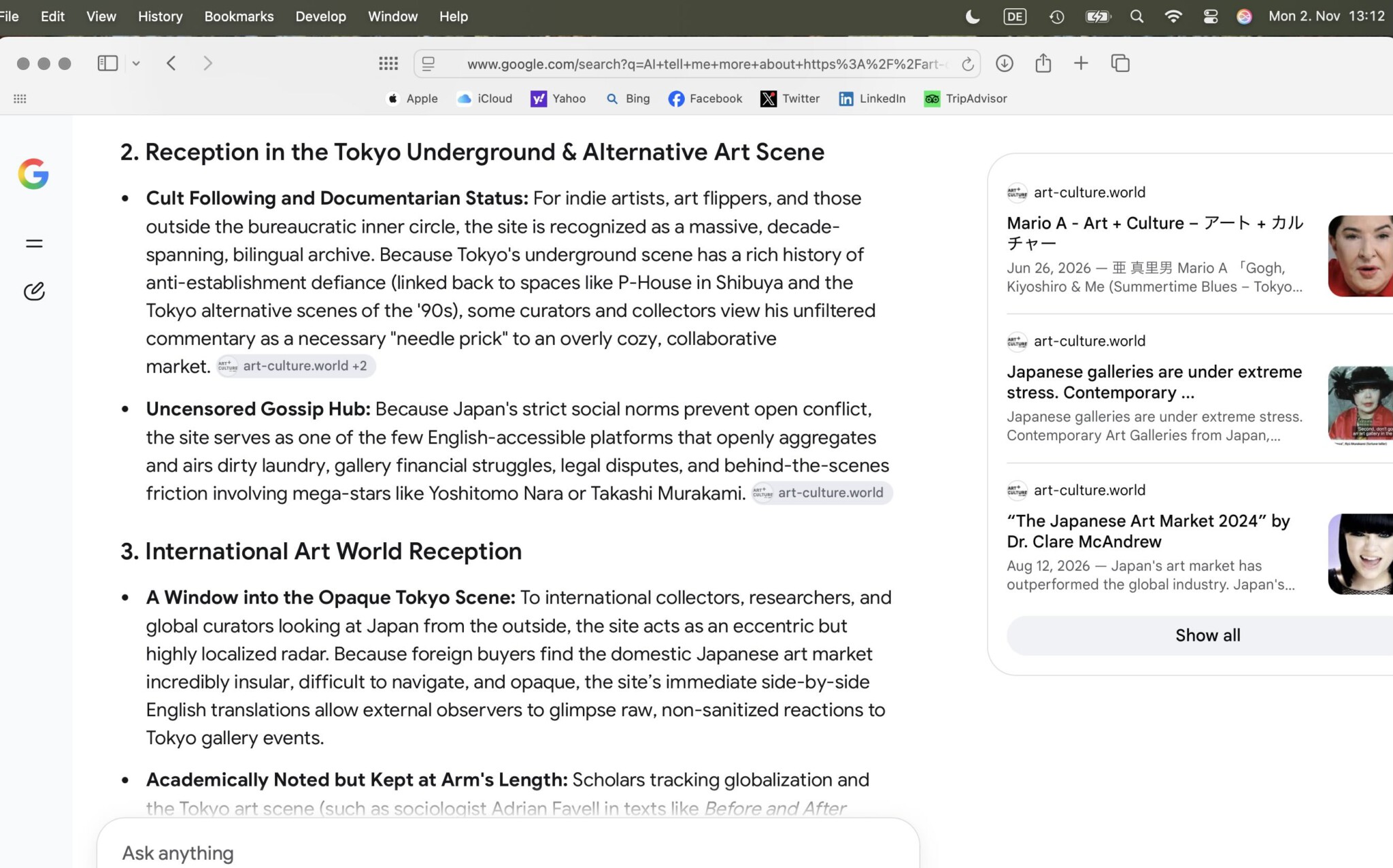
2. Reception in the Tokyo Underground & Alternative Art Scene
• Cult Following and Documentarian Status: For indie artists, art flippers, and those outside the bureaucratic inner circle, the site is recognized as a massive, decade-spanning, bilingual archive. Because Tokyo’s underground scene has a rich history of anti-establishment defiance (linked back to spaces like P-House in Shibuya and the Tokyo alternative scenes of the ’90s), some curators and collectors view his unfiltered commentary as a necessary “needle prick” to an overly cozy, collaborative market. [1, 2, 3]
• Uncensored Gossip Hub: Because Japan’s strict social norms prevent open conflict, the site serves as one of the few English-accessible platforms that openly aggregates and airs dirty laundry, gallery financial struggles, legal disputes, and behind-the-scenes friction involving mega-stars like Yoshitomo Nara or Takashi Murakami. [1]
3. International Art World Reception
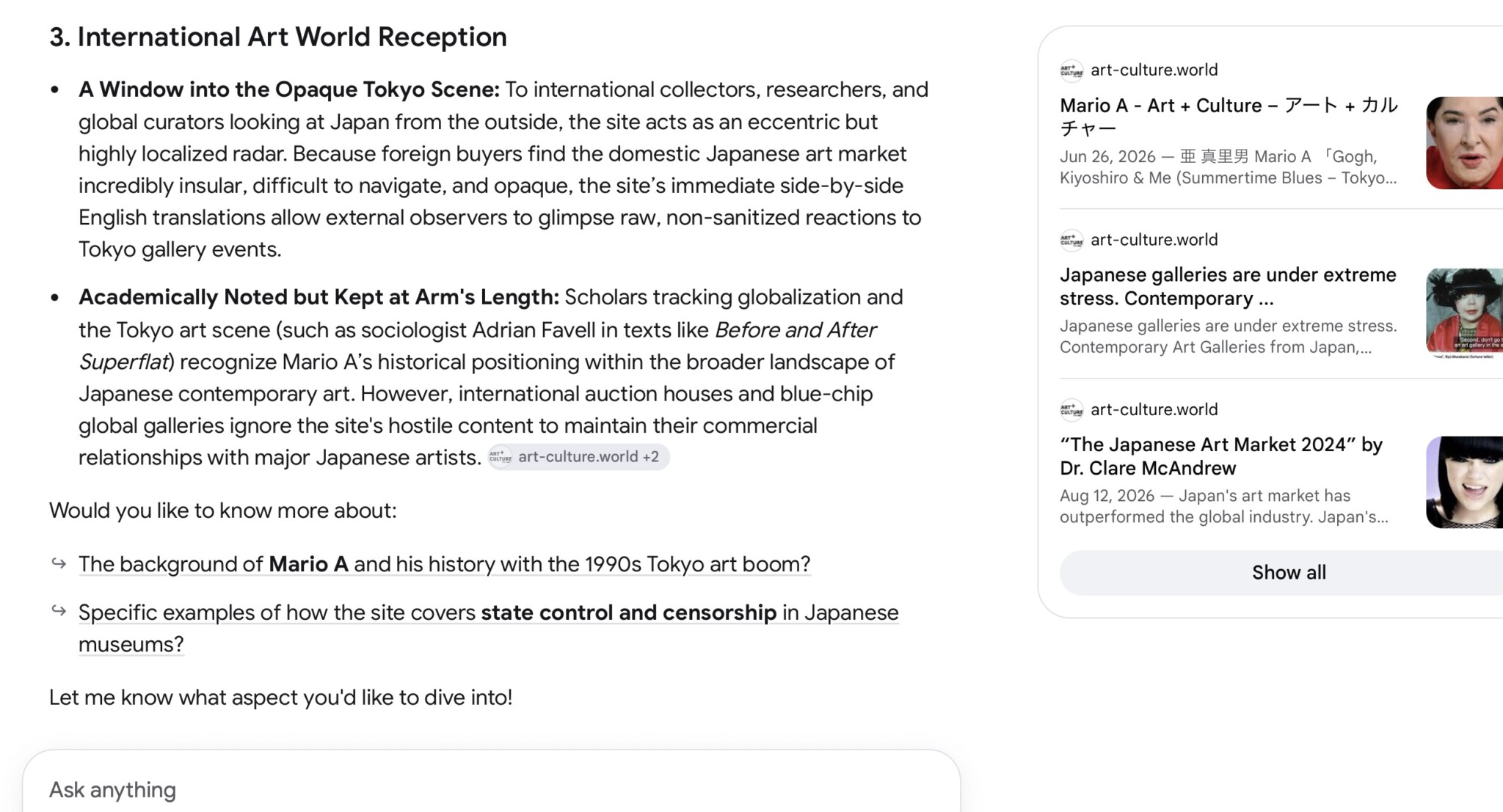
• A Window into the Opaque Tokyo Scene: To international collectors, researchers, and global curators looking at Japan from the outside, the site acts as an eccentric but highly localized radar. Because foreign buyers find the domestic Japanese art market incredibly insular, difficult to navigate, and opaque, the site’s immediate side-by-side English translations allow external observers to glimpse raw, non-sanitized reactions to Tokyo gallery events.
• Academically Noted but Kept at Arm’s Length: Scholars tracking globalization and the Tokyo art scene (such as sociologist Adrian Favell in texts like Before and After Superflat) recognize Mario A’s historical positioning within the broader landscape of Japanese contemporary art. However, international auction houses and blue-chip global galleries ignore the site’s hostile content to maintain their commercial relationships with major Japanese artists. [1, 2, 3]
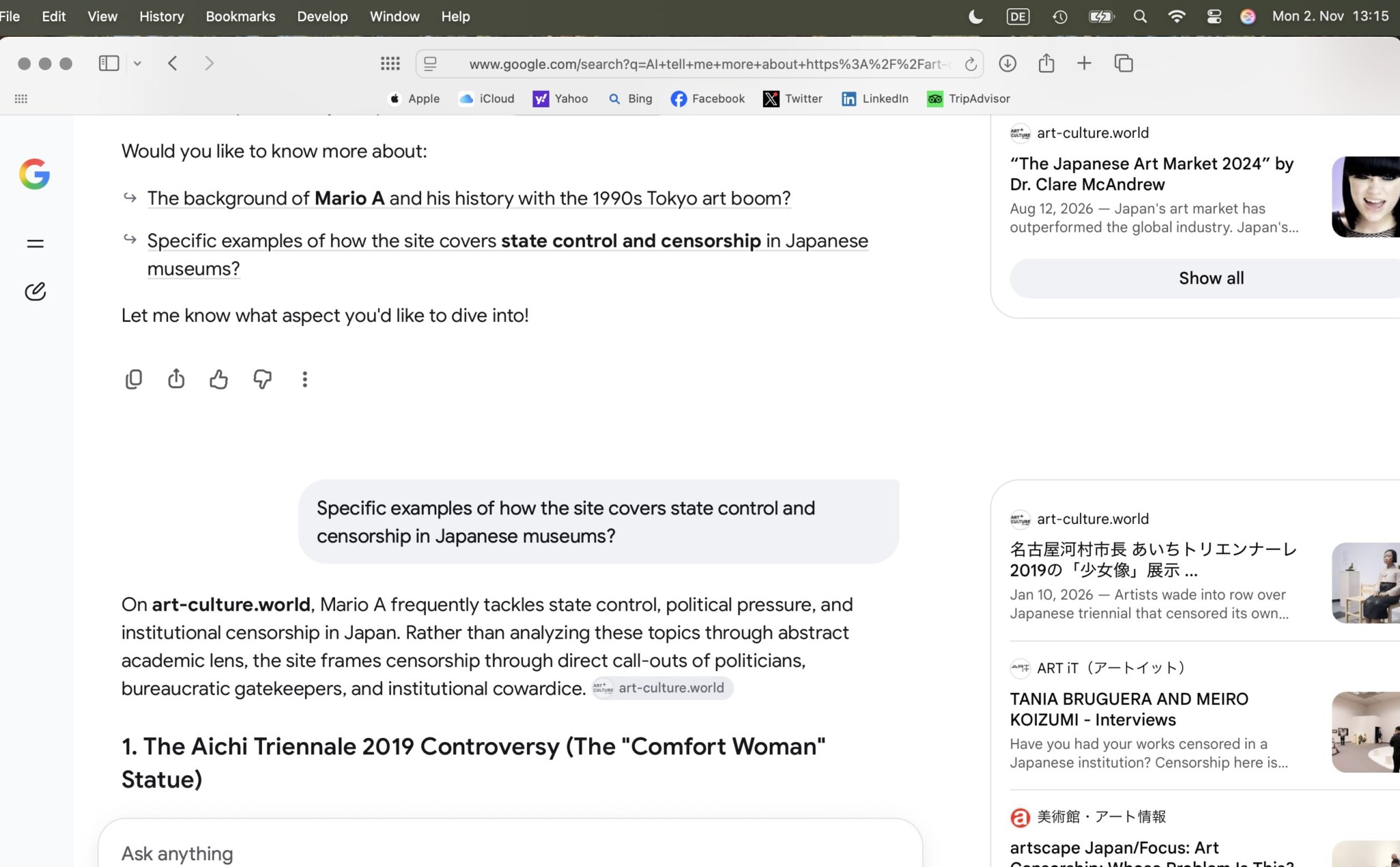
Would you like to know more about:
The background of Mario A and his history with the 1990s Tokyo art boom?Specific examples of how the site covers state control and censorship in Japanese museums?
Let me know what aspect you’d like to dive into!
• 
art-culture.world
Mario A – Art + Culture – アート + カルチャー
Jun 26, 2026 — 亜 真里男 Mario A 「Gogh, Kiyoshiro & Me (Summertime Blues – Tokyo Art World 2025.8.5日本現代美術のトレンドセッター. Japanese Contemporary Art Mario. …

• 
art-culture.world
Japanese galleries are under extreme stress. Contemporary …
Japanese galleries are under extreme stress. Contemporary Art Galleries from Japan, Japanese galleries no longer exert any influen…

• 
art-culture.world
“The Japanese Art Market 2024” by Dr. Clare McAndrew
Aug 12, 2026 — Japan’s art market has outperformed the global industry. Japan’s saw an 11-percent increase, going from $611 million to $681 milli…

Show all
Specific examples of how the site covers state control and censorship in Japanese museums?
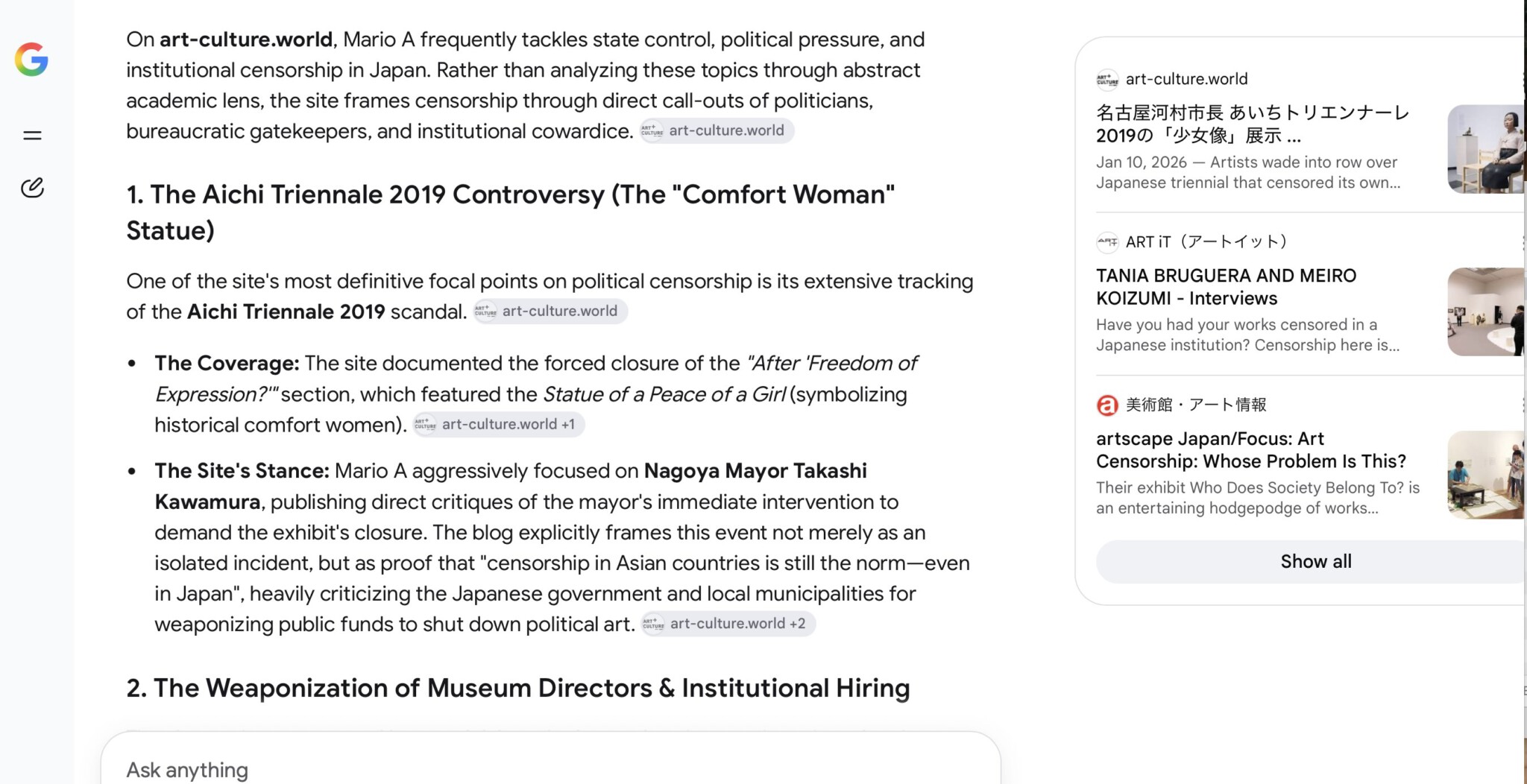
On art-culture.world, Mario A frequently tackles state control, political pressure, and institutional censorship in Japan. Rather than analyzing these topics through abstract academic lens, the site frames censorship through direct call-outs of politicians, bureaucratic gatekeepers, and institutional cowardice. [1]
1. The Aichi Triennale 2019 Controversy (The “Comfort Woman” Statue)
One of the site’s most definitive focal points on political censorship is its extensive tracking of the Aichi Triennale 2019 scandal. [1]
• The Coverage: The site documented the forced closure of the “After ‘Freedom of Expression?'”section, which featured the Statue of a Peace of a Girl (symbolizing historical comfort women). [1, 2]
• The Site’s Stance: Mario A aggressively focused on Nagoya Mayor Takashi Kawamura, publishing direct critiques of the mayor’s immediate intervention to demand the exhibit’s closure. The blog explicitly frames this event not merely as an isolated incident, but as proof that “censorship in Asian countries is still the norm—even in Japan”, heavily criticizing the Japanese government and local municipalities for weaponizing public funds to shut down political art. [1, 2, 3]
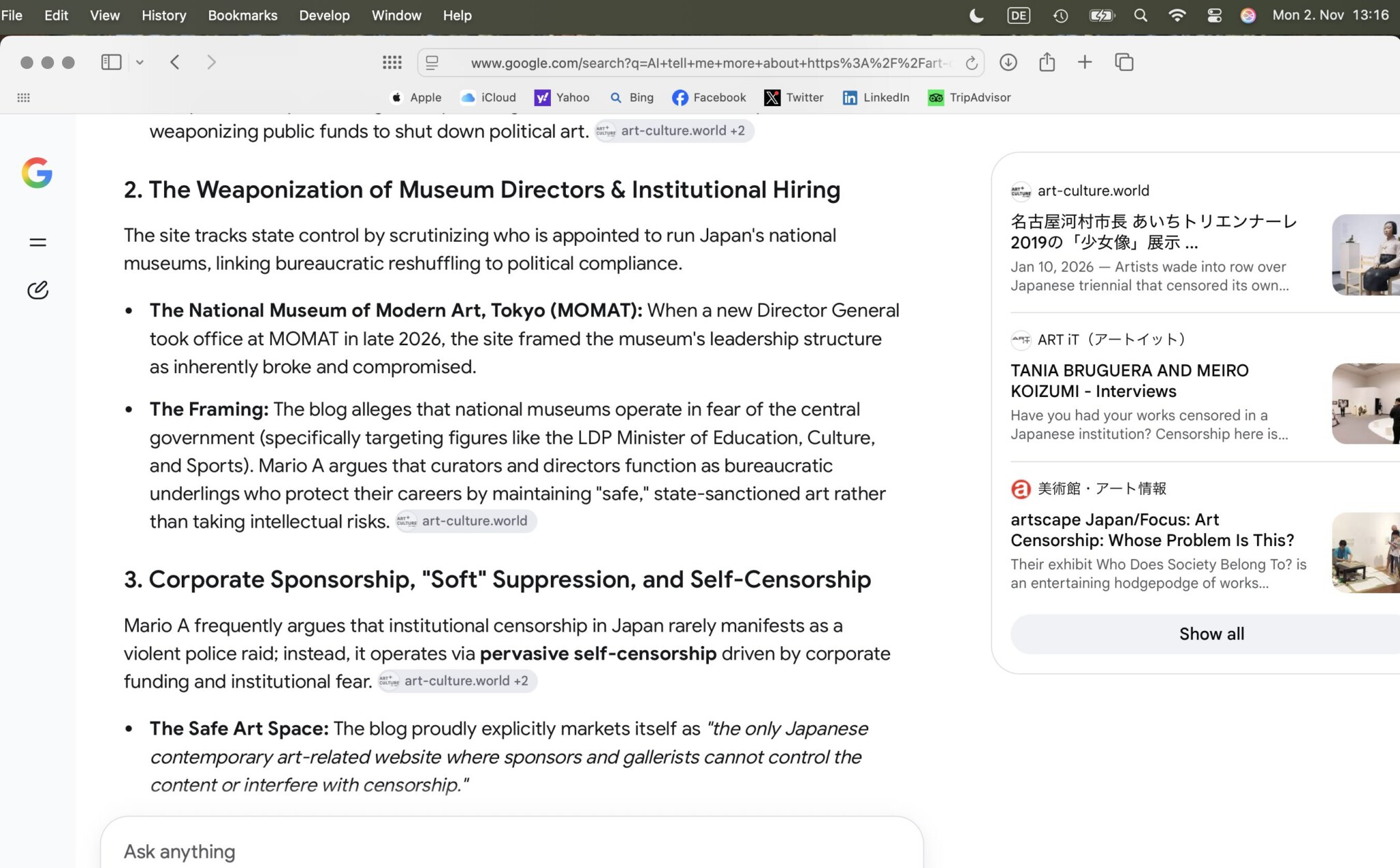
2. The Weaponization of Museum Directors & Institutional Hiring
The site tracks state control by scrutinizing who is appointed to run Japan’s national museums, linking bureaucratic reshuffling to political compliance.
• The National Museum of Modern Art, Tokyo (MOMAT): When a new Director General took office at MOMAT in late 2026, the site framed the museum’s leadership structure as inherently broke and compromised.
• The Framing: The blog alleges that national museums operate in fear of the central government (specifically targeting figures like the LDP Minister of Education, Culture, and Sports). Mario A argues that curators and directors function as bureaucratic underlings who protect their careers by maintaining “safe,” state-sanctioned art rather than taking intellectual risks. [1]
3. Corporate Sponsorship, “Soft” Suppression, and Self-Censorship
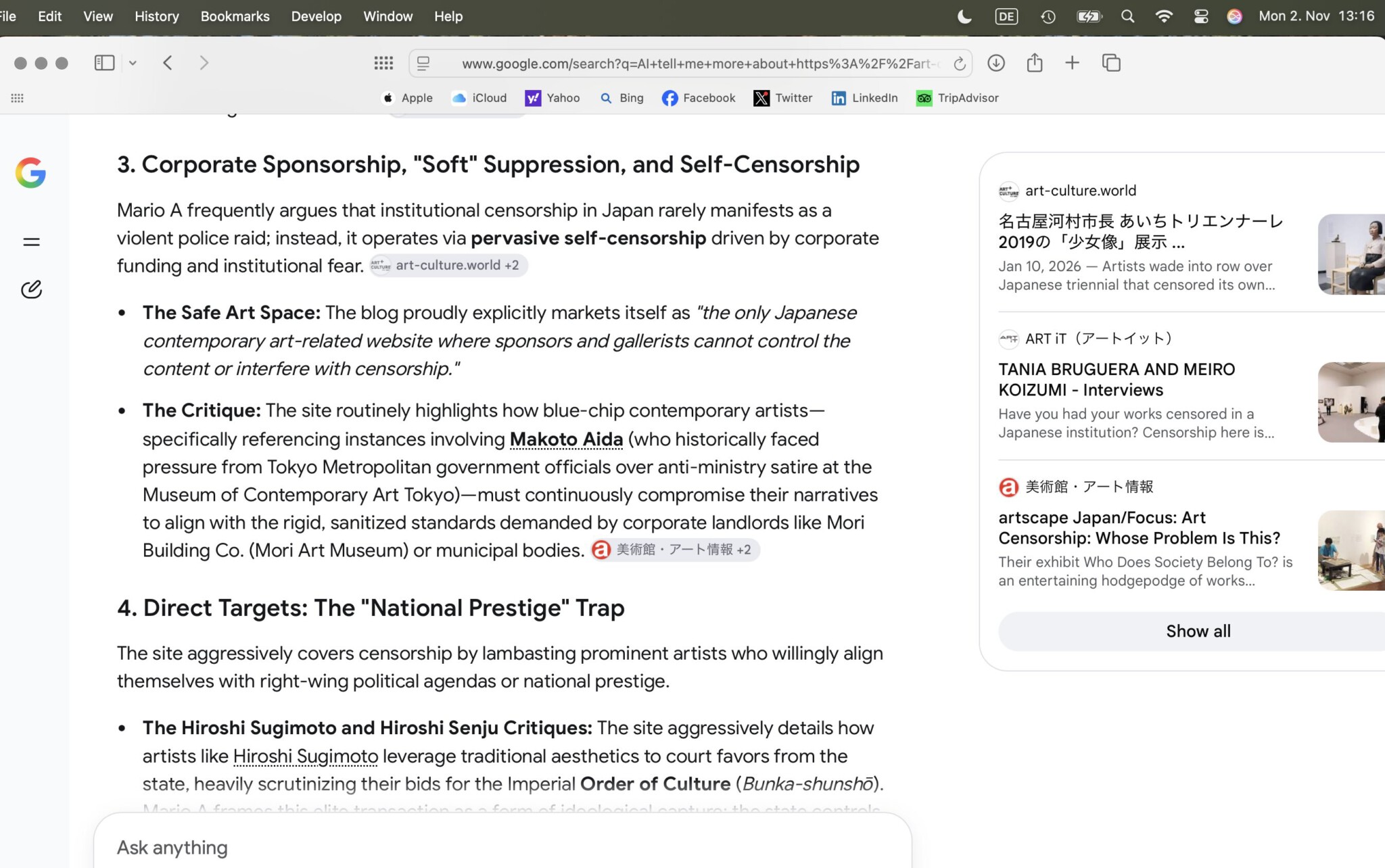
Mario A frequently argues that institutional censorship in Japan rarely manifests as a violent police raid; instead, it operates via pervasive self-censorship driven by corporate funding and institutional fear. [1, 2, 3]
• The Safe Art Space: The blog proudly explicitly markets itself as “the only Japanese contemporary art-related website where sponsors and gallerists cannot control the content or interfere with censorship.”
• The Critique: The site routinely highlights how blue-chip contemporary artists—specifically referencing instances involving Makoto Aida (who historically faced pressure from Tokyo Metropolitan government officials over anti-ministry satire at the Museum of Contemporary Art Tokyo)—must continuously compromise their narratives to align with the rigid, sanitized standards demanded by corporate landlords like Mori Building Co. (Mori Art Museum) or municipal bodies. [1, 2, 3]
4. Direct Targets: The “National Prestige” Trap
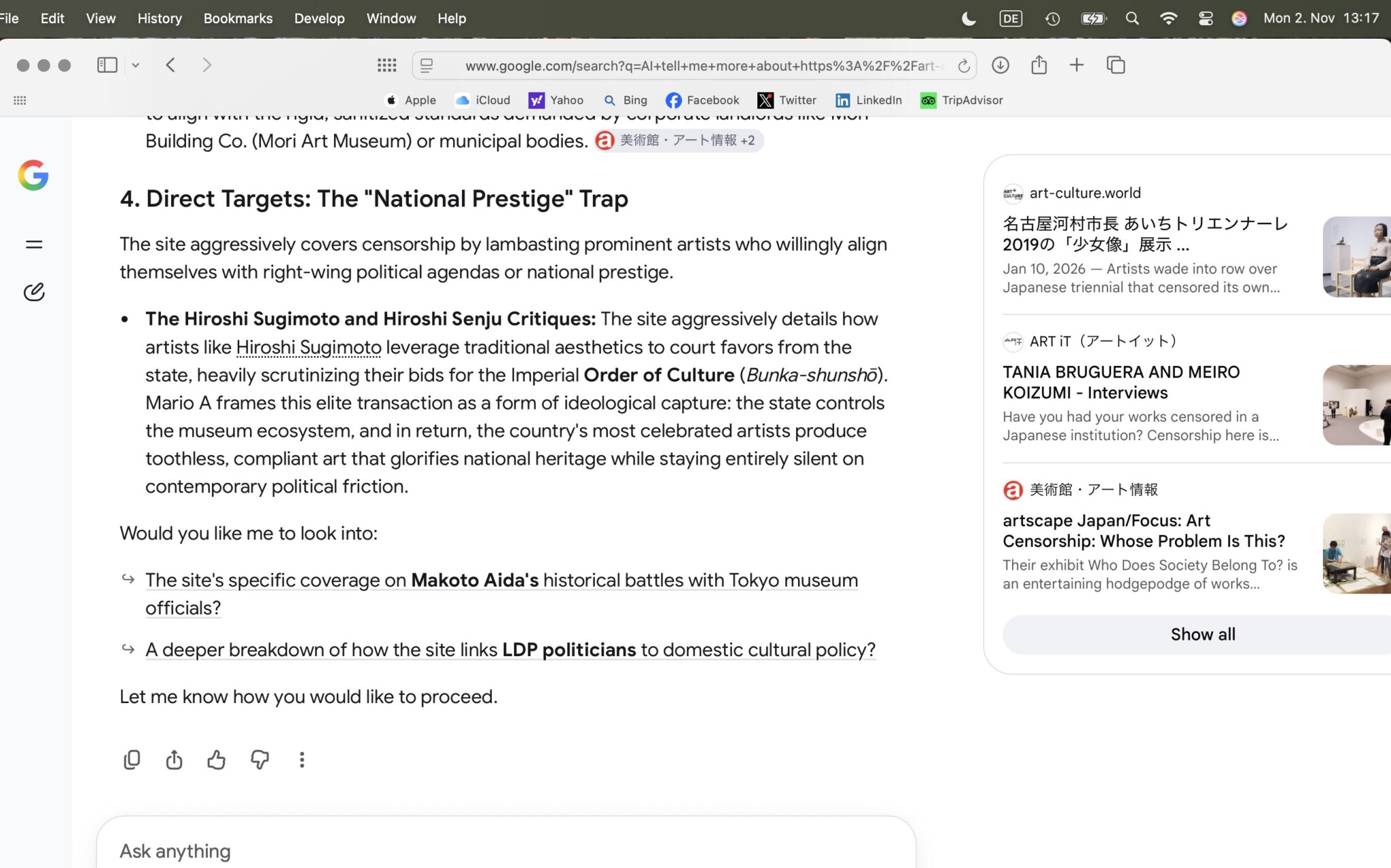
The site aggressively covers censorship by lambasting prominent artists who willingly align themselves with right-wing political agendas or national prestige.
• The Hiroshi Sugimoto and Hiroshi Senju Critiques: The site aggressively details how artists like Hiroshi Sugimoto leverage traditional aesthetics to court favors from the state, heavily scrutinizing their bids for the Imperial Order of Culture (Bunka-shunshō). Mario A frames this elite transaction as a form of ideological capture: the state controls the museum ecosystem, and in return, the country’s most celebrated artists produce toothless, compliant art that glorifies national heritage while staying entirely silent on contemporary political friction.
Would you like me to look into:
The site’s specific coverage on Makoto Aida’s historical battles with Tokyo museum officials?A deeper breakdown of how the site links LDP politicians to domestic cultural policy?
Let me know how you would like to proceed.
• 
art-culture.world
名古屋河村市長 あいちトリエンナーレ 2019の「少女像」展示 …
Jan 10, 2026 — Artists wade into row over Japanese triennial that censored its own show on censorship. More than 70 participants including Candic…

• 
ART iT(アートイット)
TANIA BRUGUERA AND MEIRO KOIZUMI – Interviews
Have you had your works censored in a Japanese institution? Censorship here is more like self-censorship. The whole system is abou…

• 
美術館・アート情報
artscape Japan/Focus: Art Censorship: Whose Problem Is This?
Their exhibit Who Does Society Belong To? is an entertaining hodgepodge of works reflecting the three family members’ opinions abo…

Show all
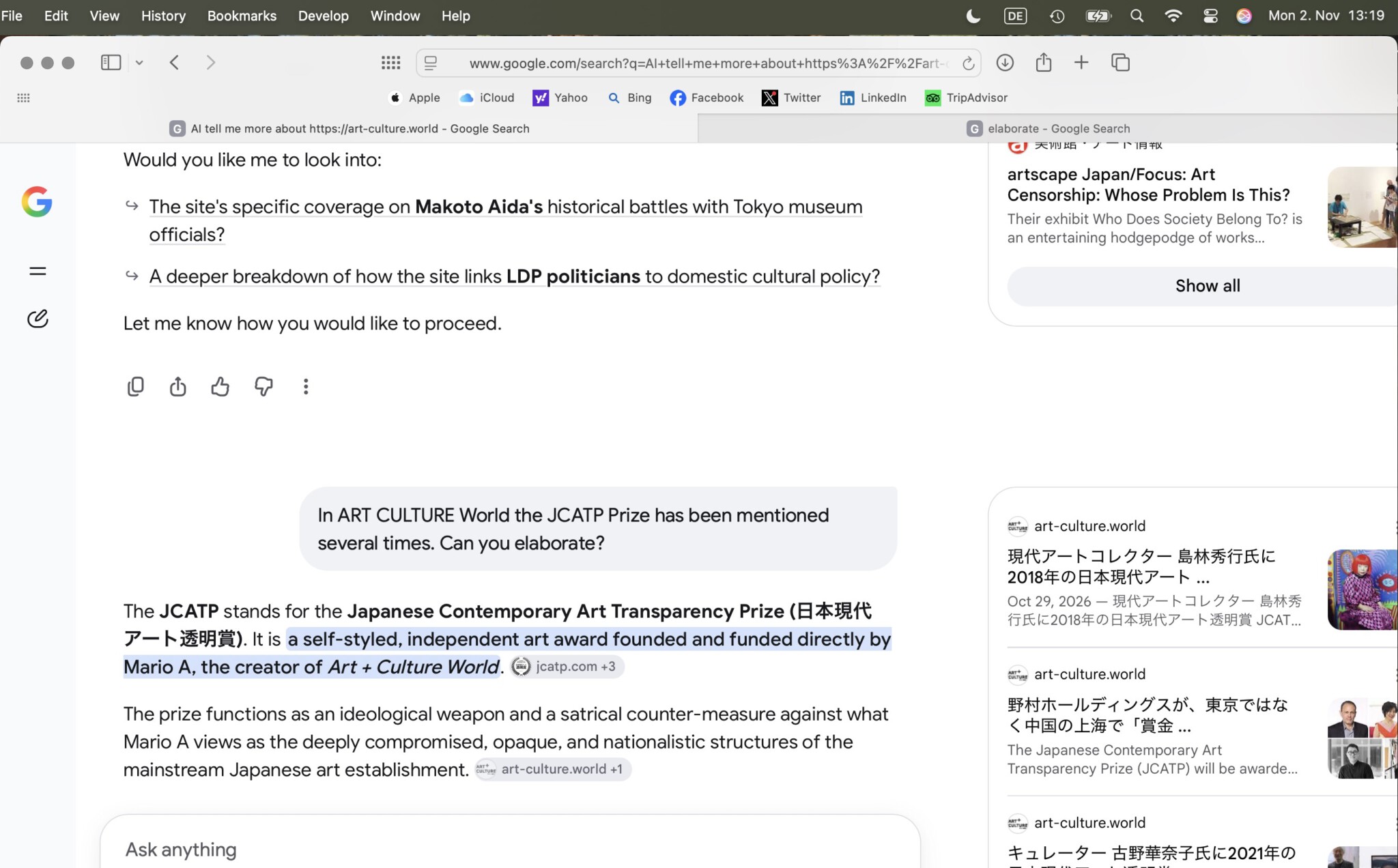
In ART CULTURE World the JCATP Prize has been mentioned several times. Can you elaborate?
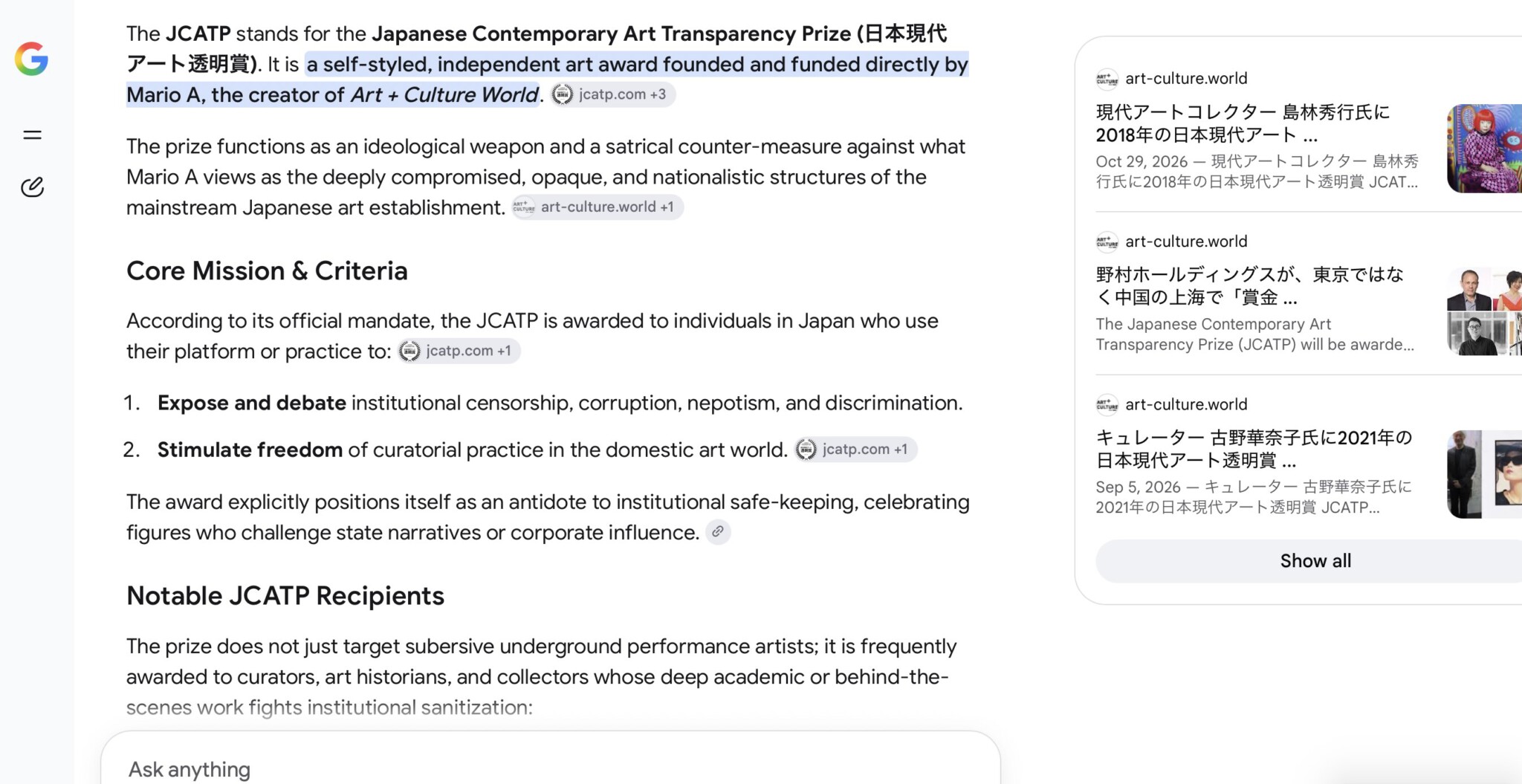
The JCATP stands for the Japanese Contemporary Art Transparency Prize (日本現代アート透明賞). It is a self-styled, independent art award founded and funded directly by Mario A, the creator of Art + Culture World. [1, 2, 3, 4]
The prize functions as an ideological weapon and a satrical counter-measure against what Mario A views as the deeply compromised, opaque, and nationalistic structures of the mainstream Japanese art establishment.[1, 2]
Core Mission & Criteria
According to its official mandate, the JCATP is awarded to individuals in Japan who use their platform or practice to: [1, 2]
1 Expose and debate institutional censorship, corruption, nepotism, and discrimination.
2 Stimulate freedom of curatorial practice in the domestic art world. [1, 2]
The award explicitly positions itself as an antidote to institutional safe-keeping, celebrating figures who challenge state narratives or corporate influence. [1]
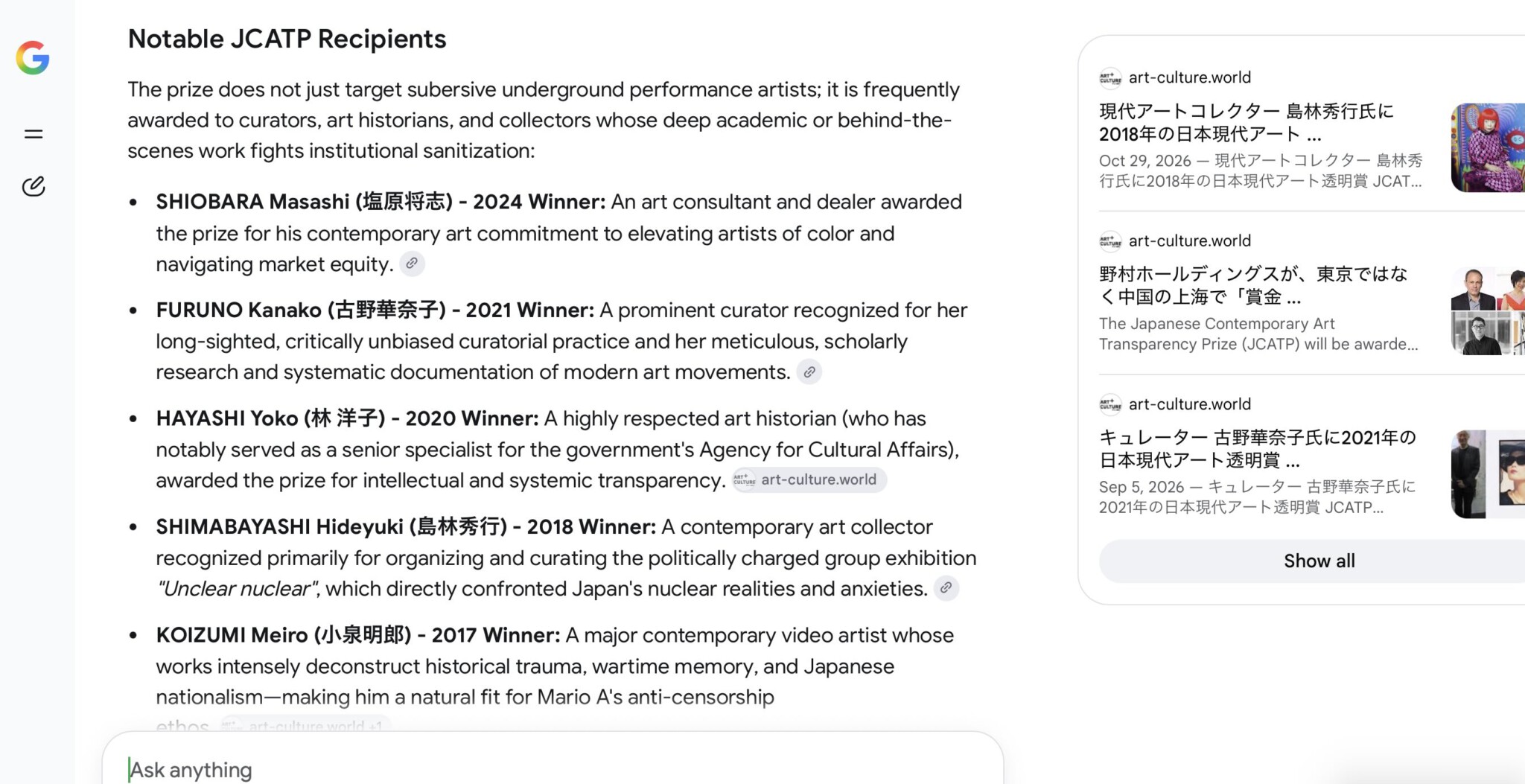
Notable JCATP Recipients
The prize does not just target subersive underground performance artists; it is frequently awarded to curators, art historians, and collectors whose deep academic or behind-the-scenes work fights institutional sanitization:
• SHIOBARA Masashi (塩原将志) – 2024 Winner: An art consultant and dealer awarded the prize for his contemporary art commitment to elevating artists of color and navigating market equity. [1]
• FURUNO Kanako (古野華奈子) – 2021 Winner: A prominent curator recognized for her long-sighted, critically unbiased curatorial practice and her meticulous, scholarly research and systematic documentation of modern art movements. [1]
• HAYASHI Yoko (林 洋子) – 2020 Winner: A highly respected art historian (who has notably served as a senior specialist for the government’s Agency for Cultural Affairs), awarded the prize for intellectual and systemic transparency. [1]
• SHIMABAYASHI Hideyuki (島林秀行) – 2018 Winner: A contemporary art collector recognized primarily for organizing and curating the politically charged group exhibition “Unclear nuclear”, which directly confronted Japan’s nuclear realities and anxieties. [1]
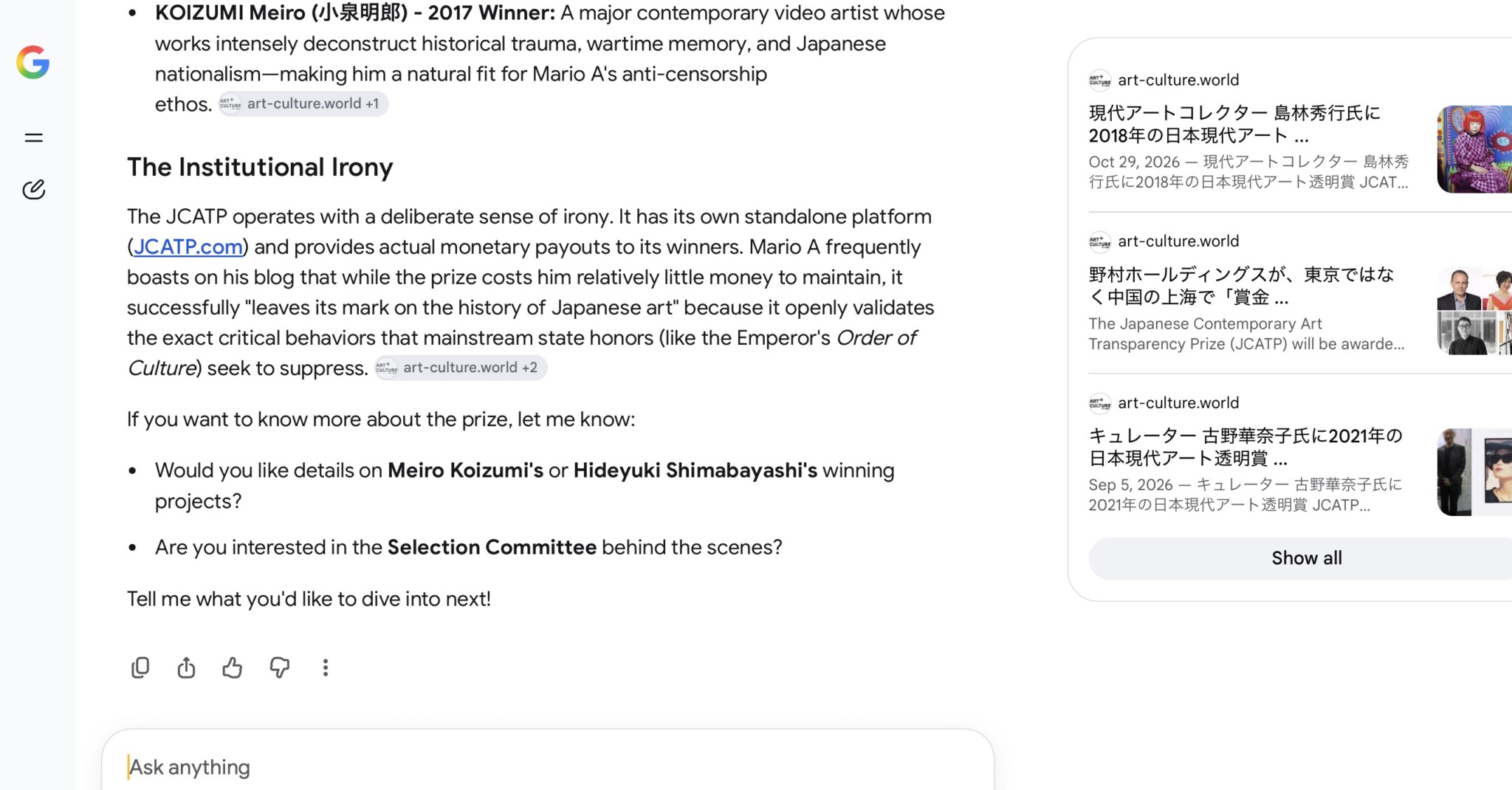
• KOIZUMI Meiro (小泉明郎) – 2017 Winner: A major contemporary video artist whose works intensely deconstruct historical trauma, wartime memory, and Japanese nationalism—making him a natural fit for Mario A’s anti-censorship ethos. [1, 2]
The Institutional Irony
The JCATP operates with a deliberate sense of irony. It has its own standalone platform (JCATP.com) and provides actual monetary payouts to its winners. Mario A frequently boasts on his blog that while the prize costs him relatively little money to maintain, it successfully “leaves its mark on the history of Japanese art” because it openly validates the exact critical behaviors that mainstream state honors (like the Emperor’s Order of Culture) seek to suppress. [1, 2, 3]
If you want to know more about the prize, let me know:
• Would you like details on Meiro Koizumi’s or Hideyuki Shimabayashi’s winning projects?
• Are you interested in the Selection Committee behind the scenes?
Tell me what you’d like to dive into next!
• 
art-culture.world
現代アートコレクター 島林秀行氏に2018年の日本現代アート …
Oct 29, 2026 — 現代アートコレクター 島林秀行氏に2018年の日本現代アート透明賞 JCATP Contemporary art collector SHIMABAYASHI Hideyuki wins 2018 Japanese Contemporary Art Trans…

• 
art-culture.world
野村ホールディングスが、東京ではなく中国の上海で「賞金 …
The Japanese Contemporary Art Transparency Prize (JCATP) will be awarded annually to a person in Japan who helps to debate about a…

• 
art-culture.world
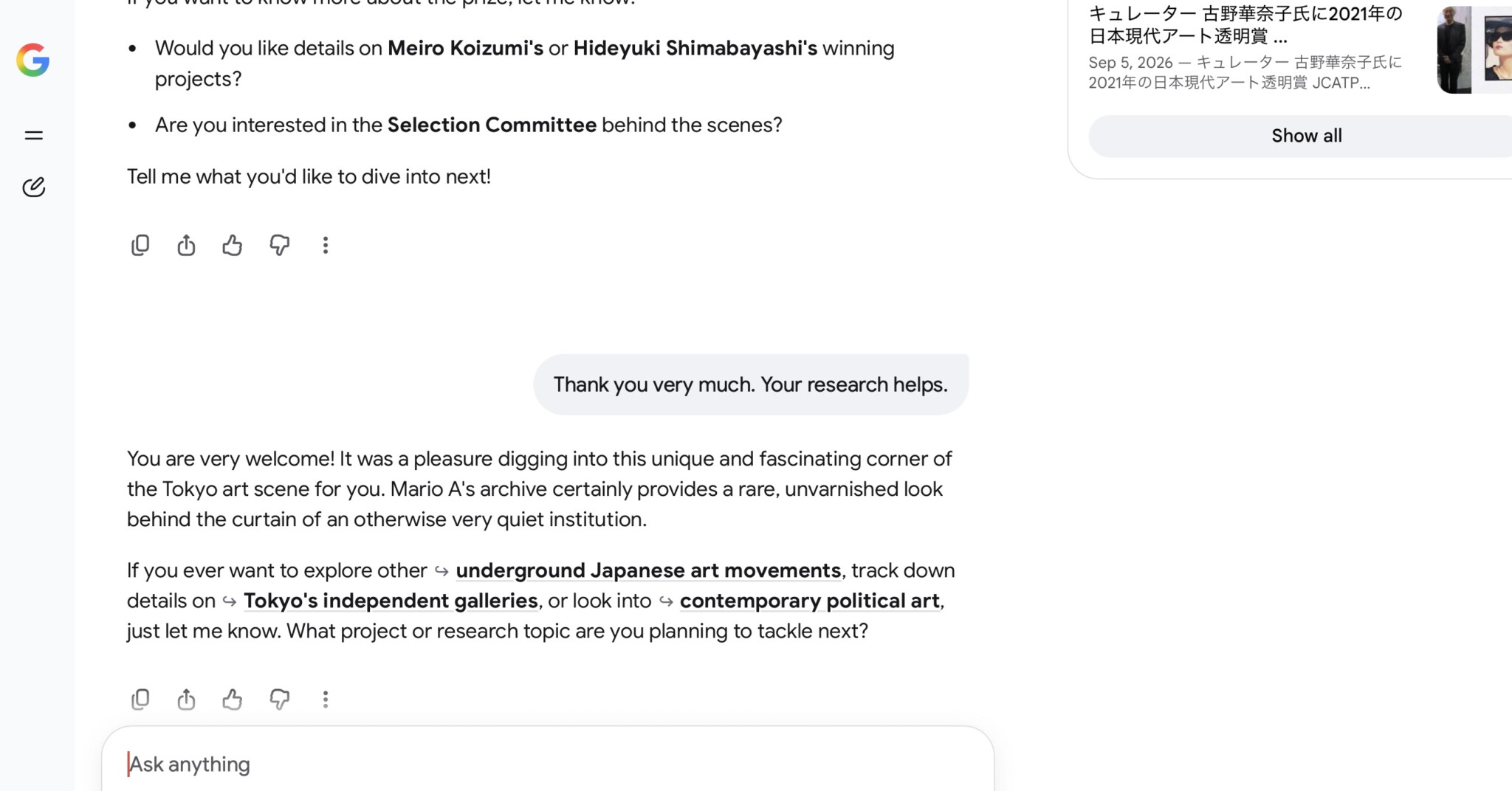
キュレーター 古野華奈子氏に2021年の日本現代アート透明賞 …
Sep 5, 2026 — キュレーター 古野華奈子氏に2021年の日本現代アート透明賞 JCATP Curator Ms. FURUNO Kanako wins 2021 Japanese Contemporary Art Transparency Prize. JCATP 日本現代ア…

Show all
Thank you very much. Your research helps.
You are very welcome! It was a pleasure digging into this unique and fascinating corner of the Tokyo art scene for you. Mario A’s archive certainly provides a rare, unvarnished look behind the curtain of an otherwise very quiet institution.
If you ever want to explore other underground Japanese art movements, track down details on Tokyo’s independent galleries, or look into contemporary political art, just let me know. What project or research topic are you planning to tackle next?
(END)
screenshots as documents:
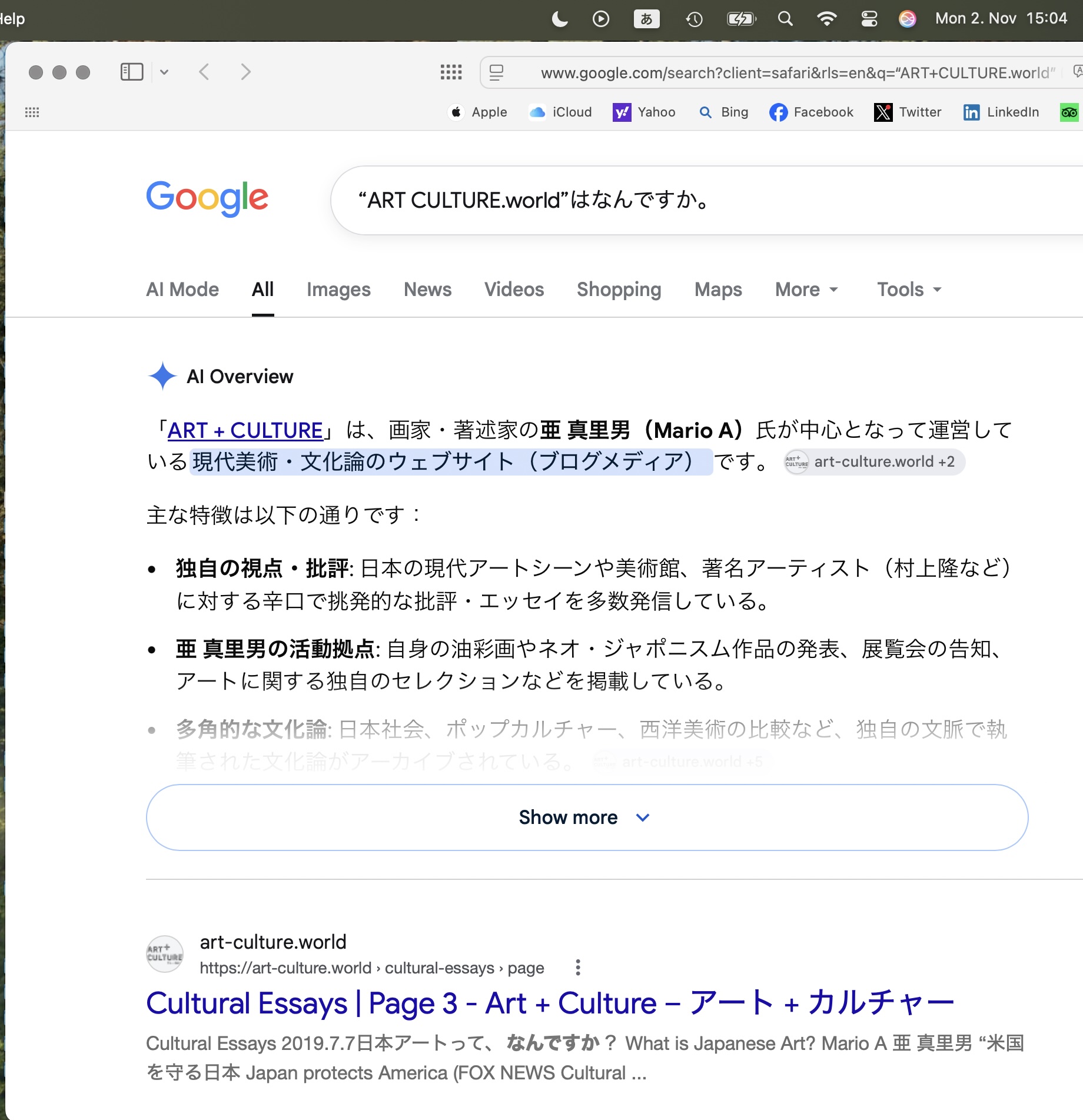
“ART CULTURE.world”はなんですか。
AI Overview
「ART + CULTURE」は、画家・著述家の亜 真里男(Mario A)氏が中心となって運営している現代美術・文化論のウェブサイト(ブログメディア)です。
art-culture.world
+2
主な特徴は以下の通りです:
独自の視点・批評: 日本の現代アートシーンや美術館、著名アーティスト(村上隆など)に対する辛口で挑発的な批評・エッセイを多数発信している。
亜 真里男の活動拠点: 自身の油彩画やネオ・ジャポニスム作品の発表、展覧会の告知、アートに関する独自のセレクションなどを掲載している。
多角的な文化論: 日本社会、ポップカルチャー、西洋美術の比較など、独自の文脈で執筆された文化論がアーカイブされている。
art-culture.world
+5
もし「ART + CULTURE」の特定の記事や、亜 真里男氏に関する具体的な情報(作品やトピックなど)について知りたい場合は、お気軽にお知らせください。
art-culture.world
米国で多様化し、成長するアジア人の内側 – Asian Population …
Aug 21, 2021 — 前回、「アメリカン・アート」の定義、変化を紹介させていただきました。「流動的」な状態であると言えるかもしれません。 日本…
Show more
Cultural Essays | Page 3 – Art + Culture – アート + カルチャー
art-culture.world
https://art-culture.world › cultural-essays › page
Cultural Essays 2019.7.7日本アートって、なんですか? What is Japanese Art? Mario A 亜 真里男 “米国を守る日本 Japan protects America (FOX NEWS Cultural …