マーク・シュピーグラー:さまざまなアートギャラリーは大丈夫じゃない Marc Spiegler: Art Galleries Are Not OK
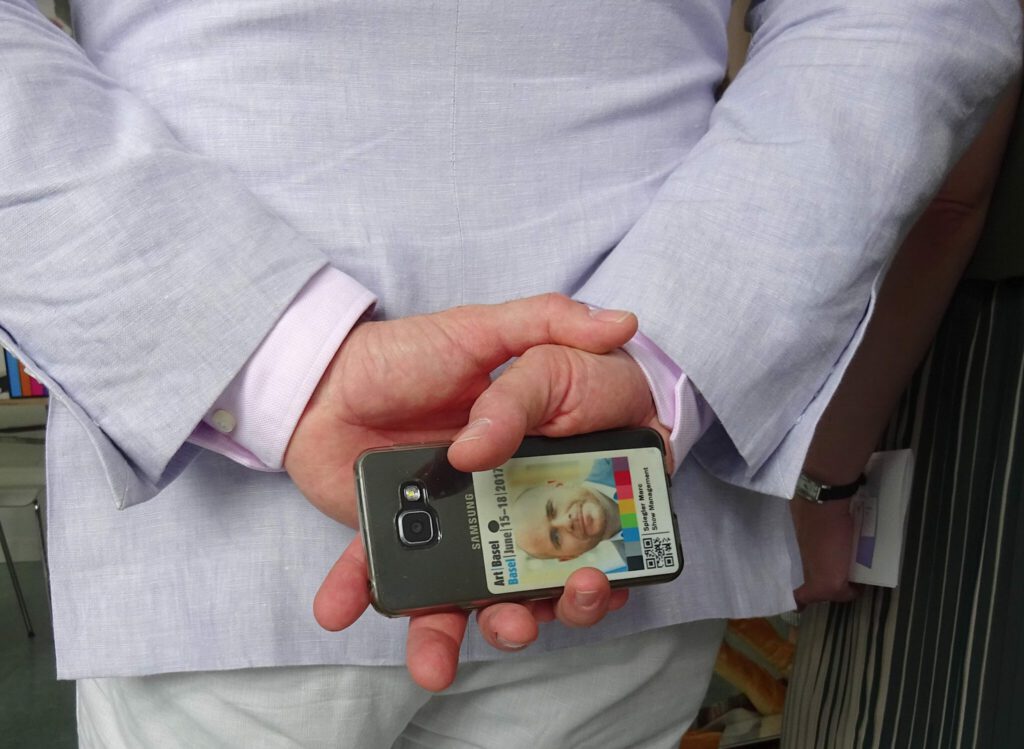
マーク・シュピーグラー:マリオ、アーティストは引退しないよ、死ぬまで働き続けるの。
With Marc Spiegler in Zürich
https://art-culture.world/art-world/mario-retires/
の続き。ART+CULTUREの読者に、特別に、無料で。友人マークの重要な昨日の記事を。
これは受け入れがたい事実かもしれませんが、マークは気品のある人物ゆえ、それを口には出さないでしょう。比較的狭いアートマーケットの中で、生き残りをかけようとするギャラリー・アートディーラーが多すぎるのです。これは「コモンズのジレンマ」です。そして、この状況は以前から続いてきました。
少数の巨大ギャラリーが群れから抜け出しているとはいえ、歴史的に見れば、このアート業界はポップコーンマシンのポップコーンの粒のように膨張してきました――限られたスペースを埋め尽くす、持続不可能なほど多くの小規模な事業体がひしめき合っているのです。
この構造的な弱点が、今日、露骨な形で露呈している。さらなる「創造的破壊」と体系的な再編こそが、唯一の打開策かもしれない。
OPINION / GUEST ESSAY
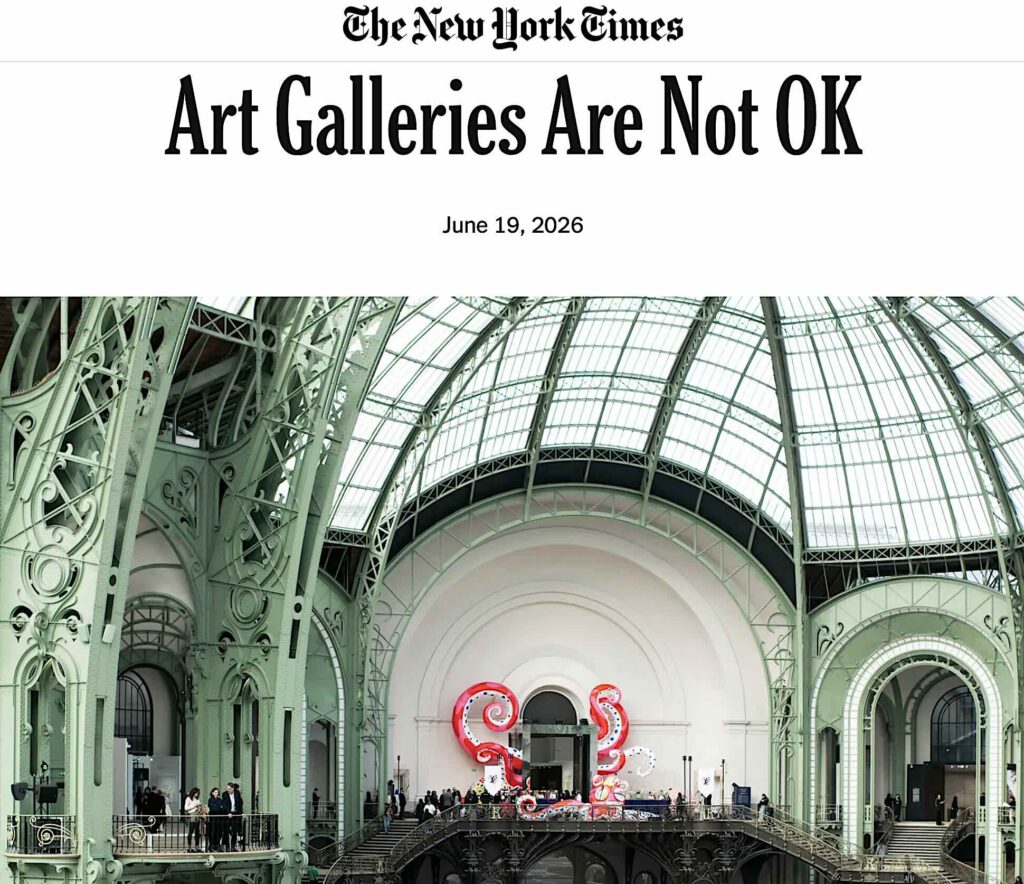
Art Galleries Are Not OK
New York Times, June 19, 2026
By Marc Spiegler
Mr. Spiegler, a former Art Basel global director, reported from Basel, Switzerland.
I’ve spent nearly 30 years in the art world. For half that time I led Art Basel, the global art fair now staged five times a year — in Miami Beach; Paris; Hong Kong; Doha, Qatar; and this week, at its namesake original location in Basel, Switzerland.
In many ways, these should be the best of times for the galleries participating in the fair: The number of ultra-high-net-worth individuals — i.e., potential collectors — has grown enormously in the past decade. And auction houses recently grabbed headlines with sales including a $181 million Jackson Pollock and a Brancusi, marketed with a Nicole Kidman video, that sold for $108 million.
Auction sales get a lot of press, but galleries are the art world’s engine. And talking to gallerists recently, as they prepared to gather for the big fair this week, uncertainty abounded. Many are questioning the fundamentals of their business. It’s as if the art world they know has fallen off its axis.
Galleries around the world have been closing at a steady clip this past year. The so-called megagallery Pace, which has locations in New York, Los Angeles, London, Geneva, Seoul, Tokyo and Berlin, shocked the art world in early June by announcing it would cut 50 artists from its roster and reduce its staff by 20 percent. “The art world has changed dramatically over the past decade, and the current gallery model isn’t only broken, it’s unfixable,” explained the Pace chief executive, Marc Glimcher. “Every gallery is currently making temporary fixes and compromises to prop up a system that no longer works.”
What went wrong? The short answer is: The art world expanded wildly, but the art market — the total dollar volume of art sales — did not. In fact, if you read the Art Basel/UBS Art Market Report for 2026 carefully, and adjust for inflation, the data shows that the art market has stagnated. The 2025 numbers are on par with those from the 2009 recession and the 2020 pandemic periods.
This stagnation has hit many galleries hard, with, as the report puts it, “variable and slower sales for some and consistently rising costs.” The report makes clear that, although there are new galleries opening, there is considerable tumult within the sector. That’s a problem for the larger art world, because galleries are the foundation of the entire market. They bring new artists into play. They offer free access to high culture. They are the shadow financiers of museum shows and biennials and the essential mechanism driving private patronage to artists, at a time when governments, corporations and museums offer ever-dwindling funding. There’s a direct correlation between the health of the gallery system and the ability of artists to produce work long term.
Galleries were once mostly small businesses, often emerging in neighborhoods where artists produced their work. Dealers discovered, nurtured and promoted artists to collectors, many of whom were connoisseurs eager for deep-dive conversations, compelled by both possessive lust and a noblesse oblige. The art market was a cozier, somewhat esoteric place, where gentlemen’s agreements sufficed to keep things rolling.
Over the last two decades, contemporary art became part of pop culture, with flashy museums opening in cities around the world, attracting selfie-taking tourists. Art fairs proliferated, and sometimes, as with Art Basel Miami Beach, became cultural events themselves, attracting celebrities and lots of media attention.
The problem is that the art-selling business itself didn’t keep up with the hype. More museums and biennials means more shows that galleries have to support. Participating in fairs has built in costs that don’t always pay off. There just aren’t enough collectors, especially new collectors, to make the math of this supersized art world add up.
Many galleries made the problem worse by making it harder for potential new clients to buy work. If the “old school” collector was in it to support the artists, many gallerists observed that the newer collector could be driven more by a desire for social cachet or to engage in financial speculation. “Art fund” founders, wealth managers and sometimes even gallerists encouraged this logic, telling clients to consider artworks an “alternative asset class” rather than the product of a creative person’s imagination, valuable for its singularity of vision.
If art is just another asset, then the smart thing is to flip a work by a hot artist for a quick profit, predominantly at auction. But auctions are unpredictable, and galleries try to keep their artists’ prices going steadily up, not peaking at moments of maximum hype and then crashing. So galleries started sharing with one another blacklists of “flippers,” by which they meant buyers with purely speculative interests who were looking only for quick profits.
Naturally, those who want to buy art don’t like being told no. Talking with collectors about galleries, and vice versa, I frequently find myself feeling like a friend to both spouses in a codependent marriage. One side effect of handling potential clients with mistrust is that it repels potential collectors, driving them into the welcoming embrace of auction houses.
Adding to the collector problem: Many younger rich people don’t seem to have the penchant for it. One adviser I know hit a wall after months of cultivating a young potential Silicon Valley client. The founder explained that upon analysis, collecting art seemed like a way to turn his money into problems. Indeed, owning art involves costs such as storage, shipping, insurance and potentially restoration.
So what can be done?
Most urgently, galleries need to push for legally enforceable resale agreements that can block flipping and let them be less fearful of unknown potential clients. And galleries need to stop promoting art as an investment. (If you want to store your money in an asset with perception based valuations, there’s always crypto.)
And instead of focusing so much on global expansion, galleries need to prioritize developing markets closer to home, keeping more continuous contact with their potential patrons. In every major urban area there are more wealthy people than ever before. They need to be cultivated through real-life interactions, not D.M.s and PDFs. This approach would mean galleries stop taking on more artists than they can sustain, stop doing more fairs than they can handle and stop chasing the chimera of globalization.
Yes, I realize many readers will find it ironic that the person who launched art fairs in Paris and Hong Kong is arguing for thinking more regionally. Already during my Art Basel time, when young galleries found themselves ardently recruited by art fairs worldwide, I advised them to be highly selective while focusing on building a stable home market. That advice was rarely followed. The art world seemed to be booming, and the young gallerists jumped into the global marathon that appeared to work for their predecessors. Until, suddenly, it didn’t work. For anybody.
I’m not arguing against art fairs — as we see in Basel this week, international fairs remain the most effective way to introduce artists to new collectors. But FOMO is not a business model. Staying closer to home might be a smarter one. We even have a precedent for this: the pandemic period when galleries were forced to go local because of travel restrictions. For many, it proved a revelation. As the pandemic ended, I went to Berlin and ran into Esther Schipper, one of the city’s most prominent gallerists. “I’ve spent the last year driving around Germany to see collectors and it really worked,” she told me. “We flew all over the world like crazy, to dozens of fairs and biennials, trying to meet collectors when actually there’s so much potential in our backyards.”
Marc Spiegler, a former journalist and Art Basel global director, now works independently from Zurich across a broad range of cultural projects.
https://www.nytimes.com/2026/06/19/opinion/art-basel-fairs-gallery-market.html
2026/6/23 update, the reaction by Barbara Pollack
Marc Spiegler Got It All Wrong
In a guest essay for the New York Times, the former Art Basel global director presented a vision of a Brave New Art World that has little to do with art and those who make it.
Barbara Pollack, HYPERALLERGIC, June 22, 2026
Marc Spiegler’s recent guest essay in the New York Times, titled “Art Galleries Are Not Okay,” can only provoke anger and frustration for artists and others trying to live and work in today’s uncertain, Brave New Art World. Spiegler, former global director of Art Basel, echoes Pace Gallery CEO Marc Glimcher’s assertion that the gallery system is broken beyond repair. He worries about the future of galleries, which he calls the “foundation” of the art market.
The art world today is unrecognizable to those who built the East Village art scene in the 1980s or fought the right during the Culture Wars of the 1990s, times when artists — not galleries or art fairs — were considered fundamental to art’s survival. As the industry grew at an unstoppable rate in a post-globalized world, the vast majority of artists still struggled to pay their own way and cling to ideals, even as $1 million NFTs received international attention.
Spiegler writes about the current demise of the gallery ecosystem as if he were just an observer, not one of its chief architects. In his role at Art Basel from 2012 to 2022, he contributed to building a profit-motivated art distribution system, helping push the narrative that art galleries could and should behave like multinational corporations. This campaign worked for a while, but in the end stalled, not least because without its bohemian raison d’etre, art loses its allure for collectors. Spiegler bemoans the new generation of collectors who prefer bitcoin to artworks. Yet, these younger buyers were only offered a commodity-based vocabulary with which to discuss art. Few were introduced to theory or history as more sound bases for acquiring a collection.
When Art Basel arrived in Hong Kong in 2013, I remember talking with Swiss collector Uli Sigg, whose trove of Chinese art now forms the cornerstone of the M+ Museum’s collection. He joked that blue-chip galleries were coming to China like deodorant salesmen coveting 2.6 billion armpits. By then, I had been reporting on China regularly, thrilled with an experimental art scene that flourished despite the lack of a domestic infrastructure. It reminded me of the days of the East Village and the 1990s in New York City, when there was a minimal market but an abundance of electrifying art experiences. In Hong Kong, Basel heralded an era when painters and sculptors, rather than performance and video artists, would become the canon of Chinese contemporary art. As galleries salivated over the new market, hardly one stood up for the human rights of Chinese artists. Art Basel has still never mentioned the pervasive repression or censorship plaguing their lives.
Don’t get me wrong, some of my best friends are gallerists. And it is clearly essential for artists to receive this support to continue creating and finding audiences. Many galleries are on the frontlines of this effort to survive a market in decline. However, in the Brave New Art World, they often cultivate artists only to see them scooped up by one of the big blue-chip distributors. Artists pursuing top careers are contributing to the stress, behaving like free agents unencumbered by allegiances. Running a well-respected, middle-market gallery has become a heartbreaking endeavor, especially as the collector base shrinks. No wonder many gallerists are choosing career adjustments or retirement at this time. But who is considering the fate of their artists?
The truth of the matter is that art needs to be upheld as an alternative to market-validation, an escape from professionalism and maximum actualization. No one wants to lose money from collecting art, but there needs to be a sense of risk, an adrenaline rush. This can only come from supporting artists determined to overturn markets and reinvent art history. Such artists exist today in abundance, but you may have to look for them in artist-run spaces or alternative arts organizations operating a bit off the grid. Such renegades are making important contributions, though their efforts barely raise a blip on the market radar. Go visit these outposts of contemporary creativity before the Marc Spieglers of the world figure out how to co-opt their energy and ideas.
https://hyperallergic.com/marc-spiegler-got-it-all-wrong/
2026/6/30 up-date
How Basel Went From Art to Art Basel
Basel’s art history predates the world’s most prominent art fair by a few centuries.
New York Times, By Nina Siegal, June 21, 2026
Basel, Switzerland, is a city of nearly 200,000 residents and nearly 40 museums — or about one museum for every 5,000 locals.
Once a year during Art Basel, the city’s population swells by tens of thousands as art aficionados from all over the world arrive to view and buy millions (possibly billions) of dollars’ worth of art.
“Attending the fair in Basel is just a deeply rich experience where you come to the city for this extraordinary fair, but the city itself becomes an extended campus of connectivity and engagement,” Noah Horowitz, Art Basel’s chief executive, said in a call last month.
But how did Basel, a relatively small city compared with Paris or New York, become a world-renowned destination for art?
“Basel sits at the crossroads of three countries, Switzerland, France and Germany,” said Isabel Friedli, a curator and the head of publications at the Schaulager, a museum storage facility just outside Basel that also exhibits its contemporary art collection. She said that trade routes in those countries came together in the 16th and 17th centuries, allowing for a greater cultural exchange.
Basel also has an extensive base of art patrons, many of whom grew wealthy in the city’s pharmaceutical industry.
The city’s cultural credentials date back to the Middle Ages.
1460: The University of Basel, the first university in Switzerland, is founded, after a papal edict from Pope Pius II. “The university is so central to why Basel became so important,” said Elena Filipovic, director of the Kunstmuseum Basel. “Over many centuries, though a small town, Basel became an important intellectual hub, cultural hub and a place of cultivated minds.”
1514: Desiderius Erasmus, a Dutch humanist, visited Basel for the first time, to work on his Greek translation of the New Testament, published in Basel in 1516 as Novum Instrumentum. In 1521, he took up residence in the city.
1515: Hans Holbein the Younger, the Northern Renaissance painter, arrived . He lived and worked in Basel until 1532, except for a two-year stint in England from 1526 to 1528. During that time, he created some of his best-known works, including his portrait of Erasmus, as well as “The Dead Christ in the Tomb,” and the “Passion Altarpiece.”
1536: Erasmus died, leaving his estate to his friend Bonifacius Amerbach, who combined it with his family’s large collection of books and coins, as well as of paintings by Holbein. Amerbach’s son added to it, collecting drawings, prints, and ethnographic and natural history objects, creating what would become known as the Amerbach Cabinet.
1661: When a collector in Amsterdam offered to buy the Amerbach Cabinet, the city of Basel and the University of Basel bought it instead, creating the first publicly owned art museum in Europe, the Kunstmuseum-Offentliche Kunstsammlung Basel, or Basel Art Museum-Public Art Collection.
1885-1900: Basel’s textile industry began to transition into a pharmaceutical industry in the late 19th century. Executives from companies like Ciba, J.R. Geigy SA, Sandoz and F. Hoffmann-La Roche & Co., often became major art collectors and museum patrons.
1932: Emanuel Hoffmann, a son of Hoffmann-La Roche’s founder and a serious art collector, died. The following year, his widow, Maja Hoffmann-Stehlin, established a contemporary art foundation in his name. In 1941, she gave the collection to the Offentliche Kunstsammlung on permanent loan.
1936: A new building was dedicated to the Offentliche Kunstsammelung, called the Kunstmuseum Basel. Today, that original building is known as the Hauptbau, and is one of three buildings that make up the museum.
1937-1939: The German National Socialists under Adolf Hitler labeled some 21,000 works of modern art as “degenerate,” and seized and destroyed many of them. The Kunstmuseum Basel’s director, Georg Schmidt, bought 21 “degenerate” works for its collection.
1945: Oskar Schloss, a book dealer based in Basel, died and left his bookshop to Ernst Beyeler, who reinvented it with his wife. They primarily collected lithographs by living artists, slowly transforming the shop into an art gallery.
1952: The Beyeler bookshop became the Galerie Beyeler, and focused its attention on German Expressionists and other European avant-garde painters, such as Käthe Kollwitz, Edvard Munch and Alexej von Jawlensky, as well as French graphic art.
1959: The Kunstmuseum Basel became one of the first European museums to buy Abstract Expressionist paintings by postwar American artists like Franz Kline, Barnett Newman, and Mark Rothko.
1967: Two Picasso paintings on loan to Kunstmuseum Basel, “The Two Brothers” (1906) and “Seated Harlequin” (1923), were about to be sold to an American collector. Basel’s citizens protested and the owner offered the city a chance to buy them first. Basel put the question to a public vote and the people decided to buy the paintings.
“That was unheard of,” said Filipovic, the Kunstmuseum Basel’s director. “There’s no other place where hippies, C.E.O.s, students, teachers, would all take to the streets to save two Picassos.”
Picasso, moved by the vote, later donated four more works to the city.
1970: Three gallery owners — Beyeler, Trudl Bruckner, and Balz Hilt — launched Art Basel. The fair had 110 exhibitors from ten countries and recorded 16,300 visitors, including the artists Robert Rauschenberg, Henry Moore, and Gilbert and George.
1974: Jean Tinguely, a Swiss artist, joined the Kuttlebutzer, a creative nonconformist group that performed at the annual Basel Fasnacht, or Basel Carnival, for more than four decades.
1980: Hoffmann-Stehlin, who had since remarried and went by Sacher-Stehlin, established the Museum für Gegenwartskunst, or the Museum of Contemporary Art in Basel, the first public museum in Europe exclusively dedicated to art made after the 1960s. Andy Warhol visited Basel and, while there, accepted a commission to create five silk-screen portraits of her.
1991: Tinguely, by then a well-established artist known for his playful machines and explosive performances, participated in the Kulturgüterwagen, a moving art train that traveled through Art Basel, in which each artist designed his or her own train car. He died a few months later.
1996: To mark its 100-year anniversary, the pharmaceutical company Roche established the Tinguely Museum in Basel, designed by Mario Botta, and built on a collection owned by Tinguely’s widow.
“Roche did it as a kind of thank you to the city of Basel, and it is still 100 percent financed by the Roche company,” Roland Wetzel, the Tinguely Museum’s director, said. “I’m not even allowed to fund raise, which is a very special situation.”
1997: Ernst Beyeler, one of Art Basel’s three founders, and his wife, Hildy, opened a new museum, the Fondation Beyeler, which contained their collection. It was designed by Renzo Piano and built on the grounds of Villa Berower in Rhiehen, just outside of Basel.
2000: Art Basel initiated “Unlimited,” a nearly 200,000-square foot space which could accommodate large-scale artworks that exceed the limits of the traditional gallery booth. Providing this flexible space for huge works became one of the fair’s most defining innovations.
2020-2022: Art Basel celebrates its 50th anniversary in 2020. The fair now has versions in Miami Beach, Hong Kong and Paris.
2026: Art Basel Qatar opened in February. Basel remains the fair’s premiere location, and this year it is set to host 290 international galleries from 43 countries, presenting works by more than 4,000 artists.
https://www.nytimes.com/2026/06/21/arts/design/basel-switzerland-art-development-timeline.html